
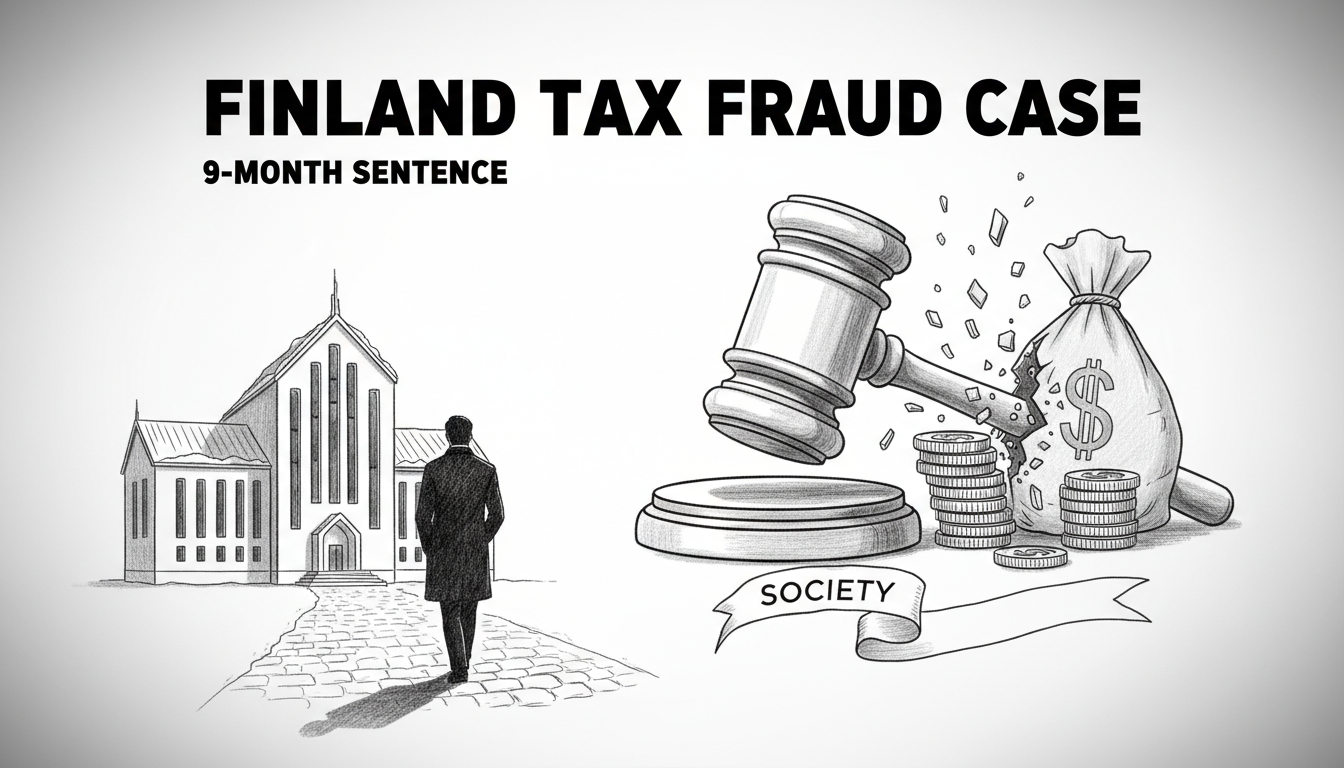
Finland's Tax Administration identifies hundreds of millions in evaded taxes annually, making each prosecution a critical defense of the Nordic welfare model. A Lappeenranta entrepreneur's recent conviction for serious tax fraud highlights the aggressive stance Finnish authorities are taking against financial crime. The South Karelia District Court sentenced the business owner to nine months of suspended imprisonment for failing to declare substantial rental income and a shareholder loan.
The court found the defendant had neglected a legal duty to correct pre-filled tax returns for 2018 and 2019 with accurate capital figures. This omission occurred while the individual simultaneously received tax refunds, a detail the prosecution emphasized as demonstrating intent. The case unfolded in Lappeenranta, a city in the region of South Karelia near the Russian border, underscoring that tax enforcement is rigorous across all of Finland, not just in the capital Helsinki.
The Mechanics of the Fraud
According to the court documents, the fraud involved two primary components: unreported rental income and an undisclosed shareholder loan. Finland's tax system operates largely on self-assessment, where taxpayers are obligated to declare all income, even if it is not pre-filled in the online tax card by authorities. The pre-filled data comes from employers, banks, and other institutions, but it is the taxpayer's ultimate responsibility to ensure completeness and accuracy.
In this instance, the entrepreneur received income from property rentals that was not automatically reported to the tax authority. Furthermore, a shareholder loan—money taken from the company by its owner—was not declared as taxable income. By omitting these figures, the defendant presented a false picture of their financial situation, resulting in an incorrectly low tax liability and, perversely, triggering refunds. This combination of active omission and financial benefit formed the basis for the 'aggravated' classification of the fraud.
Finland's Stance on Tax Evasion
Tax evasion is a criminal offense under the Finnish Criminal Code (Chapter 29). The Finnish system, funded significantly by progressive income taxes, demands high compliance to maintain public services, healthcare, and education. The Tax Administration (Verohallinto) has extensive powers to audit, investigate, and compel information from banks and other third parties. Prosecutions for aggravated tax fraud can lead to imprisonment for up to four years.
Sentences often involve conditional, or suspended, imprisonment combined with substantial back-tax payments, interests, and penalties. The court's decision to issue a nine-month suspended sentence aligns with typical jurisprudence for medium-severity cases where full cooperation and repayment may occur. The message is clear: the state will pursue legal punishment even when the financial loss is recovered.
Expert Analysis: Deterrence and Compliance
Legal experts point to this case as a standard but important application of Finnish tax law. 'The sentencing serves a dual purpose,' explains a Helsinki-based tax law attorney who wished to remain anonymous due to client relationships. 'It punishes the specific breach and acts as a deterrent to other entrepreneurs and self-employed individuals. The system heavily relies on voluntary compliance, so visible consequences for failure are essential.'
She notes that areas like rental income and shareholder loans are common flashpoints. 'Rental income can sometimes be seen as 'informal' by property owners, especially from short-term leases. Shareholder loans are a complex area; they must be carefully documented and declared. The pre-filled return system creates a false sense of security for some—they think if it's not there, they don't need to report it. This case clarifies that is a dangerous misconception.'
The expert further contextualizes the penalty. 'A nine-month suspended sentence is a serious mark on one's record. It signals the court recognized the fraud as deliberate, not mere negligence. For an entrepreneur, this can have collateral consequences beyond the legal sentence, affecting reputation and the ability to secure certain licenses or contracts.'
Implications for Finnish Entrepreneurs and the EU Framework
This prosecution arrives amid a broader European Union crackdown on tax evasion and avoidance. Finland actively participates in EU-wide data-sharing initiatives like the Directive on Administrative Cooperation (DAC), which allows automatic exchange of information on income, including rental profits. The domestic case in Lappeenranta is a local manifestation of a continent-wide tightening of fiscal oversight.
For small and medium-sized enterprise owners in Finland, the case is a stark reminder of fundamental obligations. The Finnish Tax Administration offers guidance and advisory services, but the legal responsibility rests squarely with the taxpayer. Audits can occur years after the filing, as seen in this 2018-2019 case reaching court now, with authorities using sophisticated data-matching tools to identify discrepancies.
The integrity of Finland's high-trust, high-tax social contract depends on perceived fairness. When individuals deliberately evade taxes, it undermines public confidence and shifts the burden onto compliant citizens. The South Karelia District Court's ruling reinforces a fundamental principle: the welfare state's benefits come with binding responsibilities, and the legal system will enforce them. Will this consistent judicial approach be enough to maintain Finland's historically high compliance rates in an evolving economy?