
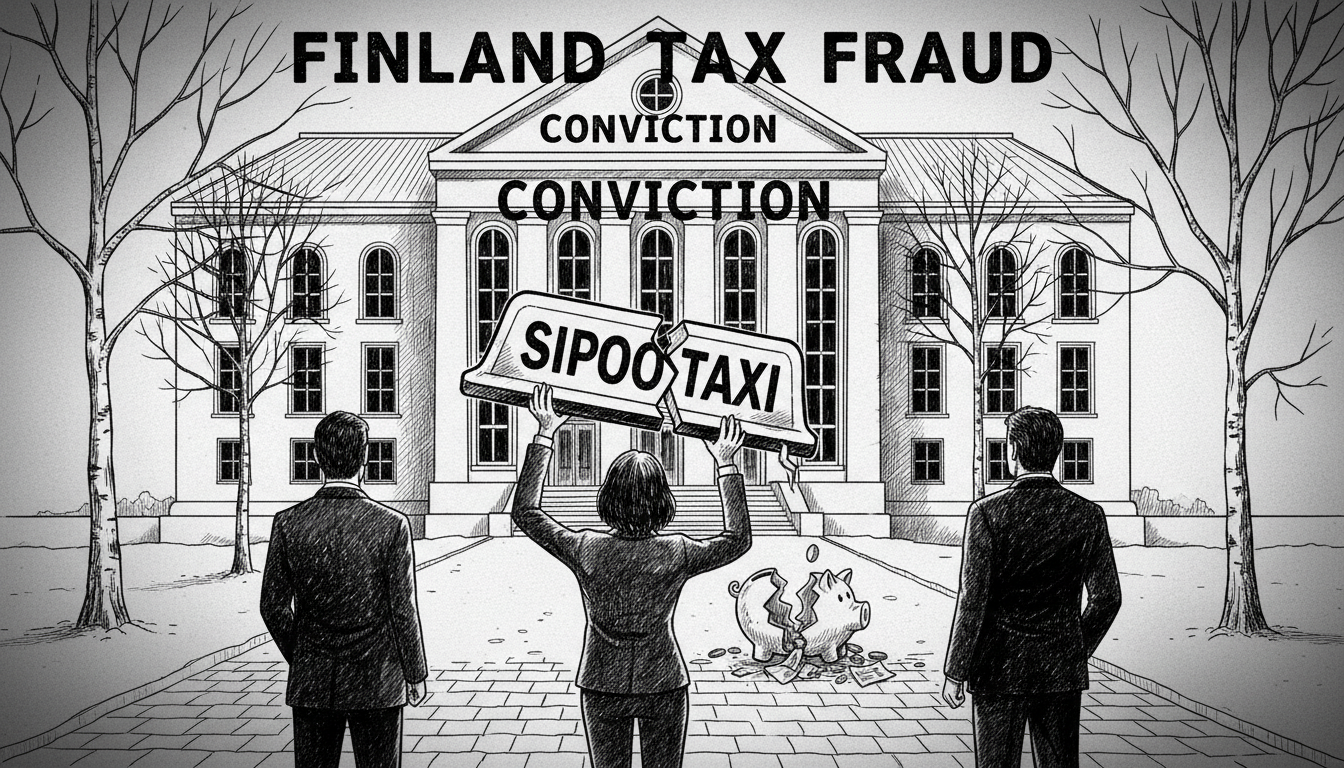
Finland tax fraud cases continue to demonstrate the strict enforcement of financial laws, with a recent conviction in Sipoo sending a clear message to small business owners. The Itä-Uusimaa District Court has sentenced a local taxi entrepreneur to a conditional prison term for aggravated accounting offenses and two counts of tax fraud. The case centered on approximately 54,000 euros that were missing from the company's official financial records, leading the court to side entirely with the Finnish Tax Administration's prosecution.
This conviction is not an isolated incident but part of a broader, systematic effort by Finnish authorities to combat financial crime. The Finnish Tax Administration, known as Verohallinto, maintains rigorous oversight of business accounting practices across all sectors. For the taxi entrepreneur, the failure to maintain accurate books crossed from a regulatory misstep into the realm of criminal activity, resulting in a serious legal penalty that will remain on their record.
The Mechanics of a Bookkeeping Failure
The core of the prosecution's case rested on the significant discrepancy discovered in the taxi firm's accounts. The missing 54,000 euros represented income that was not properly declared or documented. In Finland, all business owners are legally obligated to keep clear, accurate, and timely records of all financial transactions. This system forms the bedrock of the country's tax collection and is essential for the functioning of the welfare state.
When records are incomplete or funds are unaccounted for, it triggers an immediate red flag for auditors. The transition from a simple accounting error to a charge of 'aggravated' accounting offense typically involves the scale of the discrepancy, evidence of intentional concealment, or a pattern of behavior over time. The court's designation of the crime as 'aggravated' suggests the breach was considered serious and deliberate, rather than a minor or accidental oversight.
A Stringent System of Financial Accountability
Finland's approach to tax compliance is characterized by high levels of trust coupled with robust verification. The legal framework is unambiguous: tax evasion and fraudulent accounting are criminal offenses. Penalties can range from substantial fines and tax surcharges to unconditional imprisonment for the most severe cases. A conditional prison sentence, as issued in this Sipoo case, means the convicted individual will not serve time unless they commit another crime during a set probationary period.
However, the consequences extend far beyond the sentence itself. A criminal record for financial crime can severely impact future business opportunities, the ability to secure loans, and professional licenses. For a taxi entrepreneur, maintaining a valid operating license may become challenging following such a conviction. The deterrent effect of these collateral consequences is a calculated part of Finland's legal strategy.
"The case underscores a fundamental principle in Finnish business law: meticulous bookkeeping is not just good practice, it is a legal imperative," explains a Helsinki-based tax law expert who frequently advises small and medium-sized enterprises. "The courts and the Tax Administration have little tolerance for gaps in accounting, especially when they involve substantial sums. This enforcement is crucial for maintaining fairness; every euro concealed is a burden shifted onto compliant taxpayers and a drain on public services."
The Broader Battle Against Tax Evasion
While individual cases like the Sipoo taxi conviction make headlines, they occur within a larger national effort. The Finnish Tax Administration employs advanced data analytics and cross-references information from various registers to identify inconsistencies. Sectors with high cash flow, such as hospitality, retail, and certain transport services like taxis, often receive particular scrutiny.
The annual cost of tax evasion to the Finnish state runs into hundreds of millions of euros, though precise figures are difficult to quantify due to the hidden nature of the crime. Each successful prosecution serves a dual purpose: recovering lost revenue and reinforcing the societal norm of compliance. The government's message is consistent: the integrity of the financial system is protected by law, and violations will be pursued through the courts.
Lessons for Small Business Owners
This conviction provides a stark lesson for entrepreneurs across Finland. Reliance on informal accounting or the omission of income, even if seemingly minor at first, can escalate into a major legal problem. The threshold for criminal prosecution is lower than many assume. Experts strongly recommend that business owners invest in proper accounting software or professional bookkeeping services from the outset.
Regular reconciliation of records, clear documentation of all income and expenses, and a proactive approach to tax obligations are the best defenses against allegations of fraud. If an error is discovered, voluntary disclosure to the Tax Administration before an audit begins can significantly mitigate penalties. The system is designed to reward transparency and punish concealment.
Upholding the Social Contract
The final verdict from the Itä-Uusimaa District Court does more than close a single case. It reaffirms a key component of the Finnish social contract. The high-quality public services—from healthcare and education to infrastructure—that define life in Finland are funded through taxation. Widespread compliance is therefore viewed as a matter of collective responsibility.
Prosecutions for tax fraud are fundamentally about preserving equity. When one business evades taxes, it gains an unfair advantage over competitors who follow the rules. The conviction of the Sipoo taxi entrepreneur is a demonstration that this inequity will not be tolerated. It is a reminder that the authorities are watching, the laws are strict, and the consequences for breaking them are real and lasting. As Finland continues to navigate economic pressures, this unwavering commitment to financial accountability remains a cornerstone of its governance. Can any business afford to ignore the clear warning this case sends?