
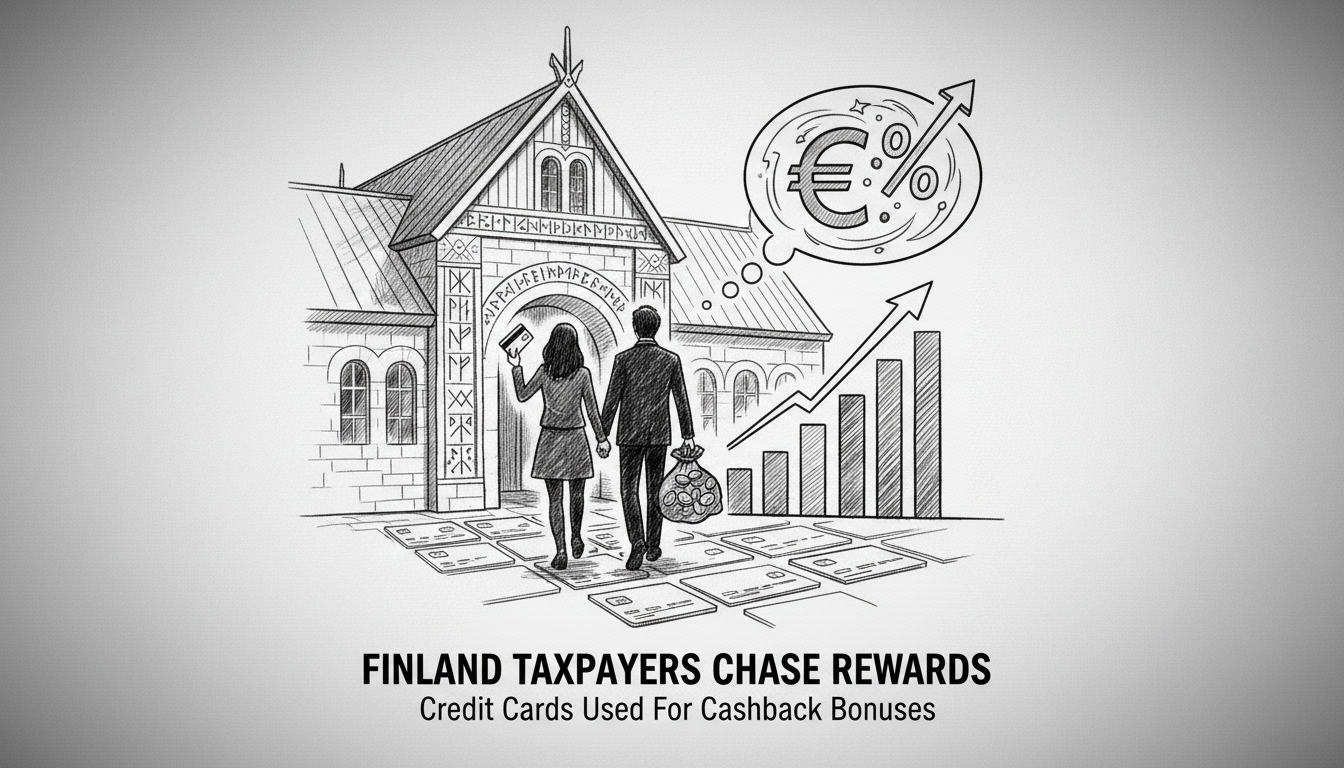
Finland's Tax Administration has observed a curious trend at its service counters: taxpayers are using credit cards to settle their bills specifically to collect cashback rewards and other cardholder benefits. This practice, confirmed by officials, highlights a modern loophole where state revenue collection intersects with private financial incentives. While not illegal, it raises questions about the efficiency of public administration and the evolving nature of consumer behavior in a digital economy.
Niko Mäkelä, a senior inspector at the Finnish Tax Administration (Verohallinto), acknowledged the phenomenon. "The Tax Administration has observed that individual taxes have been paid by card at our service points also to obtain various payment method benefits," Mäkelä stated. He noted that staff became aware of the motivation through conversations with customers during service interactions.
The Mechanics of a Tax Payment Bonus
The logic is straightforward for cardholders. Certain premium credit cards offer a percentage of each purchase back to the customer as a cash reward. When a taxpayer uses such a card at a Verohallinto service point, the transaction is processed like any other retail purchase. The card issuer then applies its reward scheme. For Nordea's Platinum card, this means a 0.5% cashback on all credit purchases, excluding cash advances and gambling. A tax payment of 1,000 euros would yield a 5 euro bonus for the cardholder.
Leo Leikola from Nordea's communications department confirmed this directly. "If our customer pays their tax at the Tax Administration's payment terminal with a Nordea Platinum card on credit, they will receive cashback from this payment as well," Leikola said. The cashback is credited to the card account and can be used to offset the card's monthly bill. Similarly, Norwegian bank Morrow Bank, which offers cards in Finland, suggested its card could qualify for a 1% cashback on tax payments, depending on the settings of the tax office's payment terminal.
A Limited but Telling Service Channel
This scenario is only possible at specific physical locations. The Finnish Tax Administration accepts cash, debit cards, or credit cards at just five service points nationwide: in Helsinki, Turku, Tampere, Kuopio, and Oulu. The vast majority of tax payments in Finland are handled through direct bank transfers, automated withholding from salaries, or online banking services. The physical service points primarily cater to individuals needing in-person assistance or those making specific, often urgent, payments.
This limited access makes the trend more of a niche observation than a systemic issue. However, its existence is symbolically significant. It demonstrates how commercial reward programs can influence behavior in unexpected corners of the public sector. For the Tax Administration, the practice is somewhat awkward. "In itself, paying taxes with a credit card specifically for payment method benefits does not align with our objectives," Mäkelä commented. He was careful to note that the cashback incentive comes from the card issuer, not from public funds. "The Tax Administration does not enable cashback for the customer; it is specifically the credit card provider," he clarified.
Financial and Administrative Implications
From a public finance perspective, the state incurs a cost when processing credit card payments. Card companies typically charge merchants—in this case, the government—a transaction fee, often a small percentage of the payment amount. When a taxpayer pays 1,000 euros, the state might receive only 995-998 euros, with the remainder going to the financial network. This processing cost is a direct expense to the administration, funded ultimately by all taxpayers.
Allowing credit card payments is a customer service decision, providing flexibility. Yet, when that flexibility is used primarily to extract private financial gain, it places the state in the role of an unwitting facilitator. The administrative cost is borne collectively, while the cashback benefit is captured individually. Some tax policy experts argue this creates a minor inequity, where those with access to specific financial products and the ability to visit urban service points can effectively secure a small discount on their tax liability, a option not available to others.
The Broader Market Context
The trend is a direct product of intensified competition in the Nordic financial sector. Banks and fintech companies are aggressively marketing cashback and points-based credit cards to attract and retain customers. These cards are designed to encourage spending on credit, with the issuer betting on interest income from revolving balances to outweigh the cost of the rewards. The discovery that tax payments can qualify for these rewards adds a new, predictable, and often large "purchase" to a cardholder's portfolio.
For consumers, it represents a savvy, if small-scale, financial optimization. In a high-tax country like Finland, turning a mandatory payment into a source of even minor reward points can be appealing. It reflects a highly digitized and incentive-driven consumer culture where payment methods are chosen strategically. Financial analyst Minna Koskinen, who tracks retail banking, notes, "This is a logical extension of reward economics. Consumers are trained to seek value in every transaction. When they identify a large, predictable payment like a tax bill that can be routed through a reward channel, they will do so. The interesting part is seeing a government agency become a point in that circuit."
Regulatory and Ethical Considerations
The Tax Administration's muted response—acknowledging the issue but stopping short of condemnation or immediate policy change—is telling. They face a balancing act. Cracking down on credit card payments would reduce customer service options and could inconvenience those who rely on them for legitimate reasons. Furthermore, attempting to police the intent behind a payment method choice would be impractical and intrusive.
However, the administration could review the cost-benefit analysis of accepting credit cards at all. If the transaction fees paid to card companies become significant relative to the utility provided, they might reconsider the policy. Another option, used by some government agencies globally, is to pass the card processing fee directly onto the user who chooses that method, eliminating any net cost to the state. This would also nullify the cashback advantage, as the fee would likely exceed the reward.
Mäkelä declined to speculate on which specific card providers' systems might allow for rewards on tax payments, stating it was a matter for the card companies. This hands-off approach underscores the administration's view that the reward mechanism is a private-sector issue. Their core mission is collecting revenue, not regulating the downstream use of payment methods.
A Glimpse into Future Frictions
This small-scale phenomenon in Finnish tax offices is a microcosm of a larger tension. As public services digitize and payment ecosystems become more complex with embedded rewards and financing options, similar frictions will likely emerge elsewhere. Could one earn airline miles by paying a municipal parking fine? Could hospital bills be paid with a card that offers extended warranty protection?
The Finnish case shows that when public and commercial systems interface, unintended consequences can arise. The state provides a necessary service (accepting payments), and commercial actors build layers of incentive on top of that transactional infrastructure. For now, the Finnish Tax Administration is watching, not intervening. The practice remains a legal, if eyebrow-raising, financial maneuver for a small number of savvy taxpayers. It serves as a reminder that in a modern economy, even the most obligatory of payments can be gamified, and the state must continually assess its role not just as a collector, but as a node in a vast and incentivized financial network.
Ultimately, the persistence of this loophole may depend less on tax policy and more on the card companies themselves. If issuers decide that tax payments are a low-margin or undesirable transaction type for their reward programs, they could simply reclassify them, much as they exclude cash advances. Until then, for those with the right card and access to a city-center tax office, April may bring not just a bill, but also a tiny rebate.