
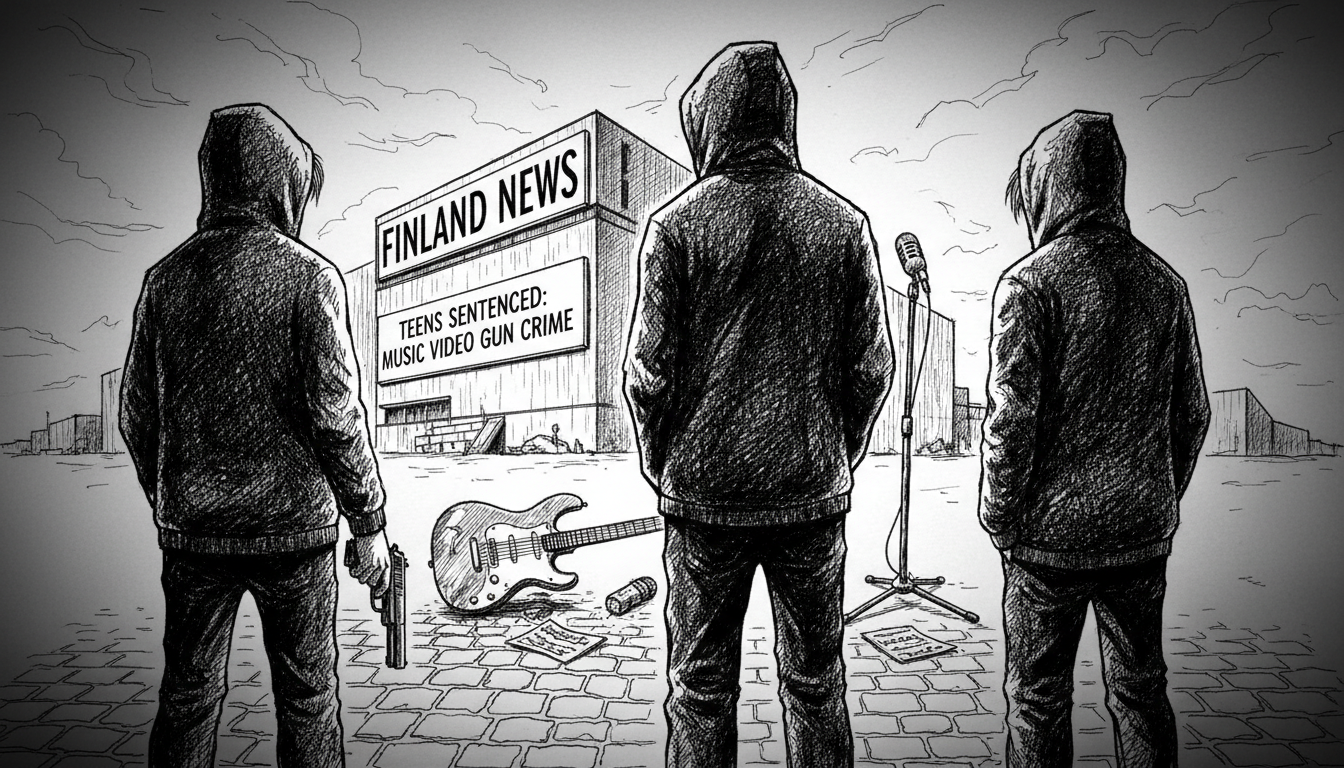
Finland's judiciary has delivered a firm message on illegal firearms after three teenage boys were sentenced to conditional imprisonment for using a modified, high-capacity semi-automatic weapon in a music video. The Helsinki District Court found the minors, all aged 16 or 17 at the time of the February 2024 incident, guilty of an aggravated firearms offense, rejecting their defense that they believed the gun was a non-functional prop.
A Rappukäytävä Performance with Real Consequences
The case centered on a video filmed in a residential stairwell, or rappukäytävä, a common urban space now transformed into a crime scene. Court documents describe one boy dancing with the firearm in hand to music, while another scene depicts a simulated shooting to the head. Crucially, the video captured the firing of a blank round, a detail that proved pivotal to the prosecution. The weapon was a modified self-loading single-shot firearm capable of discharging over 21 rounds per magazine, fitted with an extended 30-round clip. Police experts who analyzed the footage concluded the firearm was operational.
"The court considered that the trio acted in concert. In the video, the weapon is also held in turn by each of them," the judgment noted, undermining claims of ignorance about the gun's functionality. The sentences ranged from three to six months of conditional imprisonment. One boy received an additional year and three months of supervision, as police later found two more firearms in his backpack during a separate incident; he had attempted to discard them by throwing the bag from a balcony.
Navigating Finland's Strict Firearms Landscape
This case unfolds against Finland's complex relationship with guns. The country has one of Europe's highest rates of civilian gun ownership, rooted deeply in hunting and sport shooting traditions. However, its legal framework is stringent. The Firearms Act requires a license for possession, granted only for specific purposes like hunting, sport, or collection. Permits mandate background checks, safety course completion, and secure storage requirements. Illegal possession, modification—such as adding a high-capacity magazine—or carrying a firearm without a permit constitutes a serious crime.
Aggravated firearms offenses, as charged in this case, carry heavier penalties. The court acknowledged mitigating factors, including that the weapon was not used to harm anyone or commit another crime. However, it emphasized the reckless handling in a communal stairwell as an aggravating factor. "The gun was waved around in the stairwell and handled carelessly, according to the court," the ruling stated. None of the teens had prior convictions, but all were known to police, a detail highlighting growing concerns about repeat youth offenses.
Expert Analysis: Sentencing, Social Media, and Systemic Gaps
Legal experts are divided on the court's approach. "Conditional imprisonment for an aggravated offense involving a modified, high-capacity weapon may seem lenient to the public," says Dr. Elina Saarinen, a criminologist at the University of Helsinki. "But for first-time juvenile offenders, the court must balance punishment with rehabilitation. The supervision order is a critical component, aiming to steer them away from further crime."
Other analysts point to the role of social media culture. "This isn't an isolated incident. Music videos glorifying weapon culture and 'drill' rap scenes that sometimes intersect with real-world conflicts are a global phenomenon," notes youth culture researcher Marko Juntunen. "For some teens, the line between performance art and criminal act becomes dangerously blurred. The video wasn't just evidence; it was the motive for the crime—creating content."
Security policy expert Lieutenant Colonel (ret.) Pekka Toveri raises concerns about the weapon's origin. "A modified semi-automatic with a 30-round magazine is not a typical hunting weapon. Its presence signals possible connections to organized criminal networks arming youth. The sentencing addresses the symptom, but the source of these illegal weapons requires more intense investigative focus."
Broader Context: Rising Youth Crime and Political Responses
The case arrives amid a heated national debate on youth crime and gang activity, particularly in urban centers like Helsinki, Vantaa, and Turku. Statistics from the Finnish Police University College show a rise in suspected offenses by under-15-year-olds in recent years, with theft and assault being most common, though firearms offenses remain relatively rare but high-profile.
The government, led by Prime Minister Petteri Orpo's coalition, has made tightening security a cornerstone of its agenda. The Ministry of the Interior is drafting legislation to lower the age of criminal responsibility and expand police powers for searching minors. Justice Minister Leena Meri has repeatedly called for "firm and swift consequences" for youth involved in serious crime.
This sentencing exemplifies the judiciary's current balancing act: applying the law firmly while operating within a juvenile justice system that retains a strong rehabilitative ethos. The case also tests Finland's famed gun control model, demonstrating how illegal weapons pipelines can bypass even robust regulatory systems.
A Question of Deterrence and Digital Reality
As the three teens serve their conditional sentences under supervision, the broader questions linger. Does this ruling deter other young people from similar acts, or does the conditional nature of the punishment send a mixed signal? How effectively can authorities monitor the digital spaces where such behavior is planned and glorified?
The video itself remains a stark digital artifact. It was created for an audience, a performance of bravado that ultimately became Exhibit A in a criminal trial. The stairwell, a mundane piece of Finnish apartment block architecture, became a stage for a crime with real-world legal ramifications. This case underscores a modern challenge: criminal acts are increasingly performed for social media currency, blurring motives and complicating traditional legal assessments of intent and threat.
Finland's authorities now face the dual task of addressing the tangible flow of illegal weapons while grappling with the intangible influence of online cultures that romanticize violence. The sentences close one case file, but the societal conversation about youth, guns, and digital influence is far from over.