
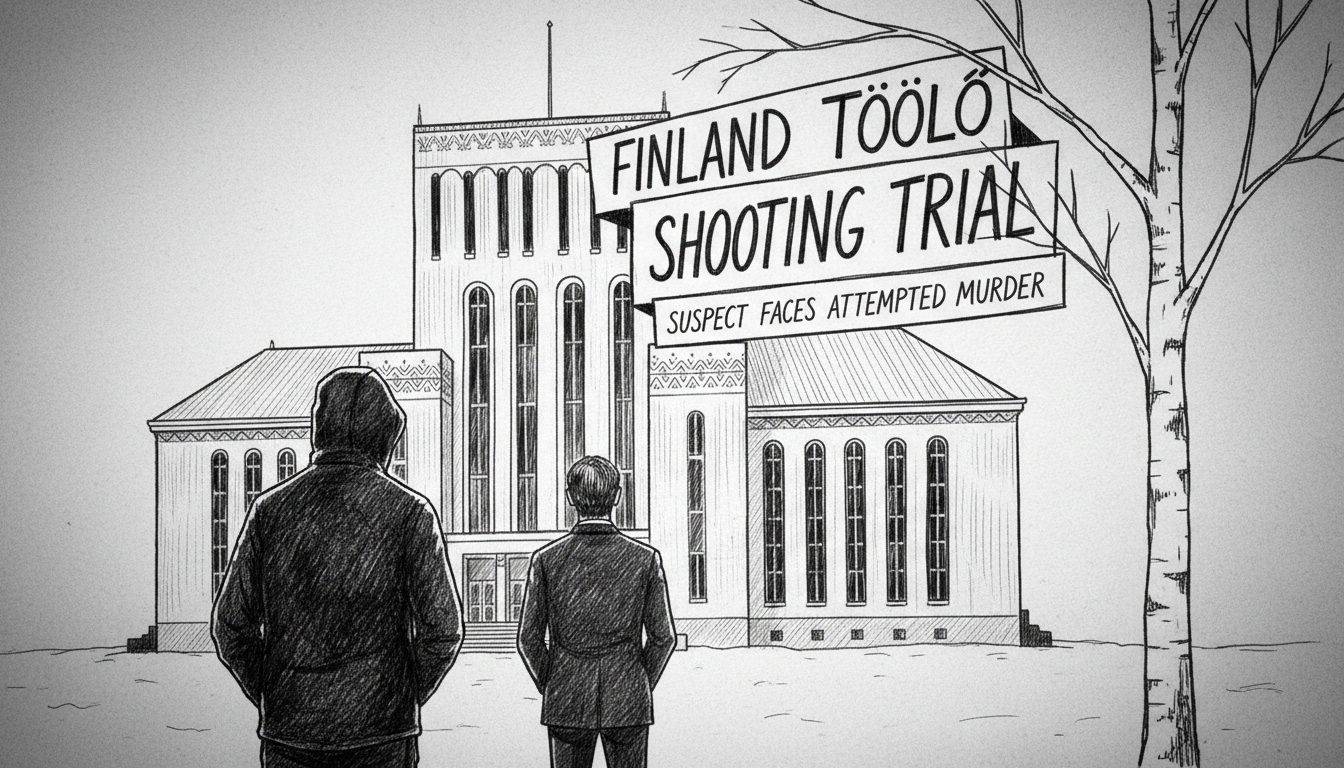
Finland's Helsinki District Court opened a high-profile trial Wednesday for a shooting that has shaken the capital's upscale Töölö district. A 19-year-old man, his face hidden behind a sheet of paper, pleaded not guilty to charges of attempted murder, firearms offenses, and drug crimes related to the late September ambush of a 16-year-old boy on Mechelininkatu. The case presents a stark challenge to Finland's reputation for low violent crime, spotlighting issues of youth violence, illegal firearms, and criminal recidivism.
A Calculated Ambush in a Quiet Neighborhood
Prosecutors described a premeditated attack in their opening statements. They allege the suspect, a Tuusula resident born in 2005, scouted the apartment building's stairwell one day prior to the shooting. On the evening of the attack, he returned dressed in dark clothing and a face mask, waiting in the darkened stairwell to ambush the victim. According to the charge sheet, he fired four to five shots at the 16-year-old, with two bullets striking the boy in the leg. The victim was with two other individuals at the time. Following the shooting, the suspect fled by car and evaded police for several days before his apprehension. The prosecutor stated the motive stemmed from a personal dispute and a debt the young victim owed to the accused.
“The shooter's actions appear quite calculated,” the prosecutor told the court, framing the incident as a planned act of violence rather than a spontaneous confrontation. The suspect, however, through his defense counsel, denied any involvement in the shooting. He admitted only to being in the Töölö area for drug transactions unrelated to the Mechelininkatu events. The defense's admission regarding drug activity was corroborated by police findings of cocaine and amphetamine in the suspect's possession at the time of his arrest.
A Young Suspect with a Lengthy Criminal Record
The trial immediately highlighted the suspect's significant criminal history, despite his youth. Court records reveal multiple prior convictions for various acts of violence, some dating back to when he was a minor. This background is central to the prosecution's case and raises pointed questions about intervention and rehabilitation within the Finnish justice system for young offenders. Legal experts observing the trial note that this prior record will heavily influence both the arguments on guilt and the potential sentencing if convicted.
“The court will weigh the evidence of premeditation very carefully, especially given the suspect's age and history,” said a Helsinki-based criminal lawyer not involved in the case. “A conviction for attempted murder, combined with prior violent offenses, carries the possibility of a substantial prison sentence. The defense’s strategy of admitting to lesser charges while denying the most serious one is a common approach, but the prosecution’s narrative of a planned ambush is compelling.”
Finland's Crime Paradox: Low Rates but Rising Concerns
The Töölö shooting has ignited a public debate that extends beyond the courtroom. Finland consistently ranks among the safest countries in the world, with homicide rates a fraction of those in many other nations. Gun ownership is strictly regulated, and legal firearms are predominantly used for hunting or sport. This incident, involving an illegal firearm in a targeted attack in a central Helsinki neighborhood, contradicts that general sense of security.
Criminologists point to underlying tensions that such cases expose. “While overall violence is low, we see concerning patterns in major urban areas,” explained a researcher from the University of Helsinki's Institute of Criminology and Legal Policy. “Factors like social exclusion, mental health challenges among youth, and the availability of illegal weapons on the black market can create pockets of serious violence. This case has several hallmarks of a dispute rooted in informal economies, which are difficult for authorities to penetrate.”
Police and security officials have repeatedly warned about the increasing presence of street gangs and organized criminal networks in Helsinki, Turku, and Tampere. These groups are often involved in drug trafficking and extortion, and conflicts between them sometimes erupt into violence. The alleged debt motive in the Töölö case fits a pattern of criminal enforcement within these circles.
The Legal Process and Broader Implications
The trial is expected to last several days, with the court hearing from witnesses, forensic experts, and police investigators. Key evidence will include surveillance footage from the area, ballistic reports linking the weapon to the scene, and digital communication records. The victim is also likely to testify. The suspect's decision to conceal his face with paper upon entering the courtroom, while unusual, is not prohibited and reflects the intense media scrutiny surrounding the case.
For policymakers in the Eduskunta, the trial adds urgency to ongoing discussions about youth crime prevention and law enforcement resources. The government's interior ministry has recently allocated additional funds for police operations targeting gang activities and illegal weapons trafficking. Justice ministry officials are also reviewing protocols for monitoring and rehabilitating young offenders with violent histories to prevent recidivism.
“Every case like this is a systemic failure,” remarked a member of the Finnish Parliament's Legal Affairs Committee. “It prompts us to ask hard questions: Where did this young man fall through the cracks? How did an illegal firearm end up in his hands? We have strong social structures, but we cannot be complacent. The goal must be to break the cycle before a dispute leads to a shooting in a stairwell.”
The Helsinki District Court's verdict, which may take weeks to deliver after the trial concludes, will provide legal closure for this specific act of violence. However, the broader societal questions the Töölö case raises about youth, guns, and crime in modern Finland will remain long after the gavel falls. The contrast between the peaceful, orderly image of Finnish society and the brutal reality of a calculated ambush in a central neighborhood creates a dissonance the nation must now consciously address.