
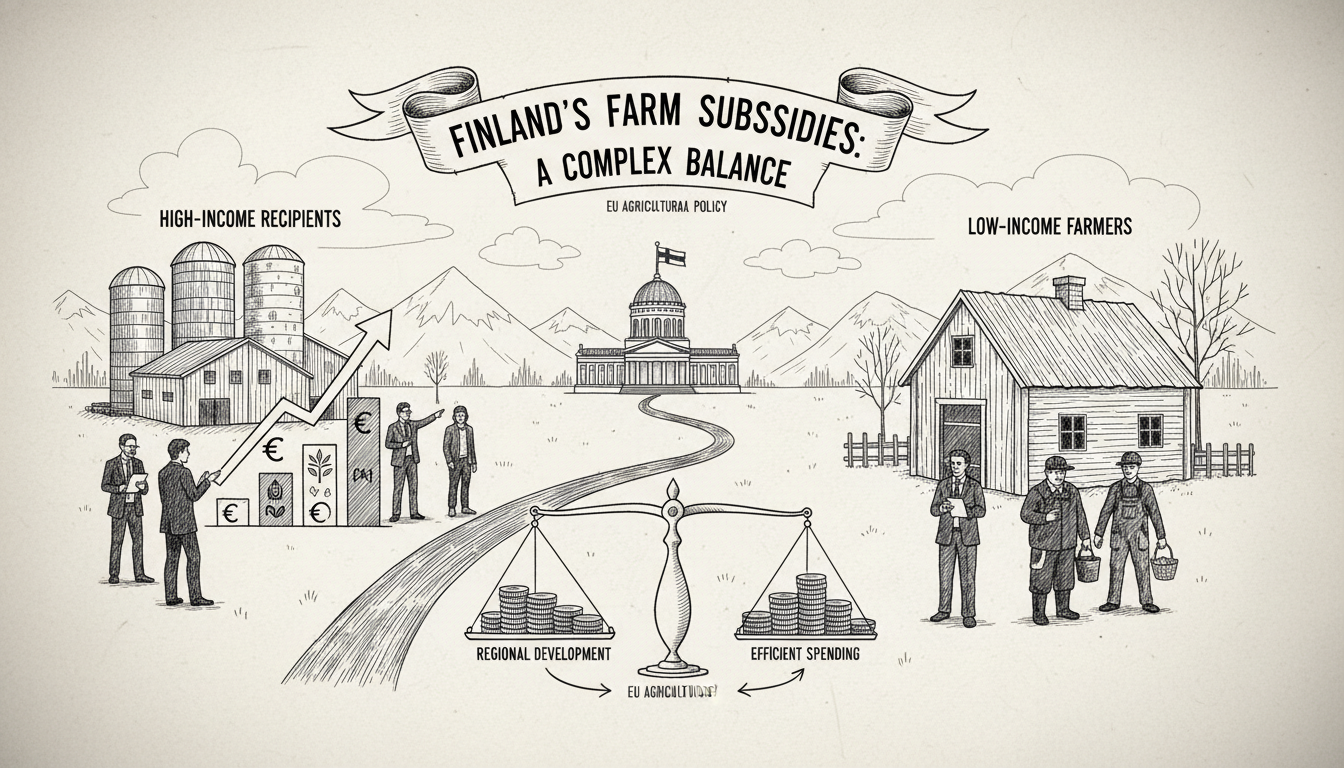
Finland's agricultural subsidy system has distributed substantial financial support across the nation's farming sector, with a newly released list of top recipients showing a diverse economic picture. The data reveals that the largest direct payments from the state budget do not always correlate with the highest farm incomes, challenging common perceptions about agricultural support. This distribution pattern reflects the complex structure of Finland's Common Agricultural Policy (CAP) implementation and ongoing debates within the Eduskunta about subsidy reform.
A detailed analysis of the subsidy allocations shows a mix of high-income and low-income farmers among the top recipients. The leading position is held by a different entity compared to previous years, indicating shifts in agricultural production patterns or business structures. Many recipients operate from smaller municipalities across regions like Ostrobothnia, North Karelia, and Satakunta, demonstrating the national reach of these support mechanisms. The Finnish Ministry of Agriculture and Forestry administers these funds through both national programs and EU-cofinanced schemes.
Farm subsidies in Finland represent a major budgetary commitment, with billions of euros allocated annually through direct payments and rural development programs. This spending aligns with European Union agricultural policy frameworks that Finland must implement as a member state. The current government coalition, led by Prime Minister Petteri Orpo, has committed to reviewing agricultural support structures while maintaining competitive production capacity. Agriculture Minister Sari Essayah has emphasized the need for balanced support that sustains rural communities across Finland's challenging climate zones.
From a policy perspective, the subsidy distribution highlights several key issues in Finnish agricultural politics. The system aims to achieve multiple objectives including food security, environmental sustainability, and maintaining rural livelihoods across the country's sparsely populated regions. Critics within parliament, particularly from the Green League and Left Alliance, argue that subsidy distribution should better reflect environmental performance and income needs. Meanwhile, the Centre Party traditionally defends strong support for the agricultural sector as vital for regional equality.
The European Union context significantly shapes Finland's subsidy framework through the CAP strategic plan. Finland implements both basic income support and voluntary eco-schemes that reward climate-friendly practices. Recent debates in Brussels about CAP simplification and future financing directly affect how Helsinki structures its national agricultural policy. Finnish MEPs have advocated for maintaining adequate funding for northern agricultural regions facing specific climatic challenges.
Historical context shows Finland's agricultural policy has evolved significantly since EU accession. Early years focused on helping farms adapt to EU competition, while recent decades have incorporated stronger environmental conditions. The current subsidy list reflects this evolution, with some larger operations receiving substantial support for implementing specific environmental measures. The basic truth is that agricultural policy remains one of Finland's most complex spending areas, balancing economic, social, and environmental priorities that sometimes conflict.
Looking forward, the subsidy distribution data will likely inform upcoming parliamentary discussions about the 2027-2032 CAP strategic plan. The government faces pressure to demonstrate that public funds deliver clear public benefits while supporting viable farm businesses. International readers should understand that Finnish agricultural debates often center on maintaining production in marginal northern areas versus concentrating support where it's most economically efficient. This tension between regional policy and agricultural efficiency defines much of the political discussion in Helsinki's government district.
For international observers, Finland's agricultural subsidy patterns offer insights into how a northern EU member state implements common policies while addressing national specificities. The data reveals the practical outcomes of political decisions made in both Helsinki and Brussels, affecting everything from dairy production in Ostrobothnia to cereal farming in Uusimaa. As global food security concerns grow, understanding these support mechanisms becomes increasingly relevant for tracking how nations maintain domestic production capacity.