
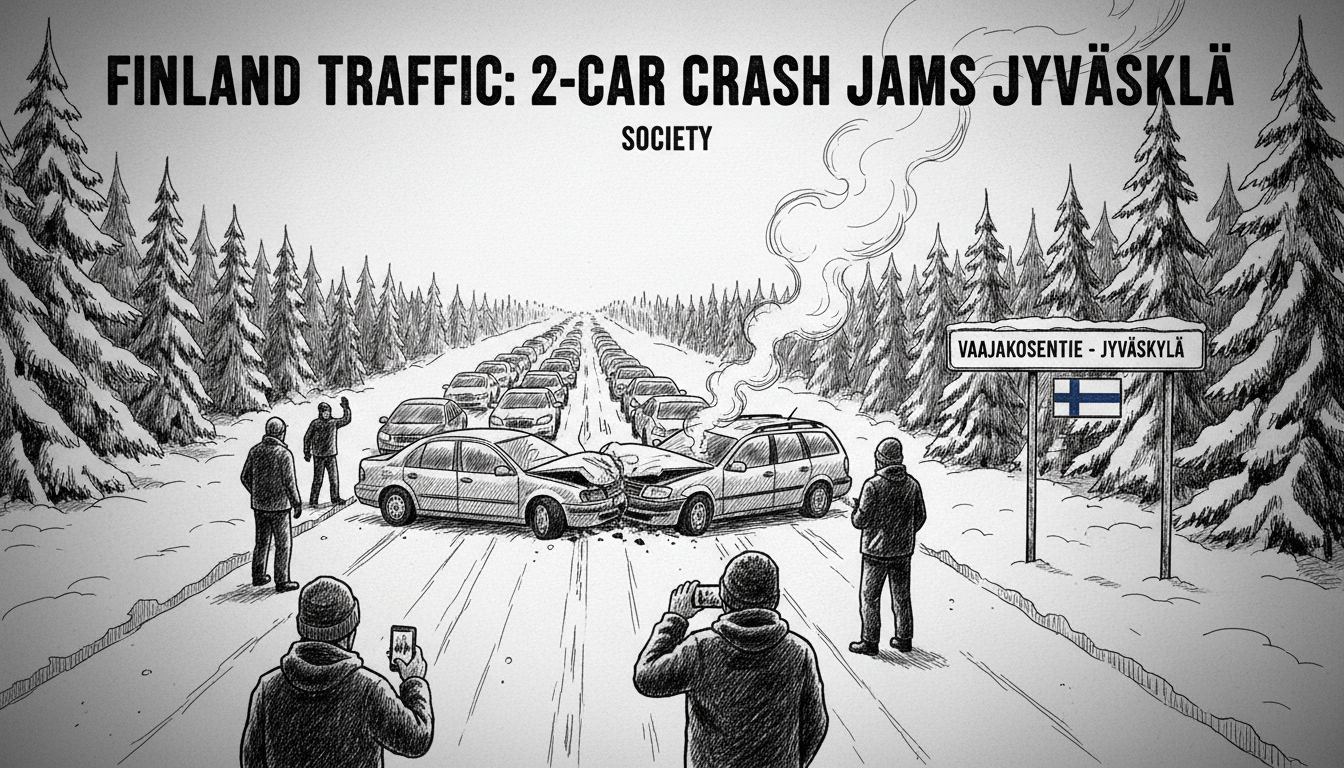
Finland traffic on a key central artery was disrupted Friday afternoon after a two-car rear-end collision on Vaajakoskentie in Jyväskylä. The crash occurred in the Kivistö area at approximately 3:17 PM, sending emergency responders to the scene and leaving one vehicle damaged enough to require a tow truck. While authorities confirmed no personal injuries resulted from the incident, the collision caused significant traffic delays during recovery operations, highlighting the persistent challenges of road safety on Finland's busy national routes.
A Routine Crash on a Critical Corridor
The collision took place on Vaajakoskentie, which carries the designation of Finnish national road 4. This route is a major north-south thoroughfare, funneling significant daily traffic through the university city of Jyväskylä. Accidents on such key roads have an outsized impact, causing ripple effects of congestion far beyond the immediate crash site. The Kivistö area, where the collision occurred, is a known point along this busy commuter and freight route. The fact that the crash happened on a Friday afternoon—a peak travel time—amplified the resulting traffic troubles for many drivers heading into the weekend.
Local police and rescue services responded promptly to the 15:17 alert. Their primary tasks were securing the scene, ensuring the safety of all involved, and clearing the wreckage to restore normal traffic flow. The successful, injury-free resolution of this incident underscores the efficiency of Finland's emergency response protocols. However, each such event consumes considerable public safety resources and disrupts the economic and social rhythms of the city.
The Persistent Problem of Rear-End Collisions
Traffic safety experts point to this common type of crash as a preventable issue. Rear-end collisions, like the one in Jyväskylä, are frequently linked to driver inattention, failure to maintain a safe following distance, or misjudgment of speed and stopping conditions. On high-volume roads like Vaajakoskentie, where traffic speeds are often high and conditions can change rapidly, these factors become critically important.
"While we are relieved this incident did not result in injuries, it serves as a crucial reminder," said a traffic safety official familiar with the region's patterns. "Maintaining a proper safety gap between vehicles is not just a recommendation; it's a fundamental requirement for preventing these kinds of collisions. On our main highways, a moment's distraction can have immediate consequences." This analysis aligns with national traffic safety campaigns that continuously emphasize defensive driving and situational awareness.
The outcome—a towed vehicle but no injuries—can be considered a best-case scenario for a highway collision. It allows investigators to focus on the mechanical and situational causes without the added complexity of a medical emergency. The damaged vehicle will likely be inspected to rule out any pre-existing mechanical failure, though initial reports suggest driver behavior and road conditions are the primary focal points.
Infrastructure and Safety in Central Finland
Jyväskylä, as a growing hub for education and technology in Central Finland, faces ongoing challenges in balancing traffic volume with safety. National road 4 is a lifeline for the region, and any incident affects commuters, commercial transport, and access to services. The city and the Finnish Transport Infrastructure Agency (Väylävirasto) continuously monitor accident data to identify black spots and plan improvements.
These improvements can include better road signage, enhanced lighting, adjustments to speed limits, or even major redesigns of intersections and merging lanes. Each crash provides data points that contribute to these long-term planning decisions. While not every incident leads to a physical change in the road, patterns of similar crashes in the same location often trigger engineering reviews.
For residents of Jyväskylä and regular users of Vaajakoskentie, this crash is a familiar story. It underscores the daily reality of sharing the road with thousands of other drivers, where individual vigilance is the first line of defense. The community's reliance on this single major route also highlights the need for robust and resilient transportation infrastructure that can withstand both daily wear and unexpected incidents.
Looking Beyond the Immediate Scene
The Jyväskylä crash, while minor in terms of human cost, fits into a broader national conversation about road safety in Finland. The country has long had ambitious goals to reduce traffic fatalities and serious injuries to virtually zero—a policy vision known as Vision Zero. Achieving this requires addressing not just catastrophic crashes, but also the multitude of smaller incidents like this one, which indicate systemic risks.
Technological solutions, such as advanced driver-assistance systems (ADAS) that include automatic emergency braking, are becoming more common in new vehicles and could help mitigate rear-end collisions. Legislative measures and continuous education campaigns also play a role. The Finnish government and organizations like Liikenneturva (The Finnish Road Safety Council) actively promote safe driving practices through various channels.
Furthermore, the economic cost of such disruptions is non-trivial. Traffic jams caused by crashes lead to lost productivity, increased fuel consumption, and delays in logistics. For a city like Jyväskylä, ensuring the reliability of its main transport corridor is also a matter of economic competitiveness and quality of life for its citizens.
A Call for Continuous Vigilance
Friday's incident on Vaajakoskentie concluded with a cleared roadway and two drivers able to walk away. This positive result should not breed complacency. Every close call or minor crash is a warning sign—a signal that the complex system of human drivers, vehicles, and roadways is operating at its limits.
As traffic volumes gradually recover and potentially increase in post-pandemic Finland, the lessons from this Jyväskylä crash remain universally applicable. Drivers must commit to full attention behind the wheel, especially on high-speed national roads. Transportation authorities must continue to invest in safe road design and maintenance. Together, these actions can reduce the frequency of such alerts and keep Finland's roads moving safely.
The next time you drive on Vaajakoskentie or any similar highway, remember the scene at Kivistö. The few seconds gained by tailgating or the momentary glance at a phone are never worth the risk of a collision, the ensuing traffic chaos, or the potential for far worse outcomes. Safe following distance is the simplest and most effective tool every driver has to prevent becoming part of the next traffic news alert.