
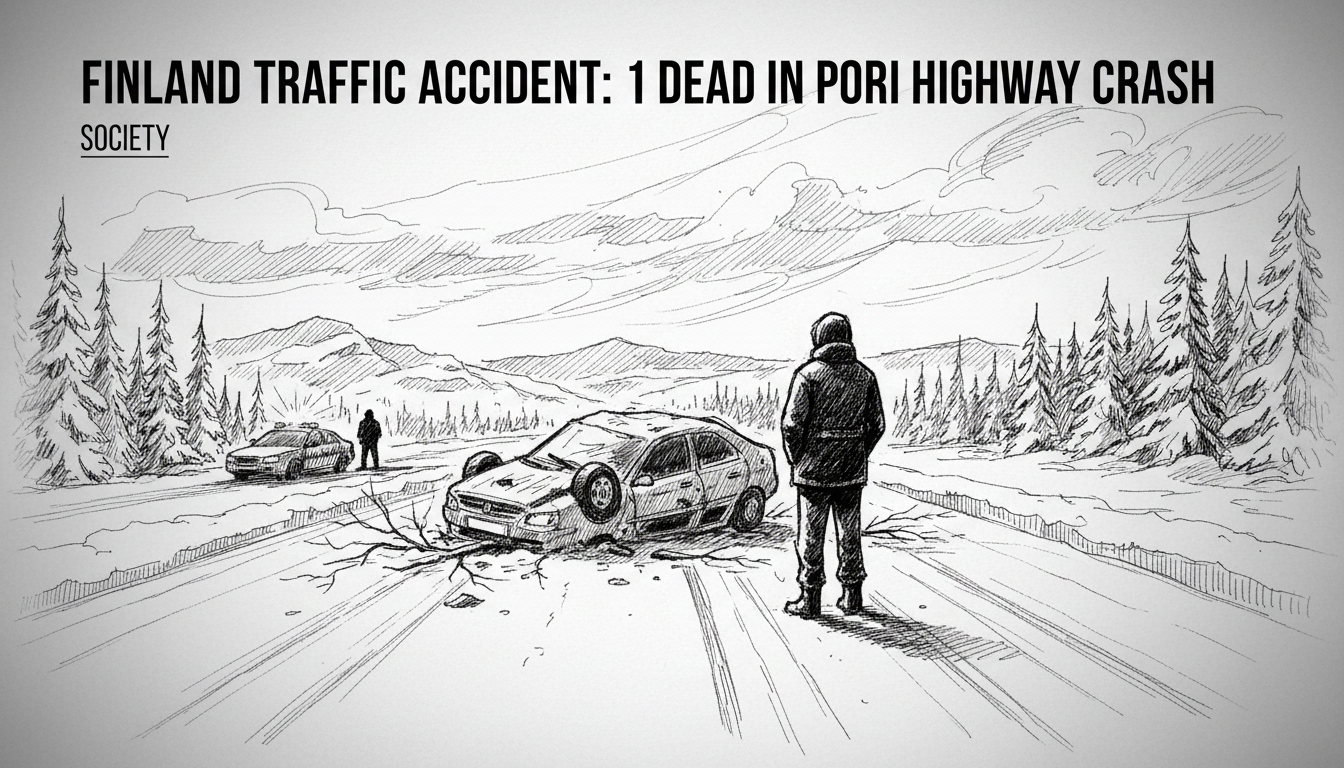
Finland traffic accident investigators are piecing together the events that led to one death on Highway 23 near Pori. A rear-end collision between two vehicles occurred on Tuesday afternoon at the intersection of Valtatie 23 and Rauhalammintie in Noormarkku. Emergency services received the alarm just after 4:30 PM. One adult died at the scene, while another person was transported to a hospital for medical treatment. The Lounais-Suomen police department has launched a full investigation into the fatal crash, which has cast a pall over the Satakunta region.
A Fatal Collision on a Key Transport Route
Highway 23 is a critical artery for freight and passenger travel, stretching from the coastal city of Pori across the country's midsection to Joensuu. The accident site in Noormarkku, a former municipality now incorporated into Pori, sits within a network of roads vital for local and regional commerce. The intersection where the crash occurred is a point where a major national highway meets a local road, creating a potential conflict zone for vehicles with differing speeds and destinations. Police have cordoned off the area for forensic examination, seeking to establish the precise sequence of events that resulted in the fatality.
Traffic was diverted for several hours as first responders worked at the scene. The police have not released the identities of those involved, pending notification of next of kin. The condition of the individual hospitalized remains unclear, though their transport for treatment suggests injuries were sustained. This incident marks another tragic entry into Finland's annual road safety statistics, prompting immediate questions about causation and prevention.
The Persistent Challenge of Road Safety
While Finland boasts one of the safest road networks in the world, fatal accidents like the Pori car crash underscore the persistent risks. Traffic safety experts consistently identify a cluster of common factors in rear-end collisions. Excessive speed for the conditions, inadequate following distance, driver distraction, and sudden stops are primary contributors. Road and weather conditions at the time of the crash will form a key part of the police inquiry. Was there ice or snow? Was visibility poor? Investigators will meticulously examine skid marks, vehicle damage patterns, and data from any onboard systems to reconstruct the vehicles' speeds and movements.
"Every fatal accident is a profound tragedy and a failure of the transport system," said a veteran Finnish traffic safety researcher, who spoke on background due to the ongoing investigation. "Our focus is always on understanding the chain of events—the human, vehicular, and environmental factors—that aligned to cause this outcome. Rear-end collisions often point to a breakdown in the fundamental rule of maintaining a safe distance to react to the unexpected." The expert emphasized that while vehicle safety technology like automatic emergency braking is becoming more common, the human element remains the most critical and variable factor.
The Human Cost and Community Impact
Beyond the stark statistics, the crash on Highway 23 represents a devastating personal loss for a family and community. The death leaves a void that extends far beyond the traffic report. Local residents in Noormarkku and the wider Pori area are confronted with the sobering reality that such tragedies can occur on familiar roads close to home. The incident serves as a grim reminder to all motorists of the immense responsibility that comes with operating a vehicle.
Finnish law mandates a thorough investigation by the police, and in some cases, the Safety Investigation Authority may also review serious traffic accidents to recommend systemic safety improvements. The findings can influence future road design, signage, speed limit evaluations, and public awareness campaigns. The intersection of Valtatie 23 and Rauhalammintie will likely be scrutinized for any engineering or visibility issues that could be mitigated.
A National Context of Cautious Progress
Finland has long pursued a "Vision Zero" policy, aiming to eliminate all traffic fatalities and serious injuries. This strategy involves safer road infrastructure, stringent enforcement of traffic laws, and continuous public education. The country has seen significant success, with road deaths falling dramatically over recent decades. However, each life lost is a signal that the work is incomplete. The Pori crash occurs within a national framework that treats traffic safety as a paramount public health issue, not merely an inevitability of modern life.
Data from previous years shows that single-vehicle accidents and collisions at intersections are persistent challenges on Finnish roads. Rural highways like Highway 23, which can have long, monotonous stretches mixed with sudden access points to local roads, present specific risks. Drivers may become inattentive or misjudge the speed of other vehicles entering or crossing the highway. The police investigation will seek to determine if any such dynamics played a role in Tuesday's collision.
Looking Ahead: From Investigation to Prevention
The immediate aftermath of the crash is focused on care for the injured and support for the bereaved. In the coming weeks, the focus will shift to the technical investigation. The police will interview witnesses, analyze physical evidence, and possibly obtain surveillance footage from nearby properties. A detailed report will be compiled, which may lead to charges if negligence or a violation of traffic laws is determined to be a cause.
More broadly, the tragedy feeds into an ongoing national conversation about road safety. It reinforces the importance of basic, life-saving habits: adhering to speed limits, maintaining a generous following distance, and eliminating distractions like mobile phones. For transport authorities, it provides another data point that may inform future infrastructure investments or targeted enforcement campaigns on specific road corridors.
The fatal crash on Highway 23 is a stark event with a simple, terrible outcome—one person lost their life. Yet it unfolds within a complex web of human behavior, engineering, policy, and chance. As the community of Pori mourns, the broader task for Finland is to learn, adapt, and relentlessly pursue a future where such journeys do not end in tragedy. The question that lingers after the emergency vehicles depart is one that haunts every advanced society: how do we make a system used by millions every day safe for every single one of them?