
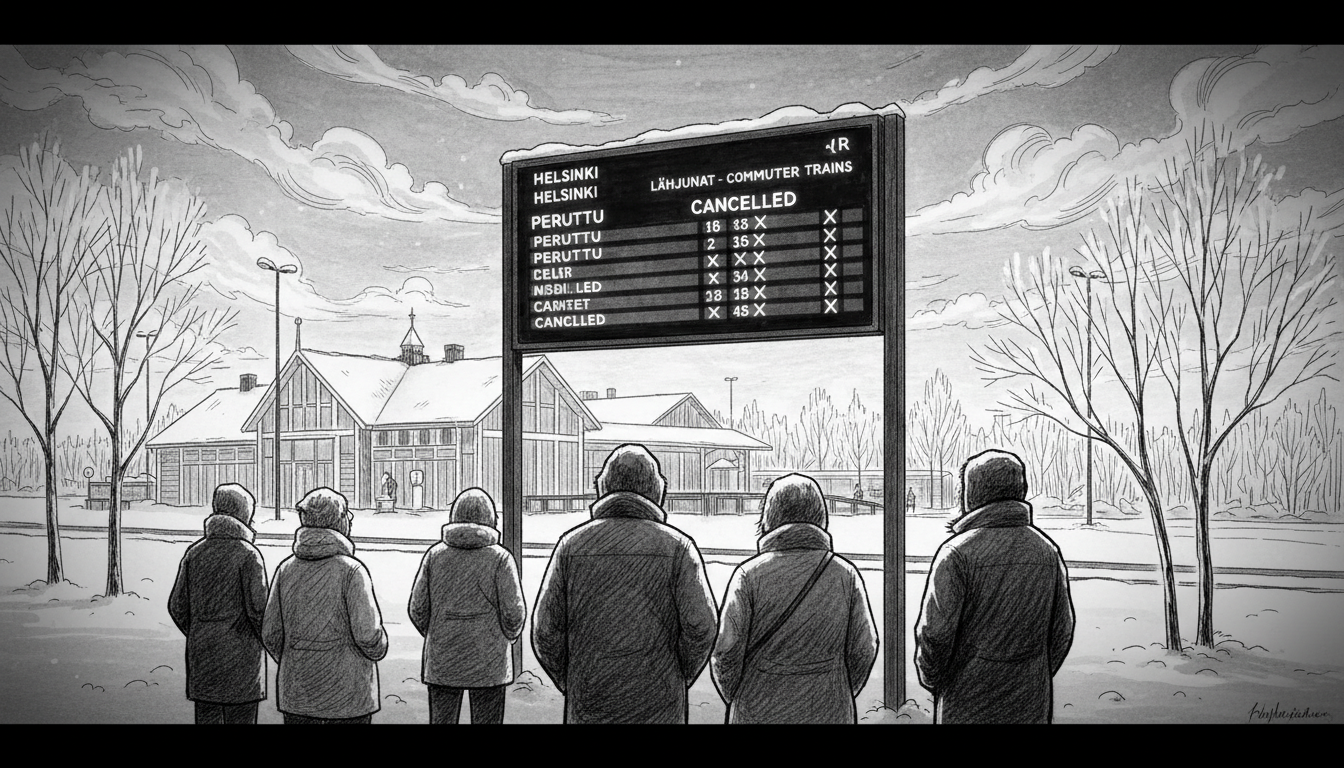
Finland train cancellations have paralyzed the Helsinki region after a track fault forced the public transport authority to axe 50% of services on three key commuter lines. The Helsinki Regional Transport Authority (HSL) announced the major disruption to I, K, and P train services indefinitely, stranding hundreds of thousands of daily passengers during the Wednesday morning rush. The fault means every other train on these vital routes is cancelled, with K-trains towards Kerava skipping all stops between Tikkurila and Korso.
Scope of the Helsinki Transport Disruption
Passengers faced immediate chaos at Helsinki Central Station and along the network. The cancellations follow a strict pattern: from Helsinki, the K-train departures at 21 and 41 minutes past each hour are cancelled. I-train services departing at 06, 26, and 46 minutes past the hour are also scrapped. For the P-line, cancellations hit departures at 18, 38, and 58 minutes past each hour. HSL stated the duration of the disruption remains unknown, offering no estimate for full service restoration. This uncertainty compounds passenger frustration, leaving commuters to seek alternatives like overcrowded buses, trams, or personal vehicles.
The impact is severe for the approximately 1.4 million residents in HSL's service area. The I, K, and P lines form critical arteries connecting Helsinki's city center to populous eastern and northern suburbs and cities like Vantaa and Kerava. These commuter trains typically carry hundreds of thousands of passengers each weekday. The disruption's ripple effect will increase congestion on parallel roads like Highway 45 and the Kehä III ring road, as well as strain substitute bus services.
Immediate Impact and Passenger Reactions
Commuters expressed sharp frustration on social media and at stations. Many criticized the lack of timely information and the suddenness of the widespread cancellations. 'This level of disruption with no end in sight shows a fragile system,' said one regular commuter from Kerava, waiting on a packed platform at Tikkurila. The disruption highlights the region's dependency on its rail network. For many living in surrounding municipalities, the train is the only viable, fast connection to workplaces and schools in central Helsinki.
Local businesses also feel the effects. Cafes and kiosks that rely on morning foot traffic from commuters reported quieter than usual trade. Employers anticipate staff arriving late or working remotely, causing a dip in productivity. The economic cost of such mass transport failure is significant, though difficult to quantify immediately. It encompasses lost work hours, increased fuel consumption, and logistical delays for goods and services.
Infrastructure Questions and Political Responsibility
This incident directs scrutiny toward the state of Finland's railway infrastructure, managed by the state-owned company Finnish Transport Infrastructure Agency (Väyläviratto). While Finland's rail network is generally reliable, experts point to aging sections and the high strain of frequent commuter traffic. 'Critical infrastructure requires continuous, proactive investment,' said Dr. Laura Niemi, a transport infrastructure researcher at Aalto University. 'Single points of failure that halt half a network suggest maintenance cycles or upgrade schedules need urgent review.'
Political responsibility falls under the Ministry of Transport and Communications. The current government, led by Prime Minister Petteri Orpo, has budget discussions that invariably involve infrastructure spending. Opposition MPs are likely to use this disruption to question whether national infrastructure funding matches actual needs. The issue ties into broader debates about sustainable urban mobility and Finland's carbon reduction goals, as reliable public transport is essential to reducing private car use.
The Ripple Effect on Roads and Alternative Transport
With rail capacity halved, other transport modes are under pressure. HSL is attempting to reinforce bus services along affected corridors, but buses lack the capacity and speed of trains. Road traffic authorities report heavier than normal traffic on key routes into Helsinki from the northeast, leading to longer commute times. This creates a negative feedback loop: as roads clog, buses are delayed, making them an less effective alternative.
The disruption tests HSL's crisis communication and contingency planning. The authority is directing passengers to its journey planner app for real-time updates, but the fundamental issue of missing half the scheduled trains cannot be solved by information alone. The event underscores the network's lack of redundancy; there are often no parallel tracks to reroute trains when a specific section fails.
Economic and Long-Term Implications
Beyond the immediate commute, sustained disruptions carry a tangible economic cost. A 2021 study by the Finnish Business and Policy Forum (EVA) estimated that major disruptions in Helsinki's public transport could cost the metropolitan economy millions of euros per day in lost productivity and added expenses. This event will likely reignite calls for accelerated investment in network resilience, including digital signaling systems and more rapid repair capabilities.
For HSL and Väyläviratto, the priority is a swift and safe repair. The nature of the 'track fault' has not been disclosed, but possibilities range from a cracked rail to issues with points or signaling equipment. Repair times depend on the fault's severity, the availability of specialized crews and parts, and safety protocols. Winter conditions, though now receding, can complicate outdoor repair work.
Looking Ahead: Resilience and Reliability
When will normal service resume? This is the pressing question for every affected commuter. HSL's vague timeline points to the complexity of diagnostics and repair. The incident serves as a stark reminder of the vulnerability of centralized transport systems. It will inevitably lead to political inquiries and public demands for explanations. Can Finland's capital region, which prides itself on efficient design, afford such systemic vulnerabilities in its public transport backbone?
The coming days will show how swiftly the system can recover. More importantly, they will test whether authorities can turn this crisis into a catalyst for more durable infrastructure investment. For now, the message to commuters is one of patience and adaptation, a temporary return to less efficient and more congested forms of travel. The true cost is measured in wasted hours, heightened stress, and a lingering doubt about the system meant to be the region's reliable lifeline.