
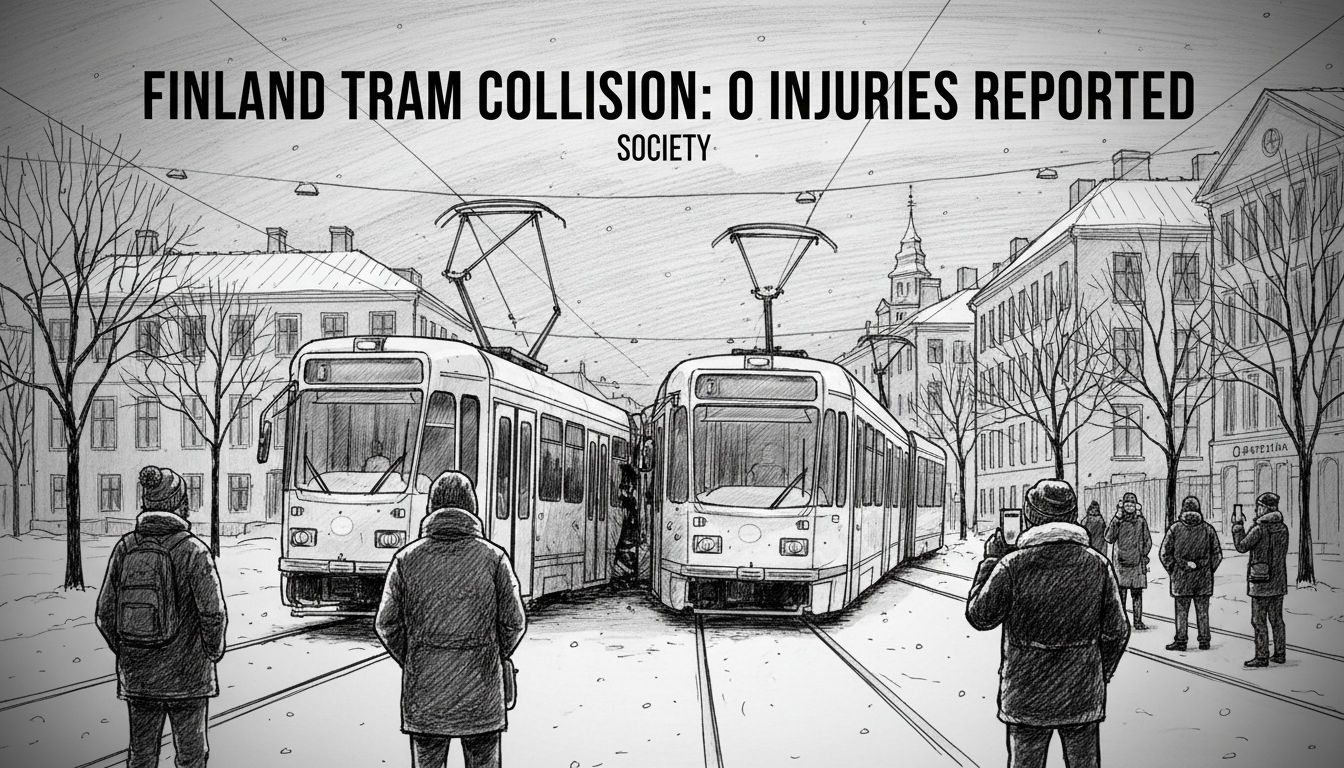
Helsinki's extensive tram network, spanning over 100 km of track, saw its daily operation interrupted when a private car and a tram collided in the Kalasatama district. The accident occurred at the intersection of Junonkatu and Parrulaituri on Saturday evening, causing damage to both vehicles but, critically, resulting in no personal injuries. Helsinki Region Transport (HSL) immediately suspended traffic through the intersection following the 6:39 PM incident, highlighting the swift procedural response to such disruptions in Finland's capital.
This collision spotlights the complex interaction between historic public transport systems and modern urban development. Kalasatama, a former harbor area, is now one of Helsinki’s most rapidly growing residential districts, characterized by contemporary high-rise construction and evolving traffic patterns. The district's ongoing development, while transformative, introduces temporary navigational challenges for both drivers and tram operators navigating altered routes and new infrastructure.
Incident Details and Immediate Response
According to the Helsinki Rescue Department, which was notified of the rail traffic accident at 6:39 PM, the primary outcome was material damage. "The collision did not cause personal injuries," a rescue department spokesperson confirmed, a fact that authorities will count as a fortunate outcome given the potential severity of such incidents. A photograph from the scene, provided by a reader, showed the damaged vehicles at the crossroads, underscoring the physical impact of the crash.
Public transport operator HSL moved quickly to manage the fallout. Traffic at the location was halted indefinitely to allow for investigation and vehicle recovery. This prompt action is part of standard protocols designed to ensure safety and assess infrastructure integrity following any collision involving trams, which carry a high passenger capacity. Service disruptions, while inconvenient, are a necessary trade-off for thorough incident management.
The Tram Network's Vital Role and Safety Record
Trams are not merely a convenience in Helsinki; they are the circulatory system of the city center. First launched in 1891, the network facilitates millions of journeys annually, forming the backbone of Helsinki's public transport alongside the metro and buses. Its deep integration into city life makes any disruption immediately felt by commuters and businesses alike. The system's generally strong safety record is a point of civic pride, making isolated accidents like the one in Kalasatama notable events.
Finland’s overall traffic safety standards are among the highest in Europe, a status achieved through continuous investment in infrastructure, public education, and strict enforcement. Tram safety, in particular, relies on clearly marked right-of-ways, audible signals, and public awareness campaigns reminding drivers and cyclists to exercise caution around tracks. The design of intersections in newer areas like Kalasatama is subject to rigorous planning to accommodate both light rail and private vehicle flows.
Urban Growth and Traffic Integration Challenges
The Kalasatama district presents a specific case study in urban planning. As a new neighborhood built on reclaimed industrial land, its layout represents the latest thinking in sustainable city design, with an emphasis on public transport, walkability, and cycling. However, the reality of a living, construction-heavy district means traffic plans must adapt in real-time. Temporary detours, changing lane configurations, and the presence of construction vehicles can create unexpected hazards, even in a well-designed environment.
Traffic safety experts often emphasize that clarity and predictability are paramount for preventing accidents. "In areas undergoing constant change, consistent signage and driver awareness are non-negotiable," explains a urban mobility analyst familiar with Helsinki's development. "The goal is to integrate new road users into an ecosystem where trams have a predictable and respected pathway. Every new intersection is a fresh test of that design philosophy."
This incident will likely trigger a review by city engineers. They will examine sight lines, signal timings, and road markings at the Junonkatu and Parrulaituri intersection to determine if any environmental factors contributed to the collision. Such post-accident analyses are standard and feed directly into Finland's proactive approach to improving traffic safety, where data from every incident is used to refine the overall system.
Systemic Resilience and Looking Forward
The true test of any complex transport system is not whether incidents occur, but how they are managed. The response to the Kalasatama collision demonstrates a structured framework: secure the scene, ensure no immediate danger to people, suspend affected services, and begin investigation. This minimizes risk and restores order efficiently. For passengers, HSL provides real-time updates through its mobile app and digital displays, directing them to alternative routes, often via the nearby Kalasatama metro station.
Finland's commitment to Vision Zero—the goal of eliminating all fatal and serious traffic accidents—provides the overarching context for this event. Every collision, even one without injuries, is scrutinized for lessons. This policy-driven approach shifts focus from blaming individual drivers to improving systemic design, an ethos embedded in Finnish traffic planning.
The future of mobility in districts like Kalasatama will increasingly rely on this seamless integration. As Helsinki continues to grow inwards and upwards, the pressure on its historic tram network will only increase. The quiet resolution of this Saturday evening crash, with no injuries and a methodical response, offers a snapshot of this challenge being managed competently. Yet, it also serves as a stark reminder that in dense, modern urban environments, the margin for error is perpetually slim.
Can a city build at breakneck speed while maintaining the impeccable safety standards its citizens expect? Helsinki's ongoing development in Kalasatama and elsewhere is the living answer to that question, with every intersection telling part of the story.