
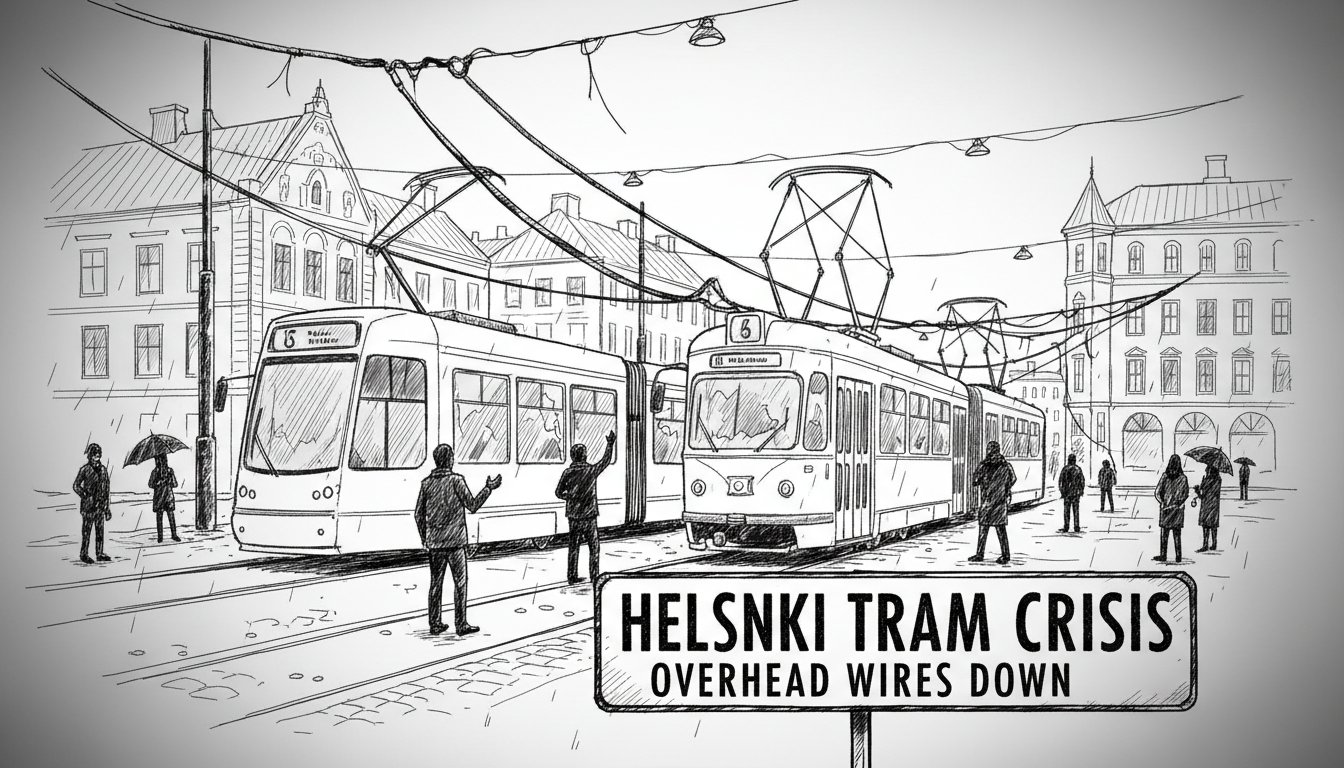
Finland's Helsinki tram network faces a major disruption after a tow truck tore down overhead power lines on the critical line 13 route Saturday afternoon. The incident on Haukilahdenkatu in the Hermannin district has suspended all tram traffic on the line, forcing transport authority HSL to implement an emergency bus replacement service between Kalasatama and Nihti. The repair timeline remains uncertain, leaving thousands of daily commuters and weekend travelers facing significant delays and crowding on alternative transport.
A Saturday Afternoon Snarl in Hermannin
The disruption began abruptly when a tow truck operating in the area made contact with the suspended catenary wires that power the city's iconic orange and green trams. Helsinki Rescue Department's situation center confirmed the incident, which brought the wires down onto the tracks. This type of mechanical failure represents one of the most severe and immediate disruptions possible for a tram system reliant on constant overhead electrical current. The location, Haukilahdenkatu, sits within a rapidly developing urban zone, meaning the impact affects both established residential areas and new business districts.
Passengers waiting at stops along line 13 found services halted without warning. Helsinki Regional Transport Authority HSL moved quickly to announce the suspension and the replacement bus plan. The bus is operating on a counter-clockwise loop, serving key stops including Kalasatama, Koksikatu, Parrulaituri, Sompasaarenlaituri, Aallonhalkoja, Capellan puistotie, and Työpajankuja. However, buses lack the capacity and frequency of the tram, leading to inevitable congestion and longer journey times for a route that typically serves dense urban neighborhoods and waterfront developments.
The Fragile Arteries of Urban Mobility
This incident highlights the inherent vulnerability of tram infrastructure, even in a system as modern and well-regarded as Helsinki's. The network is the backbone of inner-city public transport, carrying over 200,000 passengers on an average weekday. Tram line 13 specifically connects the bustling Kalasatama district—home to the massive Redi shopping center and new residential towers—with other central hubs. Its suspension creates a ripple effect, putting pressure on parallel tram lines, the metro, and city buses.
"Overhead wire damage is a critical failure point for any tram network," explains Dr. Elina Saarelma, a professor of urban transport systems at Aalto University. "The repair is not merely a case of reconnecting a cable. Teams must ensure the structural integrity of the support poles, the tension of the entire wire section, and the electrical safety of the system before power can be restored and testing can begin. This process often takes several hours, even for a skilled crew." The Helsinki City Transport maintenance unit is known for its efficiency, but the complexity of the work means officials are reluctant to give a firm restoration time.
Helsinki's Contingency Plans Under Pressure
HSL's protocol for such disruptions is now in full effect. The replacement bus service, known as a "pikavuoro" or express bus, follows a modified route to cover the major stops. While this mitigates total isolation for the affected areas, it is a poor substitute for the high-capacity, smooth-riding tram. Buses get caught in general traffic, have limited space for strollers and bicycles, and cannot load passengers as quickly. For residents with disabilities, the change presents particular challenges, as not all bus stops on the diversion route have the same accessibility features as tram platforms.
Social media channels lit up with passenger reports of crowded buses and confusion. "The bus driver was doing his best, but the bus was packed to the doors after just two stops," reported one commuter on a local forum. "There was no information at the tram stop about where to find the replacement bus." This feedback points to a persistent issue in public transport disruptions: the speed of on-the-ground information dissemination rarely matches the speed of the initial service breakdown.
A Systemic Look at Transport Resilience
This is not the first time an external vehicle has damaged Helsinki's tram infrastructure. Similar incidents have occurred in the past, often involving construction vehicles, trucks with raised beds, or buses. Each event prompts a review of safety protocols and routing for tall vehicles near tram lines. The Hermannin area, with its mix of ongoing construction and established traffic, may require renewed risk assessment from the city's planning department.
The financial cost of such an outage is multifaceted. HSL incurs immediate expenses for deploying extra buses and repair crews. The wider economic cost comes from lost productivity, delayed shipments, and reduced foot traffic for businesses along the line. For a city committed to carbon neutrality and reducing private car use, reliable public transport is non-negotiable. Every prolonged disruption risks pushing some citizens back toward private vehicles.
The Road to Restoration and Future Prevention
As repair crews work under floodlights, the focus is on a safe and permanent fix. The process involves cranes, specialized insulated platforms for workers, and rigorous testing. Once the wires are physically restored, test trams must run the route to ensure consistent power collection and safe clearance before passenger service resumes.
Looking ahead, this event will likely fuel discussions in the Helsinki City Council and HSL boardrooms about infrastructure hardening. Options could include more prominent warning signage for high vehicles, improved mapping and alerts for commercial drivers, or even physical barriers in high-risk zones. Some European cities are investing in wireless tram technology for new lines, but retrofitting Helsinki's extensive network would be a multi-billion euro project.
For now, Helsinki's commuters are left with a stark reminder of the fragility of urban systems. The city's trams are more than just vehicles; they are moving symbols of Helsinki's identity and efficient Nordic planning. When they stop, the entire city feels the jolt. The true test of the system is not that failures never happen, but how quickly and transparently the city gets its trams—and its people—moving smoothly again.