
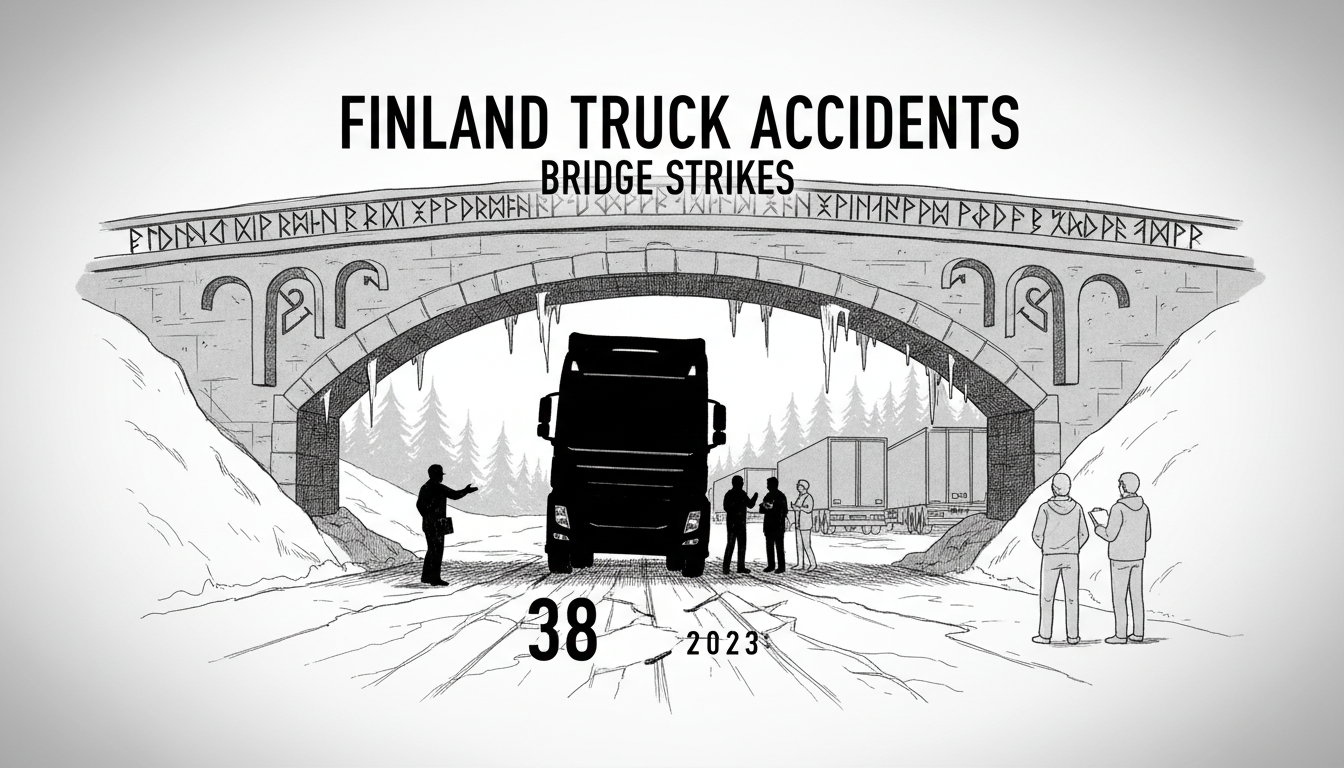
Finland’s latest truck and bridge collision occurred Tuesday afternoon, when a lorry with its cargo bed raised smashed into a railway overpass on Regional Road 637 in Leppävesi, Laukaa. Markus Moilanen, the on-duty fire chief, reported the impact left only minor contact marks, describing the damage as ‘small dents’ that did not compromise the structure of the bridge. This seemingly minor incident near Jyväskylä is part of a persistent national trend, with the Finnish Transport Infrastructure Agency (FTIA) recording 38 bridge strikes by road vehicles across the country last year alone.
A Glancing Blow on a Regional Route
The collision happened at Pieleslehto, close to the municipal border of Jyväskylä and Laukaa. Emergency services were initially alerted to a potential oil spill, but responders found only a minimal amount of asphalt contaminant. By the time rescue units arrived on scene, the truck involved had already departed. ‘The vehicle appears to have hit the bridge, but there were no structural damages,’ Moilanen stated in his assessment. Authorities confirmed the railway bridge remained fully operational, avoiding any disruption to train services—a critical concern given Finland’s reliance on rail freight for forestry and industrial products.
While this event concluded without serious consequence, it underscores a recurring vulnerability in transport logistics. Bridge strikes, often involving trucks with elevated trailers or containers, pose risks ranging from traffic delays to catastrophic structural failure. Each incident triggers mandatory safety inspections by the FTIA, diverting resources and potentially closing vital routes. The cost of these collisions is multifaceted, encompassing immediate repair bills, long-term infrastructure monitoring, and significant economic ripple effects from delayed goods and passenger travel.
Finland's Framework for Road and Rail Safety
Finnish authorities maintain a stringent regulatory environment to prevent such accidents. Clearance heights are prominently posted on bridges, and commercial vehicle operators bear legal responsibility for knowing their load dimensions. The Finnish Police and the Finnish Transport and Communications Agency (Traficom) conduct roadside checks targeting vehicle dimensions and load security. Despite these measures, human error—a moment of distraction, a misjudged route, or a failure to lower an empty tipping trailer—remains a prevalent factor.
Finland’s infrastructure, particularly its road network in regions like Central Finland, is a lifeline for the economy. Roads like Seututie 637 are essential connectors for local industries, making their uninterrupted use a priority. The country’s rail bridges are built to high durability standards, designed to withstand considerable force, which likely contributed to the minimal damage sustained in the Laukaa incident. However, experts consistently warn that no structure is impervious to repeated impacts, and even superficial damage can accelerate wear or mask deeper stress fractures.
Expert Analysis on a Persistent Problem
‘Every bridge strike is a warning sign,’ says Dr. Elina Saarelainen, a transport infrastructure researcher at Aalto University. ‘The direct structural damage might be negligible in a single event, as we see here. The larger issue is the cumulative effect on specific bridges located on common freight routes and the ever-present risk of a more severe collision.’ Saarelainen points to integrated technological solutions gaining traction elsewhere in the Nordics, such as mandatory pre-journey height checks via onboard systems and enhanced GPS routing for trucks that automatically avoids routes with low clearances.
From a policy perspective, the incident enters the data pool monitored by Trafi and the Ministry of Transport and Communications. While Finland’s overall road safety record is strong within the EU, targeted reductions in specific accident types are a continual focus. Parliamentary committees have previously reviewed proposals for stricter penalties for drivers and firms responsible for bridge strikes, framing them not just as traffic violations but as threats to national infrastructure security. The Finnish government’s current strategic transport plan emphasizes ‘resilient connectivity,’ which inherently requires protecting key nodes like bridges from avoidable damage.
The Ripple Effects of a Near-Miss
The Laukaa near-miss had several fortunate outcomes: no injuries, no major pollution, no rail disruption, and no need for immediate costly repairs. Yet it serves as a case study in potential ‘what-ifs.’ Had the bridge been older or of a different design, the outcome could have involved a lengthy closure of both the road below and the rail line above. The resulting logistical chaos would have impacted commuters, school buses, and freight shipments across the region.
For local municipalities and the FTIA, the process following any strike is procedural but vital. Engineers will conduct a detailed inspection of the bridge’s abutments, girders, and deck. This data feeds into national maintenance models and helps identify hotspots where additional signage, improved road design, or driver education campaigns might be needed. In a country where winter conditions and limited daylight for much of the year already challenge drivers, eliminating preventable errors like forgetting a raised load becomes paramount.
A Call for Integrated Solutions
Finland’s transport ecosystem is a complex interplay between private logistics companies, public infrastructure agencies, and regulatory bodies. Preventing the next bridge strike requires action across this chain. Logistics associations advocate for more training, while technology firms promote sensor-based alert systems for cab interiors. Meanwhile, infrastructure agencies must balance the cost of physical interventions—like installing protective beam barriers in front of bridges—against the statistical risk at thousands of locations nationwide.
The Leppävesi incident, though minor, is a stark reminder that infrastructure safety is an active, not a passive, endeavor. It relies on the constant vigilance of drivers, the proactive planning of firms, and the resilient engineering of the bridges themselves. As Finland continues to develop its bioeconomy and export sectors, ensuring the smooth and safe flow of truck-borne goods will only grow in importance. The question for policymakers is whether the current mix of regulation, enforcement, and technology is sufficient, or if the 38 strikes recorded last year represent 38 arguments for a more aggressive preventative strategy. The next strike might not be so forgiving.