
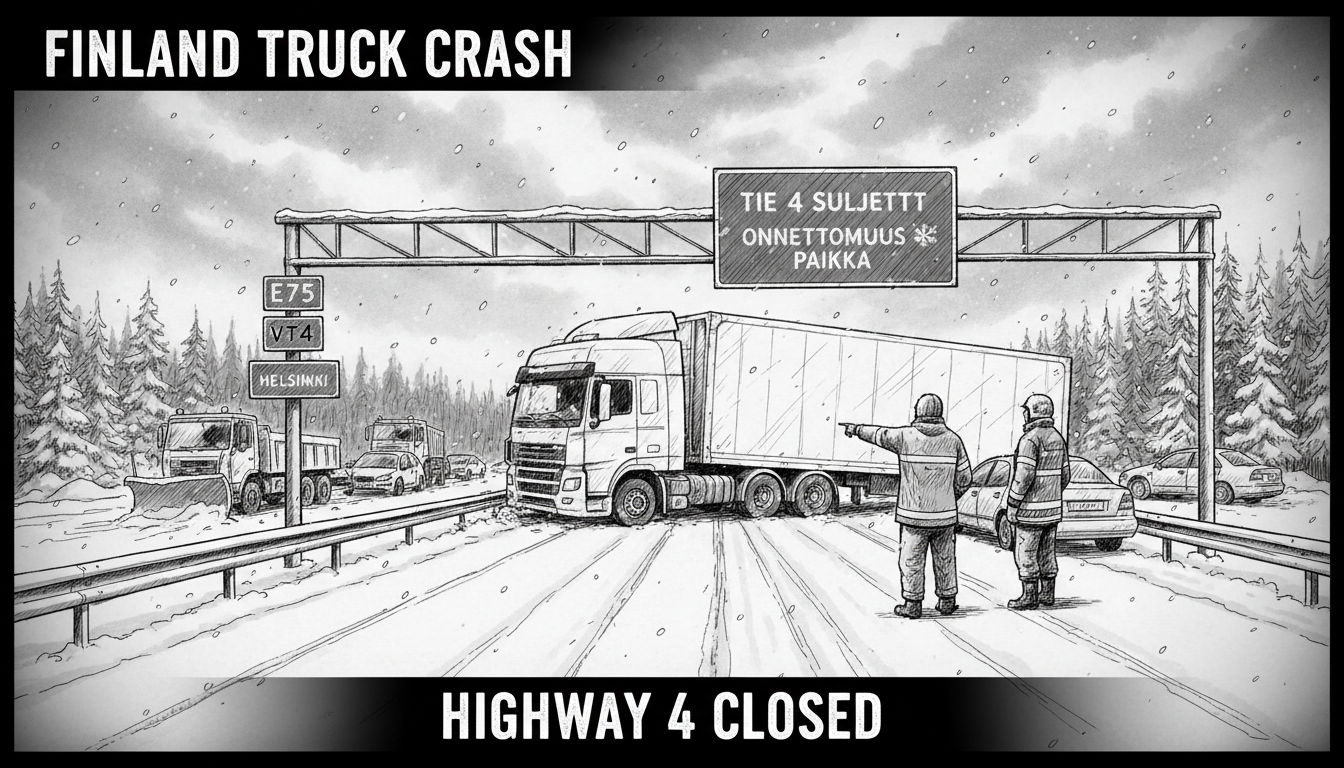
Finland's Highway 4 faced severe disruption early Monday after a cargo truck carrying window panes veered into a ditch near Viitasaari. The incident occurred just before 4:00 AM on the crucial E75 European route, prompting immediate emergency response and expected prolonged traffic delays. Recovery operations for the specialized load have commenced, with authorities warning motorists to seek alternative routes throughout the day. This accident on a central arterial road highlights persistent challenges in Nordic transport logistics and road safety enforcement.
Early Morning Crash Halts Major Artery
Police and rescue services were dispatched to the scene in Viitasaari municipality following reports of the heavy goods vehicle leaving the roadway. The truck, transporting a full load of fragile window glass, came to rest in a roadside ditch. No other vehicles were involved, and initial reports indicate the driver sustained only minor injuries. The precise cause remains under investigation by Keski-Suomen police district. Highway 4, known as Nelostie, is a vital north-south corridor connecting Helsinki to Lapland, making any closure significant for national and international freight movement.
Traffic management centers issued alerts via national systems, rerouting long-haul trucks and passenger vehicles onto secondary roads. The Finnish Transport Infrastructure Agency (FTIA) confirmed that recovery would require heavy cranes due to the cargo's nature and the vehicle's position. Cleanup of shattered glass from the roadway adds complexity to reopening procedures. This section of the E75 sees substantial commercial traffic, including transport to and from the Baltic region, amplifying the economic ripple effects of such an incident.
Recovery Efforts and Traffic Implications
Nostotyöt, or lifting operations, began at first light but are projected to extend into the afternoon peak hours. Specialized equipment is needed to secure and remove the undamaged window panes before the truck itself can be extracted. FTIA officials stated that one lane might reopen sooner, but full capacity restoration depends on the stability of the roadside embankment. Commuters between Central Finland and Northern Savonia regions are experiencing detours adding up to 50 kilometers to their trips.
Local businesses in Viitasaari are monitoring the situation, concerned about delivery delays and access for customers. The accident site is near several industrial areas, heightening the impact on just-in-time supply chains. Finnish logistics associations have echoed these concerns, noting that Highway 4 is a critical link for the construction sector, which relies on timely material deliveries. The window pane shipment, likely destined for a major building project, now represents a costly delay and potential insurance claim.
Analyzing the Causes: Fatigue and Regulation
Traffic safety experts point to the early morning timing as a key factor for investigation. Professor Liisa Hakamäki from the University of Helsinki's Transport Research Unit emphasizes the risks associated with driver fatigue during pre-dawn hours. "The period between 2:00 AM and 6:00 AM is statistically high-risk for solo commercial drivers, especially on long, monotonous stretches like Highway 4," Hakamäki said. She links this to EU-mandated driving hour rules, which Finland enforces through digital tachographs and regular inspections.
Finland's Ministry of Transport and Communications has consistently advocated for stricter enforcement of the EU's Mobility Package regulations. The current government coalition, led by Prime Minister Petteri Orpo, included infrastructure resilience in its strategic program. However, opposition MPs from the Left Alliance have criticized recent budget allocations for road maintenance as insufficient. Data from Trafi, the Finnish Transport and Communications Agency, shows that single-vehicle run-off accidents constitute approximately 18% of all serious truck incidents on Finnish highways annually.
EU Directives and Finnish Policy Responses
This accident occurs against the backdrop of the European Commission's Road Safety Policy Framework 2021-2030, which aims to halve serious injuries by 2030. Finland, as a member state, is required to implement specific safety measures on its Trans-European Transport Network (TEN-T) roads, which include Highway 4. The Eduskunta's Transport and Communications Committee recently debated a proposal to increase investment in roadside barrier systems on high-risk segments. That proposal is tied to broader EU cohesion funding for peripheral regions.
Transport Minister Lulu Ranne could address the incident in upcoming parliamentary questions. Her office has previously highlighted the integration of EU Directive 2019/1936 on road infrastructure safety management into national law. The directive mandates systematic safety assessments for roads like the E75. Finland's response includes the ongoing 'Safe Roads 2025' program, which targets a 10% reduction in fatal accidents on national highways. Critics argue that program funding has not kept pace with inflation, potentially slowing the rollout of improved signage and road geometry corrections.
Supply Chain and Economic Consequences
The disruption exposes vulnerabilities in Finland's freight network, particularly for specialized cargo. Jari Kukkonen, a logistics analyst with the Confederation of Finnish Industries, notes that window glass transport requires precise scheduling to match manufacturing and construction timelines. "An accident like this doesn't just delay one truck. It can stall entire production lines at glass factories and halt construction sites awaiting materials," Kukkonen explained. He estimates that a 12-hour closure on Highway 4 can generate six-figure economic losses across interconnected sectors.
Finnish glass manufacturers, such as Glaston Finland, operate on tight margins and depend on reliable road transport. The accident may prompt renewed calls from industry groups for government investment in alternative rail freight capacity along the Helsinki-Oulu corridor. The Ministry of Economic Affairs has been evaluating such proposals, but decisions are pending broader coalition negotiations on climate and transport budgets. This incident could strengthen the case for diversifying transport modes to mitigate road dependency.
Looking Ahead: Infrastructure and Safety Investments
As recovery crews work to clear the scene, the long-term question revolves around preventing similar accidents. The FTIA's latest infrastructure report identifies several segments of Highway 4 in Central Finland as candidates for widening or safety upgrades. Funding these projects requires approval from the Eduskunta, where debates often center on regional equity versus national priorities. The Central Finland region has lobbied for years to secure priority status for Highway 4 improvements, citing increasing traffic volumes and safety records.
Future safety measures may include more dynamic signage warning of fatigue risks, expanded rest area facilities for truckers, and enhanced road surface monitoring. These align with EU-funded research projects Finland participates in, such as the Nordic Safe Roads initiative. The ultimate test will be whether political consensus can translate into actionable and funded infrastructure plans. For now, the focus remains on restoring normal traffic flow on a highway that serves as Finland's backbone, reminding all stakeholders of the constant balance between mobility and safety.