
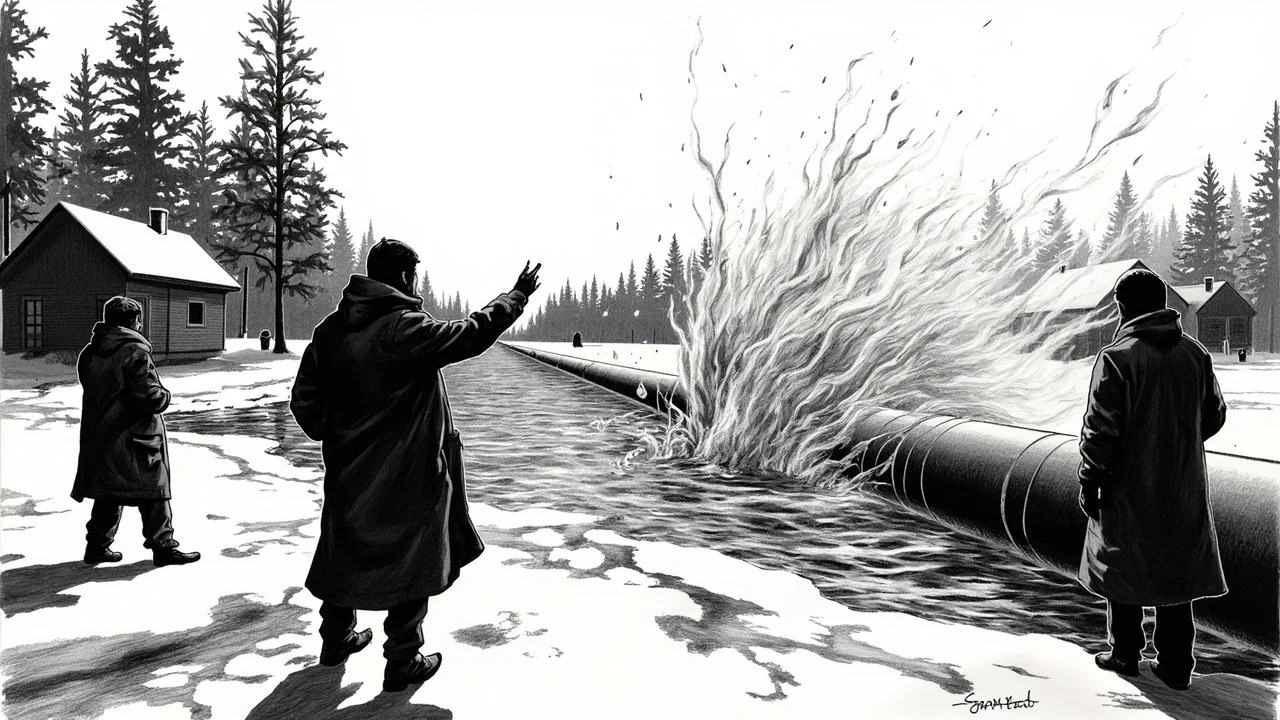
Finland's water infrastructure faced a localized but telling crisis on Friday as a second major pipe rupture in one day cut off supply to residents in the city of Kouvola. The break on Helantie street in the Niskala district, announced by the municipal utility Kouvolan Vesi in the evening, followed an earlier morning rupture in the Käpylä neighborhood, highlighting vulnerabilities in aging networks across the country.
Residents at Helantie 2 and 3, and Niskalantie 174, 170, and 163 found themselves without running water from approximately 7 p.m. The utility stated service would be restored immediately after repair work concluded, but the incident forced households to adapt rapidly. This double failure in a single day within one midsize Finnish city raises pointed questions about the state of national waterworks, often considered a benchmark of reliable public service.
A Friday of Disruptions
The day's troubles began in Kouvola's Käpylä district, where a water main leak triggered a supply cut during the morning hours. Crews worked through the day to resolve that initial rupture, only for a second, separate failure to occur hours later in Niskala. While each incident affected a limited number of properties, their proximity in time within the same municipal area is statistically unusual for Finland's generally robust systems. These networks, built during periods of rapid urbanization in the mid-to-late 20th century, are now entering critical decades where material fatigue becomes more common.
Local utilities like Kouvolan Vesi operate under significant pressure to maintain continuous service despite tightening municipal budgets. The repairs involve not just fixing the broken pipe segment but also comprehensive flushing of the system. Sediment and rust dislodged by the pressure change can cloud the water and stain laundry, a common post-disruption nuisance. The utility advises residents to run cold taps until the water runs clear, a process that can take several minutes and wastes significant volumes of treated water.
The Hidden Cost of Aging Networks
Finland's water and sewage infrastructure represents a massive, mostly buried public asset. The Association of Finnish Local and Regional Authorities estimates the replacement value of the country's water networks exceeds 20 billion euros. Annual renovation rates, however, lag behind the pace of deterioration in many municipalities. A 2021 report by the Finnish Water Utilities Association noted that while water quality remains excellent, the condition of the pipe network is a growing concern, with leakage rates indicating systemic wear.
"When you have two significant breaks in one day in a smaller city, it's not a coincidence; it's a symptom," said a municipal infrastructure engineer who requested anonymity as they were not authorized to speak publicly. "We are managing failures reactively. The investment needed for proactive, preventive replacement is enormous, and it competes with every other social and educational priority in the municipal budget. The pipe is out of sight, and until it breaks, it's out of mind for many policymakers."
This reactive maintenance model carries hidden costs. Emergency repair crews require overtime pay, traffic disruptions impact local businesses, and the water lost from breaks represents wasted energy used for purification and pumping. For residents, the inconvenience is immediate. The loss of water halts cooking, cleaning, and sanitation, a stark reminder of modern society's dependence on this invisible utility.
Health Advisory and Household Impact
In its communications, Kouvolan Vesi moved quickly to address public health concerns. The utility confirmed that while discoloration or cloudiness might occur, the water quality deviations were not dangerous to health. The primary risks are practical and economic: sediment can clog faucet aerators and washing machine filters, leading to appliance damage and costly repairs. Brownish water can also ruin a load of light-colored laundry, a small but frustrating financial loss for households.
The standard advice is to avoid using hot water first, as it can draw sediment from the heater tank, and to flush the system through the cold tap closest to the main water intake. This process, however, assumes a level of practical knowledge not all residents possess. For elderly or vulnerable populations, even a short water cutoff can pose a significant challenge, disrupting medication routines or hygiene practices.
A National Challenge with Local Solutions
Finland's water management is highly decentralized, with over 300 water utilities serving municipalities and regions. This local control allows for tailored solutions but can lead to disparities in investment and maintenance standards. Wealthier municipalities may keep pace with renewal projects, while others with shrinking populations and tax bases defer essential work. The Ministry of Agriculture and Forestry, which oversees water services, promotes cooperation between utilities to improve efficiency, but fundamental funding issues remain.
Climate change adds another layer of complexity. More frequent freeze-thaw cycles in winter and periods of ground subsidence during dry summers place additional stress on buried pipes. The infrastructure designed for the stable conditions of the past may be increasingly vulnerable to new weather patterns. This environmental pressure turns a simple maintenance issue into a long-term climate adaptation challenge, requiring forward-looking investment strategies that are difficult to enact.
Looking Beyond the Repair
The Friday breaks in Kouvola will be fixed, likely within hours. The visible hole in the street will be filled and repaved. For the affected residents, life will return to normal. Yet for municipal engineers and planners, these incidents are data points in a worsening trend. The debate is not about if pipes will fail, but where and when, and how to finance their systematic replacement before they do.
Some Nordic neighbors are experimenting with new models. In parts of Sweden, municipalities use advanced acoustic sensors to listen for leaks in networks, allowing for repairs before a catastrophic rupture. Other regions are investigating more durable pipe materials for replacements. These solutions require capital, which forces a public conversation about the value of reliability. Are citizens and politicians willing to pay higher water rates or taxes today to fund the renewal of infrastructure for the next generation?
The events in Kouvola serve as a microcosm of a quiet crisis facing many developed nations. The gleaming surface of modern society—the schools, hospitals, and digital networks—relies entirely on a foundation of aging concrete, brick, and iron. When that foundation cracks, the disruption is a powerful reminder that sustainability requires constant, unglamorous investment. The water will flow again in Niskala, but the question of how to keep it flowing reliably for decades to come remains unanswered, bubbling beneath the surface of Finnish cities and towns.