
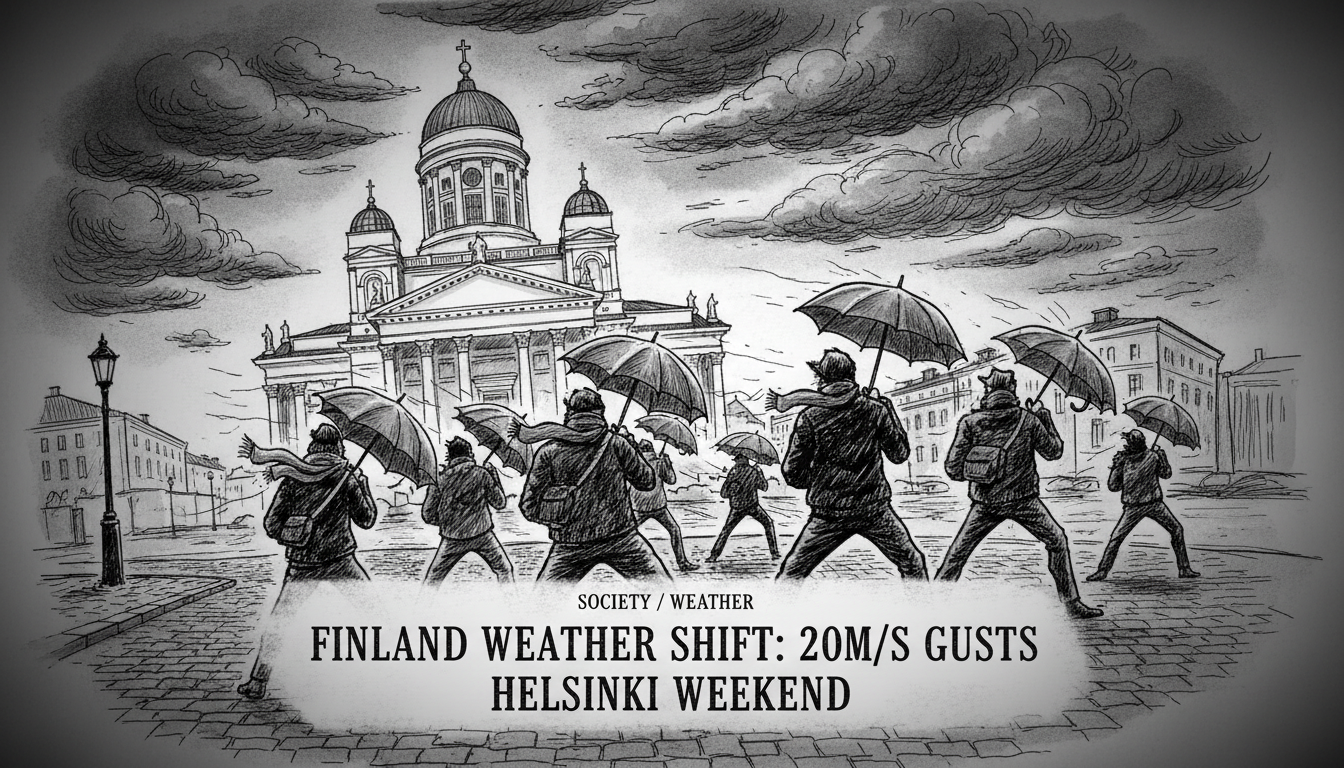
Finland's Helsinki metropolitan area braces for a dramatic weather reversal this weekend, with wind gusts up to 20 meters per second and a volatile mix of precipitation expected. The abrupt change from recent mild conditions underscores the region's climatic vulnerability and tests the public safety frameworks managed by Finnish authorities. As the Finnish Meteorological Institute (Ilmatieteen laitos) issues its forecasts, the event highlights the ongoing need for effective communication and infrastructure resilience in the face of increasingly unpredictable patterns.
A Rapid Meteorological Reversal
The contrast could not be starker. While St. Stephen's Day brought sunshine to Helsinki, the coming hours promise a turbulent shift. Meteorologist Jari Tuovinen from the state-run Finnish Meteorological Institute states the situation plainly. 'But from there, anything could come from the sky,' Tuovinen said, summarizing the forecast for Saturday evening. The institute predicts a swift transition from relatively mild conditions Saturday morning to strengthening westerly and northwesterly winds by nightfall. These gusts, potentially reaching 20 meters per second, will drive fast-moving showers of rain, sleet, or snow across the capital region. Any snowfall is expected to melt quickly upon contact with the still-warm ground, but the primary hazards remain high winds and rapidly changing road conditions.
This precise forecasting is a core public service funded by the Finnish government, operating under the Ministry of Transport and Communications. The Institute's warnings are disseminated through national channels and directly inform the decision-making of municipal crisis management teams in Helsinki, Espoo, Vantaa, and surrounding areas like Tuusula. The accuracy of these predictions is critical for transport agencies, energy providers, and emergency services, which activate response plans based on such alerts.
Government Readiness and Public Safety Protocols
The unpredictable weekend weather places immediate focus on Finland's civil protection apparatus, coordinated by the Ministry of the Interior. Finland's approach to severe weather events is embedded in the Rescue Act, which mandates preparedness at both national and local levels. 'Our systems are designed for rapid response to precisely these kinds of short-notice natural events,' noted a senior official from the Ministry's Rescue Department in a background briefing. While no widespread emergencies are anticipated, the gusty winds necessitate vigilance. The Finnish Transport Infrastructure Agency monitors road and rail networks, while Helsinki's city emergency services remain on standby for potential disruptions.
This event, though minor in scale, serves as a practical drill for larger crises. The Finnish Parliament's (Eduskunta) ongoing committee work frequently reviews funding for the Meteorological Institute and disaster response capabilities. In recent budget debates, MPs from across the spectrum have emphasized maintaining strong forecasting tools as a non-negotiable element of national security. The coalition government, led by Prime Minister Petteri Orpo, has consistently backed investments in the Institute's radar and satellite data analysis systems, which are vital for tracking fast-moving squalls like those forecast for Saturday night.
The Broader Climate Context and EU Policy Links
Beyond the immediate forecast, such volatile weather episodes resonate within wider European climate discussions. Finland, as an EU member state, contributes data to the Copernicus Climate Change Service and aligns its national adaptation strategies with the EU's Green Deal objectives. Increasing frequency of rapid weather shifts—from mild intervals to harsh conditions—correlates with broader models of climate change affecting the Baltic Sea region. 'What we see in the Gulf of Finland is consistent with broader patterns of atmospheric instability,' explained a climate researcher affiliated with the University of Helsinki, pointing to the mixing of maritime and continental air masses that define Finnish weather.
The European Environment Agency's latest assessments indicate that Nordic countries face heightened risks from extreme wind and precipitation events. Finland's national climate policy, debated intensely in the Eduskunta, includes measures for strengthening infrastructure against such threats. EU cohesion funds have partially financed upgrades to coastal and urban drainage systems in the Helsinki region, a fact often cited by Finnish MEPs in Brussels negotiations. This weekend's weather, while not extreme, is a tangible example of the phenomena that these policies aim to mitigate over the long term.
Practical Impacts and Resident Advisories
For residents of the capital region, the meteorological details translate into direct consequences. The strong winds forecast for Saturday evening pose risks for loose outdoor items, temporary structures, and travel. The Finnish Meteorological Institute advises that showers may last only ten minutes but could occur multiple times throughout the night. 'Those aiming to stay dry should venture outside during the daytime,' Tuovinen recommended, offering practical guidance that stems from the Institute's public service mandate. Between Saturday night and Sunday, temperatures are expected to drop below freezing, creating a risk of icy patches on roads and walkways by morning.
Local authorities in Helsinki and neighboring municipalities typically issue their own advisories based on the national forecast, often through social media and local news outlets. The consistency of messaging between state institutes and city officials is a key component of Finland's well-regarded safety governance. By Sunday, conditions are expected to ease, with winds slowing and sunshine returning, but the interim period demands public awareness. This cycle of alert and recovery is a routine but essential function of the Finnish state's interaction with its citizens.
Analyzing the Political and Infrastructural Response
From a political correspondent's perspective, weather events like this weekend's forecast act as a stress test for administrative coordination. The seamless flow of information from the Finnish Meteorological Institute to the Ministry of the Interior and down to local rescue services exemplifies the Finnish model of integrated risk management. It is a system built on decades of refinement, often reviewed in parliamentary committees like the Administration Committee and the Transport and Communications Committee. Recent government reports have highlighted the importance of maintaining this infrastructure, especially as climate change may increase the frequency of similar unpredictable weather patterns.
Opposition parties, including the Social Democrats and the Green League, have used previous budget sessions to argue for even greater investment in climate adaptation and early warning systems. Their scrutiny ensures that weather preparedness remains a visible political issue, not just a technical one. The performance of the Meteorological Institute this weekend will be noted by policymakers in Helsinki's government district, where long-term funding decisions are made. In essence, a forecast for wind and showers in Tuusula is intimately connected to broader debates about resilience, public spending, and Finland's strategic priorities within the European Union.
Looking Ahead: Resilience in an Unpredictable Climate
As Finland navigates this weekend's weather, the episode reinforces a critical reality: the nation's security encompasses not just defense but also environmental vigilance. The work of the Finnish Meteorological Institute, supported by stable government funding and EU collaboration, provides the first line of defense against natural hazards. Residents tuning in for the Helsinki weekend weather update are accessing a service that is both scientific and fundamentally political, underpinned by legislative decisions made in the Eduskunta.
The coming days will show how effectively forecasts translate into public behavior and institutional response. With temperatures dipping below freezing after the winds pass, the focus may shift to road maintenance and energy consumption—another set of challenges for local and national governance. As climate patterns evolve, the integration of meteorological expertise into policy planning will only grow in importance. For now, the message from officials is clear: monitor updates, secure loose objects, and be prepared for anything from the sky—a succinct reminder of Finland's pragmatic approach to the forces of nature.