
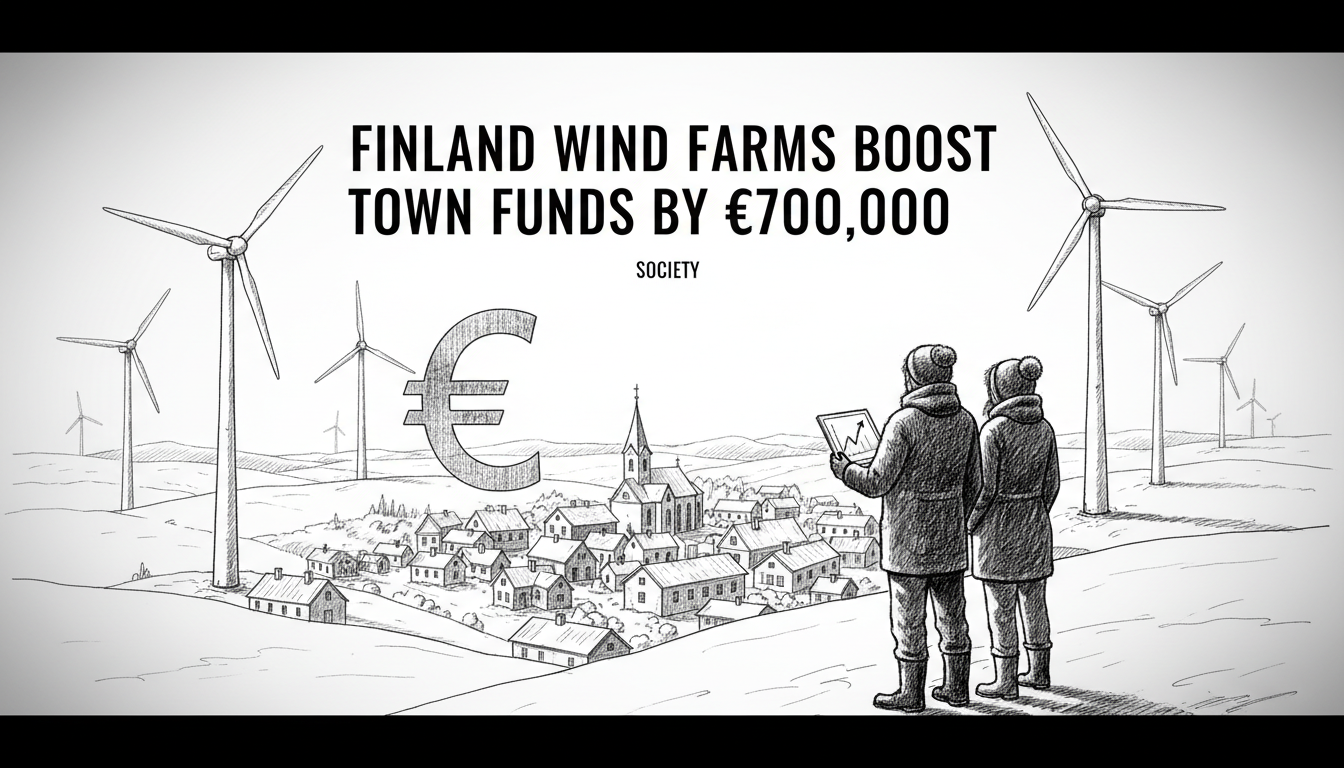
Finland's small municipality of Karstula is projecting a remarkable budget surplus of nearly one million euros this year, driven by a single transformative force: wind power. The municipal government has announced that tax revenues for 2025 are exceeding original estimates by approximately 700,000 euros, a direct result of property tax income from newly operational wind farms in the region. This unexpected financial windfall is reshaping the economic prospects for this Central Finland community and providing a compelling case study for the local impact of Finland's green energy transition.
Karstula's municipal board is now proposing a strongly surplus-based budget of 778,000 euros for 2026, building on an estimated 956,000-euro surplus for the current year. These figures represent a dramatic turnaround for many rural Finnish municipalities, which often grapple with tightening finances due to aging populations and rising service costs. The core of this change lies in the completion of new wind power parks, whose turbines and infrastructure have become significant contributors to the municipal tax base through property taxation.
A Rural Municipality's Fiscal Transformation
Karstula, with a population of around 4,000, exemplifies the challenges and opportunities facing rural Finland. Municipalities here hold extensive responsibilities, providing education, healthcare, social services, and infrastructure. Their primary funding comes from municipal income tax, state subsidies, and property tax. For years, many have faced declining or stagnant revenues. The influx from wind power directly addresses this pressure point. The 700,000-euro increase is not from income or corporate taxes but specifically from property tax (kiinteistövero), a levy on land and buildings where the municipality sets the rate within a national framework.
This revenue stream is particularly valuable because it is stable and predictable, tied to the physical assets of the wind farms. 'The increase in property tax revenue significantly improves the budget outlook for 2026 as well,' the municipal government noted in its statement. This allows for long-term financial planning that was previously more difficult. While the average municipal tax rate in Finland is around 20%, property tax rates vary. The substantial valuation of modern wind turbines and their associated land use creates a potent new source of income for the host municipality.
The Mechanics of the Wind Power Dividend
How does a wind farm translate into municipal cash? In Finland, when a wind energy project is built, the turbines, foundations, transformer stations, and other permanent structures are assessed for their taxable value. The municipality then collects an annual property tax based on this value. For a large-scale wind park comprising multiple turbines, the total taxable property value can run into tens of millions of euros. Even at a modest property tax rate, this generates substantial annual revenue.
This model provides a direct financial incentive for municipalities to host renewable energy projects. It turns a national climate goal into a tangible local benefit, funding schools, elderly care, road maintenance, and other public services. The case of Karstula demonstrates that the energy transition can have a pronounced positive impact on public finances in the regions where infrastructure is built, not just for the energy companies and national grids.
A Model for Rural Finland?
Karstula's experience is being closely watched across Finland, especially in regions with suitable wind conditions. Many smaller municipalities are actively seeking to attract wind power investment as a strategic tool for economic development and fiscal stability. This aligns with the Finnish government's ambitious targets to increase clean energy production and achieve carbon neutrality. The situation creates a potential win-win: the nation gains more renewable energy, and rural communities gain a stronger financial foundation.
However, the phenomenon is not without its complexities and debates. Some communities have raised concerns about landscape impact, noise, and effects on tourism or property values. The financial benefit, therefore, becomes a central part of the local political discussion, weighing immediate economic gains against other community priorities. Karstula's clear budgetary improvement will likely be cited by proponents in other areas as evidence of the concrete advantages.
Expert Perspective: A Boon with Caveats
Political and economic analysts note that Karstula's story highlights a significant trend. 'Wind power projects can be a powerful tool for revitalizing the finances of smaller municipalities,' says one expert familiar with regional development. 'This provides direct, long-term revenue that can help sustain vital public services in areas facing demographic challenges.'
Yet, experts also inject a note of caution. Relying heavily on a single revenue source, even one as stable as property tax from wind infrastructure, carries inherent risks. Changes in national energy policy, shifts in market subsidies, or technological disruptions could affect the long-term valuation or operation of these assets. Municipalities are advised to treat such windfalls as an opportunity to strengthen their overall economic resilience, perhaps by investing in broadband, business parks, or education, rather than simply increasing recurring operational spending.
Furthermore, the distribution of these benefits is not uniform. Municipalities with high wind resources stand to gain, while others do not, potentially widening the economic gap between different rural areas. This raises questions for national policymakers about how to ensure a fair transition and support all regions in the shift to a green economy.
The Road Ahead for Karstula and Green Energy
The immediate future for Karstula looks financially secure. The projected surpluses for 2025 and 2026 provide a buffer and create opportunities. The municipal council must now decide how to allocate these resources. Options could include lowering the municipal income tax rate, investing in one-off infrastructure projects, boosting service quality, or creating a stabilization fund for future years. The decision will reflect the local political priorities and the community's long-term vision.
On a national scale, the success story reinforces the Finnish model of municipal autonomy in taxation and planning. It shows how local governments can directly benefit from the green transition when the fiscal frameworks are correctly aligned. As Finland continues to expand its wind power capacity, both onshore and offshore, the experiences of municipalities like Karstula will be critical in shaping public acceptance and local political support for new projects.
The question now is whether this model can be replicated and scaled, turning Finland's climate ambitions into a widespread engine for regional development and fiscal health across its rural heartlands.