
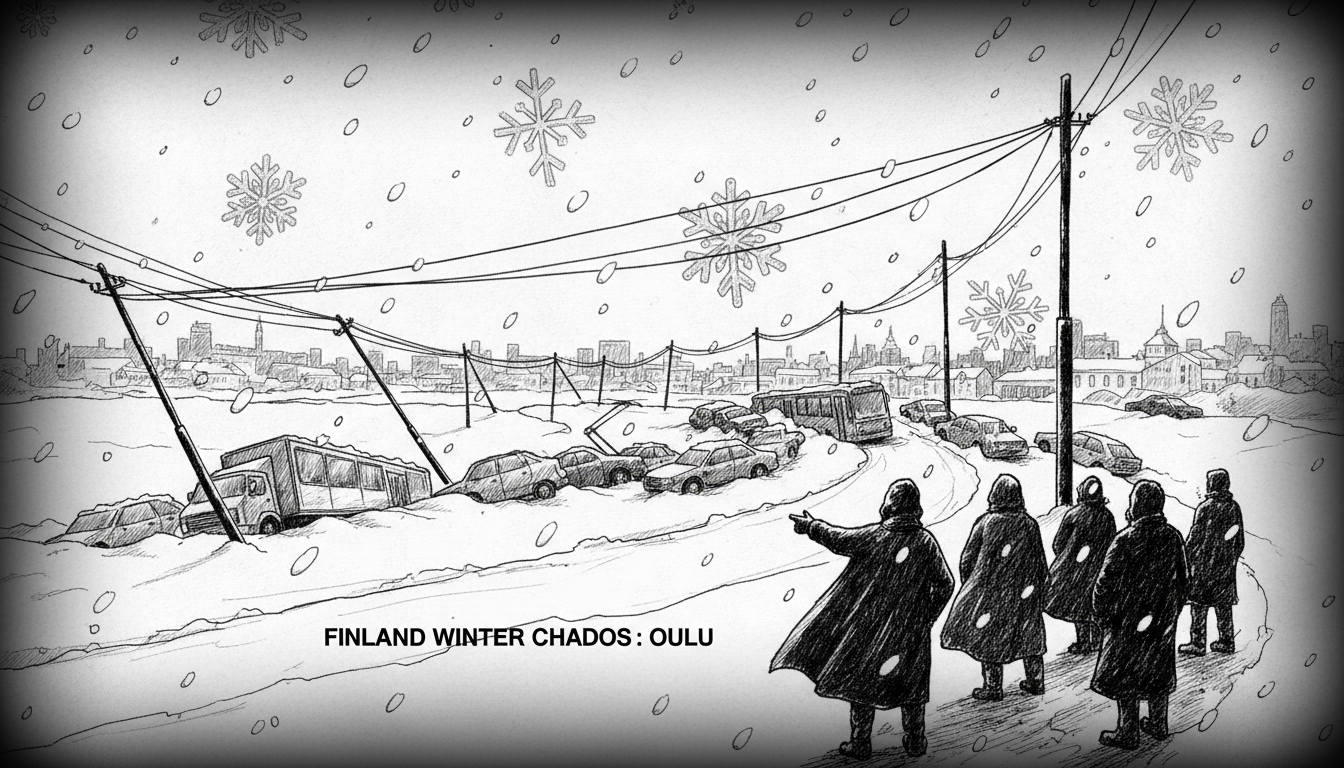
Finland winter driving turned treacherous in Oulu overnight as police reported a series of serious accidents on icy roads, with officers stating some crashes by young drivers were effectively 'ordered' through reckless behavior. Multiple vehicles lost control at high speeds, ending up in ditches, with at least two cars rolling over. Remarkably, police confirmed no serious injuries resulted from the incidents, which included collisions with lamp posts and low-speed ditch departures amid poor visibility and slushy conditions.
A Night of Controlled Chaos
Oulu Police Department's area became a scene of repeated vehicular drama during the night. Road surfaces were extremely slippery, with blowing snow reducing visibility in places and slush creating additional hazards. In their official statement, police highlighted the severity of some incidents. 'More serious accidents occurred when drivers lost control of their vehicles at speeds of around 80 kilometers per hour,' the statement read. 'Several cars ended up in ditches at high speed.'
The description of specific crashes was vivid. At least two vehicles came to rest on their roofs on the roadside. One of these was reported to have rolled over three times. Despite the dramatic nature of the accidents, authorities confirmed that serious personal injuries were avoided—a fact attributed partly to luck and the safety standards of modern vehicles. Emergency services also responded to reports of rear-end collisions at intersections, vehicles sliding into lamp posts, and ditch departures at lower speeds.
The Alarming Concept of 'Ordered' Accidents
The most striking comment from police concerned the cause of some incidents, particularly those involving younger motorists. Police stated that a portion of the accidents involving young drivers were 'so-called ordered.' They elaborated: 'Cars were played with and slid around for so long that the vehicle eventually ended up at the bottom of a ditch or the journey came to an abrupt halt against a lamppost.' This terminology points to deliberate risk-taking, where drivers actively test limits on hazardous roads until a loss of control becomes inevitable.
This behavior occurs against a sobering statistical backdrop. In 2022, Finland recorded 3,345 road accidents involving personal injury. Young drivers are statistically overrepresented in traffic accidents nationwide, a trend that intensifies under challenging winter conditions. Contributing factors like speeding, impaired driving, and fatigue are major concerns for traffic safety experts year-round.
Expert Analysis: Why Winter Demands Respect
Traffic safety professionals consistently emphasize a core set of principles for Finnish winter driving. The mandatory use of winter tires—often studded in northern regions like Oulu—is just the starting point. 'On poor driving conditions, it is especially important to ensure appropriate speeds for the situation and safe following distances,' Oulu police reminded the public in their statement. This advice forms the bedrock of official safety campaigns.
Driver education in Finland incorporates specific training for winter conditions, teaching techniques for controlling skids and understanding how ice and snow affect braking distances. Experts stress that speed limits are set for ideal conditions; appropriate 'situational speed' can be significantly lower. Increased following distance is critical, as stopping power is drastically reduced. Avoiding distractions is paramount, requiring full attention on the evolving road surface.
Oulu's Arctic Driving Reality
The location of these crashes is a key part of the story. Oulu is a major city in northern Finland, situated near the Arctic Circle. This geographic position makes it prone to severe and rapidly changing winter weather. Conditions can shift from clear to whiteout within minutes, and ice forms readily. The Finnish government invests heavily in road maintenance, including plowing and salting, but nature often outpaces these efforts, especially during active snowfall or freezing rain.
Local drivers possess experience, but this can sometimes lead to overconfidence. The phenomenon of 'ordered' accidents suggests a familiarity that breeds contempt for the conditions. Playing with a vehicle's limits on an empty, icy road might seem like controlled fun, but it ignores the unpredictable variables—a hidden patch of black ice, a sudden gust of wind, or an unexpected obstacle.
The Bigger Picture of Finnish Road Safety
Finland's approach to traffic safety is globally respected, yet winter remains its greatest adversary. The government's investment in road maintenance and public safety campaigns is a continuous effort to mitigate risks inherent to the climate. These campaigns target key behaviors: the necessity of winter tires, the dangers of even moderate speeds on ice, and the lethal mix of alcohol and driving.
The overnight events in Oulu serve as a microcosm of the national winter challenge. They showcase both the effectiveness of safety systems—evidenced by the lack of serious injuries despite dramatic crashes—and the persistent human element of risk. Technology like electronic stability control and robust vehicle safety cages protects drivers from the consequences of mistakes, but it cannot eliminate poor judgment.
A Warning as Winter Deepens
As the winter season continues, the incidents near the Arctic Circle stand as a stark warning. They highlight the thin line between skilled winter driving and dangerous overconfidence. The police's unusual phrasing—'ordered accidents'—is a deliberate attempt to reframe reckless behavior not as a mistake, but as a deliberate choice with a predictable, purchased outcome.
The takeaway for drivers across Finland and in similar climates is clear: respect for winter conditions is non-negotiable. Appropriate tires, situational speed, ample distance, and undivided attention are the essential tools. As one traffic safety expert not involved in the Oulu response noted, 'The winter road does not forgive. It treats a moment of inattention or a calculated risk exactly the same way—with a loss of control.' The empty ditches and scarred lamp posts in Oulu are this season's proof.