
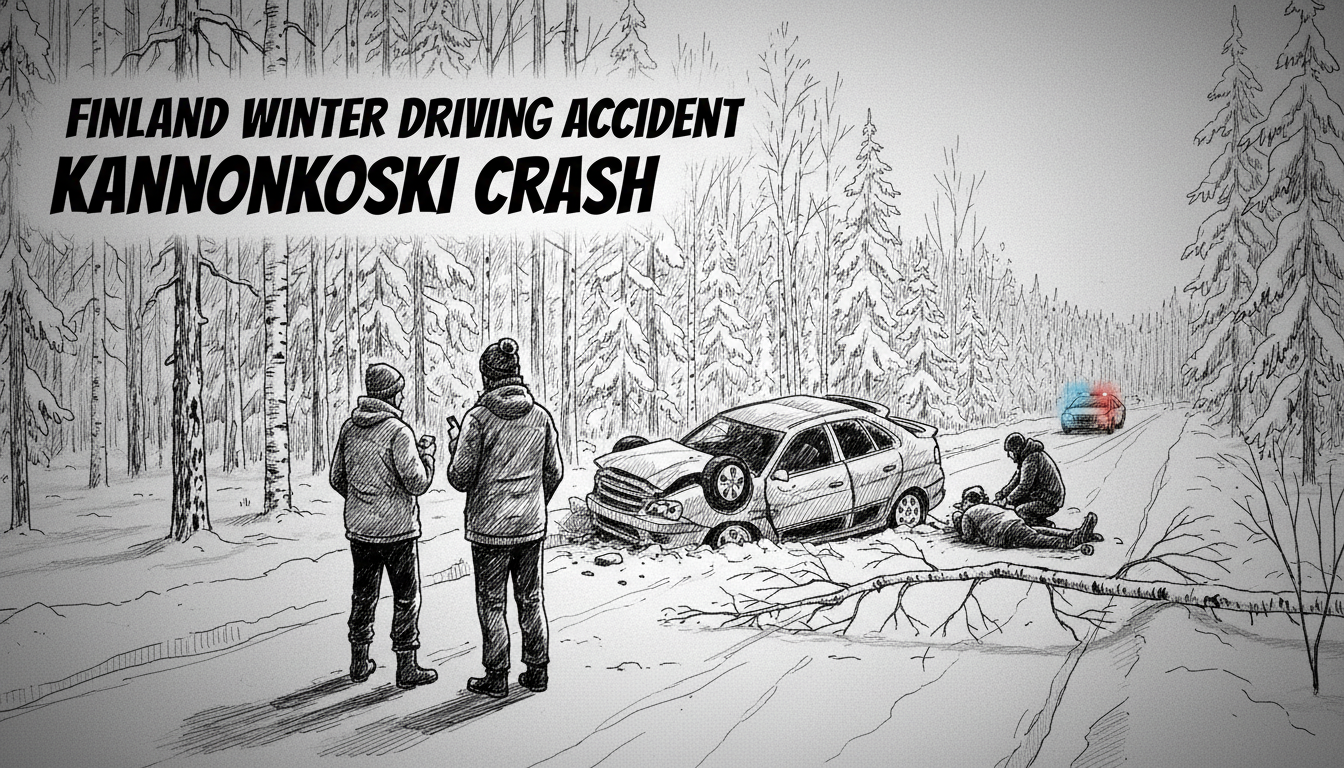
Finland winter driving conditions are again in focus after a car skidded off the road in Kannonkoski on Sunday evening. The incident occurred on Saarijärventie, the highway connecting Kannonkoski and Saarijärvi in Central Finland. Emergency services received the alert before 8 p.m., responding swiftly to the scene. Remarkably, no injuries were reported despite the vehicle leaving the roadway. Preliminary investigation points to poor weather and road conditions as the likely cause, a familiar hazard during the Finnish winter months.
This single accident underscores a persistent seasonal challenge. Finland's long, dark winters bring snow, ice, and rapidly changing weather that test both drivers and infrastructure. The Kannonkoski event, while minor, serves as a timely reminder of the risks inherent in Nordic mobility. It prompts a deeper examination of road safety protocols, driver preparedness, and the effectiveness of national policies designed to mitigate winter-related accidents.
Details of the Saarijärventie Incident
The accident took place approximately 10 to 15 kilometres from Kannonkoski towards Saarijärvi. Saarijärventie, officially designated as Highway 648, is a regional road traversing the forested and lake-dotted landscape of Central Finland. Local rescue services managed the situation efficiently, confirming that the occupants of the car were unharmed. Police have launched a standard investigation, but early indications strongly suggest that slippery conditions were a primary factor. No other vehicles were involved, and traffic disruptions were minimal.
Such incidents are logged by the Finnish Transport Infrastructure Agency (FTIA) as part of ongoing traffic safety monitoring. While this crash ended without physical harm, it represents a data point in a much larger annual pattern. The FTIA consistently notes a spike in single-vehicle accidents during the winter season, often attributed to loss of control on icy surfaces. The Kannonkoski case fits neatly into this statistical trend, highlighting the ever-present gap between mandated precautions and real-world driving conditions.
The Broader Landscape of Finnish Winter Roads
Finland's relationship with winter driving is complex, shaped by necessity and ingrained expertise. From December 1 to March 31, the use of winter tires—either studded or non-studded friction tires—is legally mandatory for all passenger vehicles. This law is a cornerstone of national road safety strategy. Yet, as the Kannonkoski event shows, technical compliance does not eliminate risk. Weather in regions like Central Finland can be unpredictable, with black ice, sudden snow squalls, and packed snow creating treacherous patches even on maintained roads.
Municipalities and the state-run FTIA deploy extensive resources for winter maintenance, including plowing and salting. However, the vastness of the road network and the intensity of weather systems mean that conditions can deteriorate faster than services can respond. This reality places a significant onus on individual drivers to exercise judgment. The Finnish Meteorological Institute issues frequent warnings, but heeding them requires a cultural commitment to defensive driving that is constantly reinforced through public campaigns.
Analyzing the Human Factor in Accidents
National statistics provide crucial context for understanding this crash. According to FTIA data, approximately 70% of all road accidents in Finland are primarily due to human factors. Speeding and driving under the influence remain major contributors to severe outcomes. In winter conditions, the human element often involves a failure to adequately adjust speed or following distance to match the reduced grip and visibility. While the Kannonkoski driver avoided injury, the suspected cause—poor conditions—interacts directly with driver behavior.
Experts at institutions like VTT Technical Research Centre of Finland repeatedly stress that winter tires are merely a tool, not a guarantee. Safe winter driving demands a holistic adjustment of habits. This includes increasing following distances to at least double the summer norm, avoiding sudden steering or braking maneuvers, and planning journeys around weather forecasts. The accident on Saarijärventie likely involved a momentary lapse in one or more of these adaptive techniques, a common trigger for loss of vehicle control on slick surfaces.
Policy Frameworks and European Union Context
Finland's approach to road safety is nested within broader European Union directives. The EU's strategic goal of halving serious road injuries and fatalities by 2030 influences national policy-making in Helsinki. Finnish authorities align domestic measures, such as winter tire mandates and infrastructure investment, with these transnational objectives. The Ministry of Transport and Communications regularly reviews accident data to inform policy updates, often consulting with the European Transport Safety Council.
Domestically, the Finnish government allocates substantial funds for road maintenance and safety technology. This includes investments in weather-responsive traffic management systems and improved road signage. The Eduskunta, Finland's parliament, has historically supported robust funding for these areas, recognizing their critical role in economic connectivity and public welfare. From an EU perspective, Finland is often cited as a case study in managing extreme climatic challenges within a common regulatory framework, though local incidents like the Kannonkoski crash illustrate the ongoing work required.
Voices from the Safety Community
Road safety professionals emphasize that prevention is a shared responsibility. Jussi Paju, a senior advisor at the Finnish Road Safety Council, often notes in public statements that technology and regulation must be coupled with personal vigilance. "The law gives you the equipment, but your brain provides the safety," Paju has said in past campaigns. He advocates for continuous driver education, especially for newcomers to Finland who may lack experience with Nordic winters.
Other experts highlight the importance of vehicle preparedness beyond tires. This includes ensuring functioning lights, charged batteries, and clear windows and mirrors. Keeping an emergency kit in the car—with blankets, a shovel, and reflective warning triangles—is also standard advice. The non-injury outcome in Kannonkoski could be seen as a positive sign of general safety awareness, but it does not diminish the need for constant reinforcement of these messages through media, schools, and official channels.
Future Directions for Winter Mobility Safety
Looking ahead, Finnish authorities are exploring several avenues to enhance winter road safety. Digitalization offers promising tools, such as real-time road condition apps integrated with vehicle systems. The FTIA is piloting projects that use sensor data to provide hyper-local ice warnings. Additionally, there is ongoing debate in policy circles about potentially extending the mandatory winter tire period or introducing stricter requirements for tire tread depth.
Public awareness campaigns remain a key pillar. Each autumn, a nationwide campaign reminding drivers of the December 1 tire deadline and safe driving techniques saturates television, radio, and online platforms. The goal is to make safe winter driving second nature, reducing the frequency of accidents like the one in Kannonkoski. As climate change introduces more variability into winter weather patterns, with possible increases in freeze-thaw cycles, adapting these strategies will become even more critical.
The Kannonkoski incident, though minor, is a microcosm of Finland's annual winter challenge. It reflects a system that generally works well but is never foolproof. The absence of injuries is fortunate, but it should not lead to complacency. Every such event provides data and a narrative reminder that safety on Finland's winter roads is a continuous negotiation between human skill, technological aid, and natural forces. As the days remain short and the temperatures low, the question persists: how can collective behavior evolve to match the sophisticated policies already in place?