
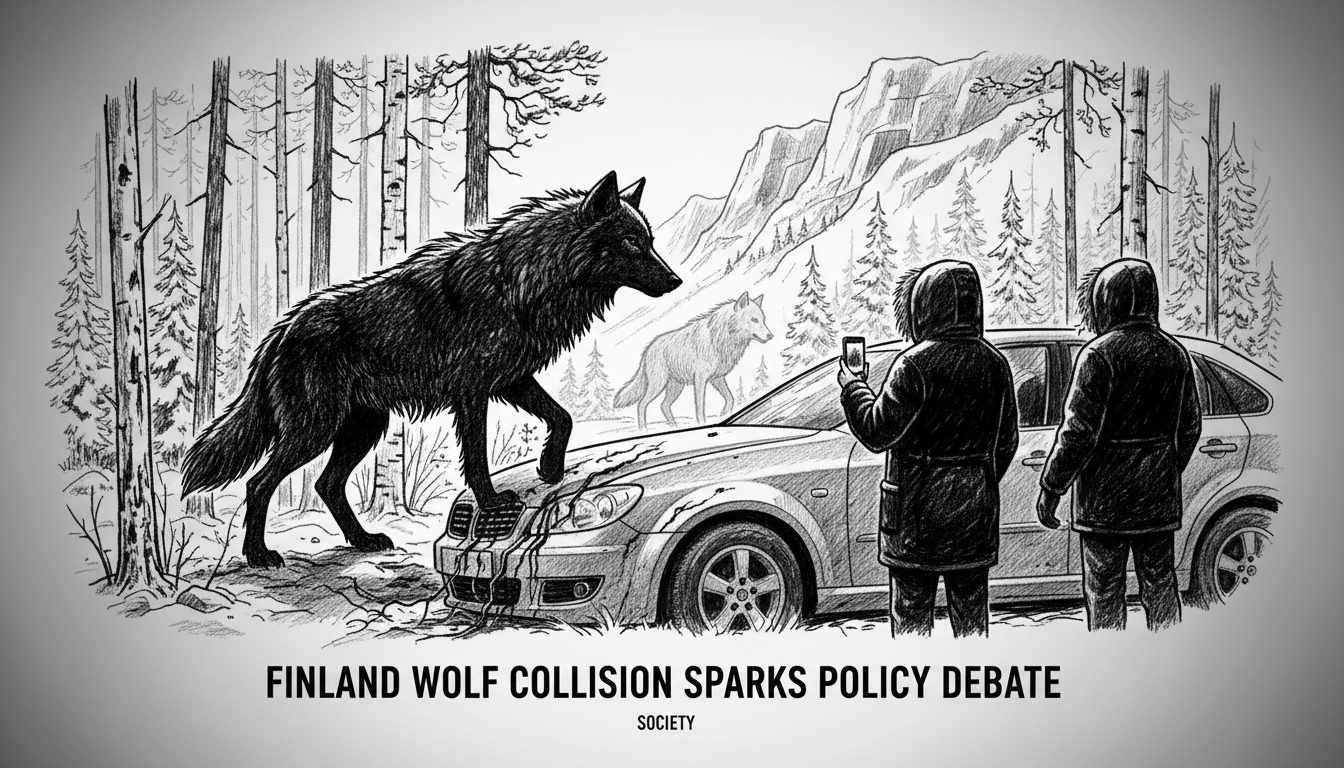
Finland's wolf population of approximately 310 individuals faces a new urban challenge following a vehicle collision in Inkoo. A driver struck and injured a wolf on Degerbyntie road at 9:30 AM on Wednesday, marking another incident in the growing interface between humans and recovered predator populations. No people were hurt, but the injured animal fled into the surrounding forest, prompting an ongoing search by wildlife officials. This singular event on a quiet morning road encapsulates a national conflict balancing conservation, rural livelihoods, and EU directives.
Authorities from the West Uusimaa Police Department issued specific public guidance following the incident. They instructed anyone facing an immediate threat from a wolf to call emergency number 112 and seek shelter indoors. For non-urgent sightings, such as observing tracks or a wolf at a distance that moves away, the public should contact a designated predator contact person. This tiered response system highlights the established, yet frequently tested, protocols for human-wildlife encounters in Finland.
Search Underway for Injured Predator
Large game support personnel, known as suurriistavirka-aputoimijat, are leading the effort to track the wounded wolf. Their work is critical for animal welfare and public safety, as an injured predator can behave unpredictably. The search focuses on the forested areas around Inkoo, a municipality in the Uusimaa region not far from the expanding Helsinki metropolitan sphere. This location is significant, showing wolf presence edging closer to densely populated southern Finland.
“The situation did not result in human injuries,” the police confirmed in their statement, underscoring the primary concern for public safety. However, the fate of the wolf remains unknown, and its pursuit involves careful coordination between police, wildlife specialists, and possibly local hunters. Each interaction between humans and large carnivores generates data that influences national management strategies.
A Population in Perpetual Debate
The Finnish wolf population has seen dramatic shifts over the past century. Hunted to near extinction, protective measures enabled a slow recovery, leading to an estimated 290-330 wolves today according to the Natural Resources Institute Finland (Luke). This recovery is a conservation success but also a source of continuous tension. Rural communities, particularly farmers and reindeer herders in the north, report livestock losses and express safety concerns.
In response, Finland employs a licensed hunting model to manage population growth and mitigate conflicts. Quotas are set regionally, often sparking legal and ethical debates. Conservation groups frequently challenge these hunts in administrative courts, arguing they sometimes violate EU biodiversity directives. The Finnish Parliament’s Eduskunta regularly revisits the issue, with parties like the Centre Party advocating for more localized control and the Greens pushing for stricter protections.
“Every incident like the one in Inkoo is immediately pulled into a broader political narrative about coexistence,” said a policy advisor familiar with the Ministry of Agriculture and Forestry’s deliberations. “For some, it’s evidence that populations are too high near residential areas. For others, it’s a tragic but rare accident that underscores the need for better driver awareness and wildlife corridors.”
EU Law and National Policy Collide
Finland’s wolf management operates under the strict gaze of the European Union’s Habitats Directive. The wolf is a strictly protected species under Annex IV, requiring member states to maintain its population at a ‘favourable conservation status’. The European Commission has closely monitored Finland’s management plans, and past hunting seasons have prompted infringement discussions. Finnish officials must constantly prove that any culling is justified and does not threaten the species’ overall status.
This EU framework limits national discretion. Any amendment to hunting quotas or management practices must be backed by robust scientific data from Luke. The incident in Inkoo, occurring in southern Finland where wolf densities are lower, could feed into arguments for preventive population control in specific areas. However, conservation scientists warn that removing individuals from small, fragmented packs can harm genetic diversity and long-term sustainability.
The Road Ahead for Coexistence
Beyond high-level policy, practical coexistence measures are evolving. These include better road signage in known wildlife areas, public education campaigns on how to react during sightings, and state compensation for verified livestock predation. The government also funds preventive measures like electric fences and guardian dogs for farms. The challenge is scaling these solutions effectively across the diverse Finnish landscape, from the pastoral south to the vast reindeer herding lands of Lapland.
The Inkoo collision is a microcosm of this complex challenge. It happened not in the remote wilderness but on a regional road, indicating how wildlife territories intersect with daily human commutes. As Finland’s urban areas expand and wolf packs establish territories, such encounters may become less statistically rare. The national conversation is shifting from mere survival of the species to the logistics of shared space.
Will Finland’s model of regulated hunting and proactive mitigation foster a sustainable balance? Or will growing pressures lead to more frequent conflicts and heightened political strife? The search for the injured wolf near Inkoo is more than a track through the snow; it’s a path through the heart of Finland’s enduring struggle to define its relationship with the wild. The answer will be written in the policies debated in Helsinki and the quiet moments of caution on darkened country roads.