
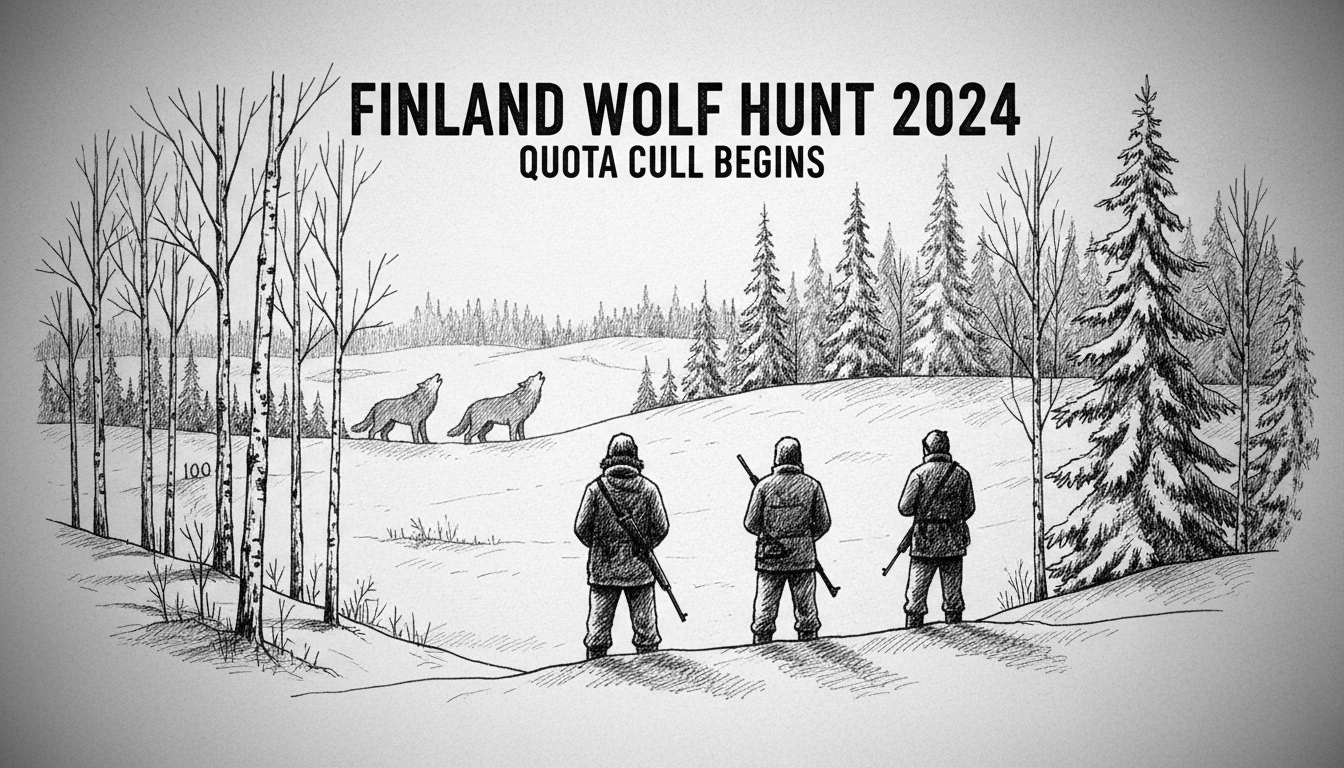
Finland's controversial 2024 wolf hunting season commenced, with over a dozen wolves culled on the first day alone. This year's management hunt, permitted under EU law, authorizes the killing of up to 100 wolves outside reindeer herding areas, continuing a fiercely debated national policy that balances rural livelihoods with conservation goals. Every carcass from this hunt now embarks on a detailed scientific journey to the Natural Resources Institute Finland, known as Luke (Luonnonvarakeskus), where researchers like Jaakko Alalantela work to extract vital data before the remains are destroyed.
From Forest to Laboratory
Hunters are legally obligated to report their kill immediately and must deliver the wolf carcass to Luke within 14 days. The institute's examination is meticulous. 'For males, we hope to receive the head, skinned. Then if we get a female, we hope for the entire carcass, also skinned,' explains Jaakko Alalantela, a research master at Luke. The requirement for an intact female carcass is crucial for determining reproductive status, a key data point for population modeling. Upon arrival, technicians take a mandatory tissue sample, typically a piece of the tongue. This sample unlocks the animal's biological story: its age, reproductive history, and genetic purity.
'The tissue sample is essentially a piece of the tongue, and by law it must be delivered to us,' Alalantela states. 'With it, we can identify the individual. We get confirmation, for instance, on whether it is a pure wolf or if it might have been a hybrid.' Identifying a wolf-dog hybrid is significant, as such kills do not count against the regional hunting quota. This genetic screening forms part of Luke's ongoing work to monitor the purity of Finland's wolf population.
The Fate of the Carcass
After science is served, the physical remains of the wolf face disposal. 'I cannot answer that directly,' Alalantela admits when asked about the final destination. 'It is not burned, but there are specific rules for disposal.' The hunter is entitled to keep the skull and the pelt, which can be sent to a taxidermist. The rest of the carcass, however, is condemned. The idea of consuming wolf meat remains outside Finnish custom. 'It is certainly not common practice to use it,' Alalantela confirms. This process highlights a central irony of the managed hunt: the animal is valued intensely for the data it provides, while its body is treated as biological waste.
The Numbers Behind the Debate
The hunt is framed by the government as a necessary tool for population management and reducing socio-economic harms. The Finnish Wildlife Agency states the goal is to reduce the current wolf population and prevent damages, addressing public concerns about safety and livestock predation. Luke's latest population assessment, from March of the previous year, estimated Finland was home to approximately 430 wolves—a 46% increase from the year before. This figure is the bedrock upon which the annual quota of 100 wolves is set. However, conservation biologists frequently question the sustainability of such culls, arguing they can disrupt pack structures, reduce genetic diversity, and may not effectively target the specific individuals causing conflicts.
A Policy Entrenched in EU Law and Local Conflict
Finland's wolf management operates within a strict EU framework. Wolves are strictly protected under the EU Habitats Directive. Member states can, however, derogate from this protection under specific conditions, including preventing serious damage to livestock. Finland invokes this clause, arguing that a managed hunt is necessary to maintain social acceptance for wolves in rural areas and to protect reindeer herding—a critical economic and cultural activity in Lapland. The tension is palpable between Helsinki, which sets policy, and the EU Commission in Brussels, which monitors compliance. Finland must repeatedly justify that its hunting quotas are proportionate, non-detrimental to the population's favorable conservation status, and that non-lethal methods are insufficient.
Expert Perspectives on a Perennial Conflict
'The debate in Finland is less about biology and more about sociology,' notes one European carnivore conservation specialist familiar with the Nordic context. 'The scientific capacity at Luke is excellent, but the political decision on the quota often exceeds what pure population dynamics would advise.' Experts point to a gap between the national policy and local implementation. While non-lethal measures like electric fences and livestock guarding dogs are promoted, many rural municipalities and hunters express stronger trust in direct population control through hunting. This creates a cyclical conflict: high-profile hunts galvanize urban conservation advocates, whose opposition then fuels rural perceptions that 'Helsinki elites' do not understand their reality, entrenching positions further.
Looking Beyond the Hunting Season
The 2024 season will close on February 10th, but the controversy will not. Each wolf carcass delivered to Luke adds another row to a dataset that will be scrutinized by scientists, NGOs, and EU officials. The key questions remain unresolved. Is a quota of 100 wolves from a population of 430 biologically sustainable in the long term? Does the cull actually reduce livestock conflicts, or does it disrupt stable pack territories and create more unpredictable lone wolves? And can Finland craft a wolf policy that genuinely reconciles the requirements of EU biodiversity law with the legitimate fears and economic interests of its rural citizens? The answers are not found in the laboratory at Luke, but in the far more complex arena of Finnish politics and human-wildlife coexistence. As the snow melts next spring, the cycle of counting, debating, and setting a new quota will begin again, with the wolf firmly trapped in the middle.