
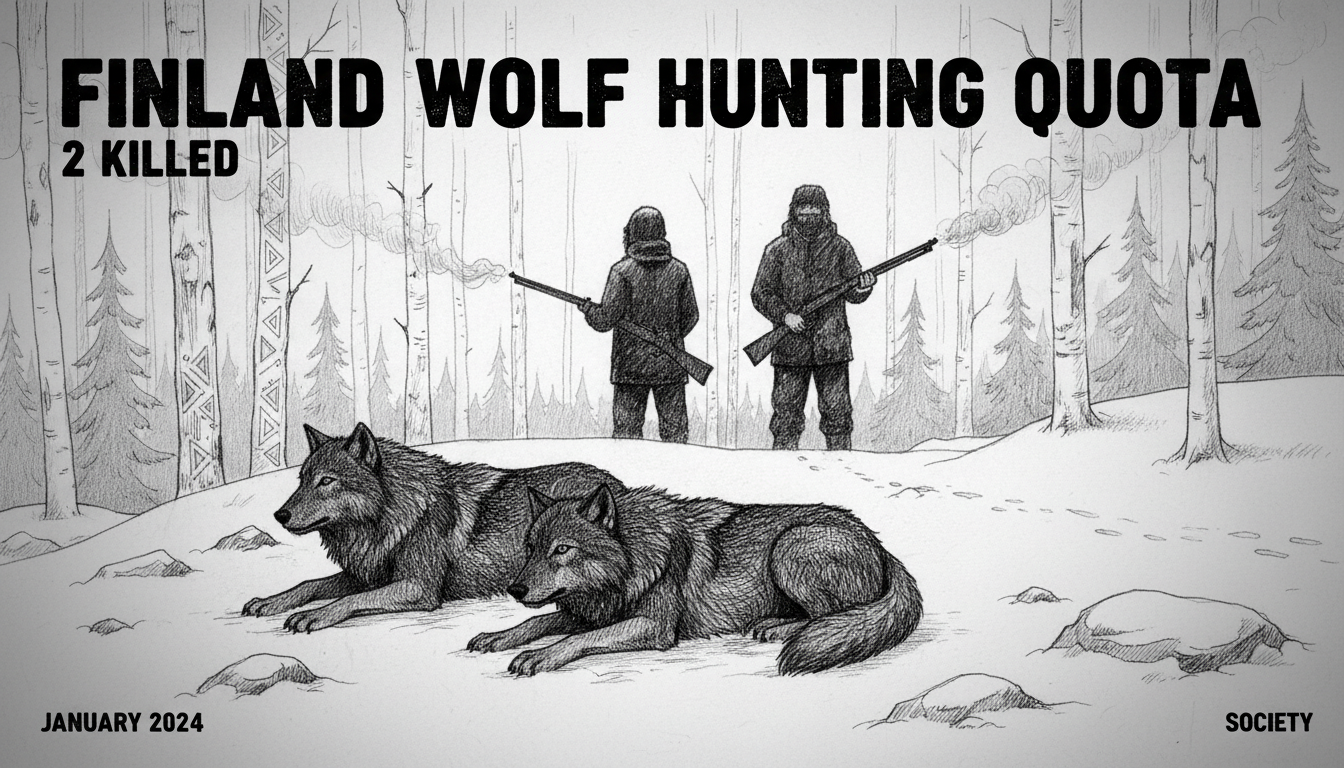
Finland's controversial wolf quota hunt began with immediate results as two wolves were killed in North Karelia on New Year's Day. The hunts in the Tohmajärvi-Kitee area mark the start of a government-sanctioned cull aiming to remove 100 wolves from Finland's population this winter outside the reindeer management zone. Led by local hunt master Mika Piiroinen, the operation concluded rapidly. "We started in the morning and finished in the morning," Piiroinen stated, emphasizing efficiency over duration. This launch follows the reformed Hunting Act that came into force on January 1, 2024, which streamlined the process for authorizing population management hunts for large carnivores. The Finnish Ministry of Agriculture and Forestry, under Minister Sari Essayah of the Christian Democrats, granted the national quota based on population estimates and reported livestock damages.
A Policy Forged in Conflict
The quota hunt represents the latest chapter in Finland's long and fraught relationship with its wolf population. For decades, the issue has polarized urban conservationists and rural residents, particularly livestock owners. The current three-party coalition government, led by Prime Minister Petteri Orpo of the National Coalition Party, has made resolving human-carnivore conflict a priority. Their program explicitly supports "the sustainable management of large carnivore populations" to ensure social acceptability in rural areas. The reformed Hunting Act of 2024 is a key legislative tool in this effort, shifting some authority from regional administrative courts to the Finnish Wildlife Agency for faster permit decisions. This change aims to address local concerns more responsively but has drawn criticism from environmental groups who fear weakened oversight.
The North Karelian Frontline
In North Karelia, the specific quota is four wolves from the Tohmajärvi-Kitee region. The swift success on day one highlights both the preparedness of local hunters and the known presence of wolf packs in the area. "We hunters have no intention of shooting wolves excessively," Piiroinen noted, framing the cull as a targeted management action, not a wide-scale eradication. The area is a mosaic of dense boreal forest and small-scale farms, where encounters between wolves and free-grazing domestic animals can be frequent. Local municipalities have long petitioned the government for stronger measures to control the wolf population, citing fear for livestock safety and, in some cases, personal security despite extremely rare wolf attacks on humans. The hunt's execution is tightly regulated; it is a quota-based cull, not an open season, meaning only specific individuals in designated areas are authorized.
Clashing with European Conservation Law
Finland's wolf management policy operates under the constant shadow of European Union law, specifically the Habitats Directive. The directive strictly protects the wolf (Canis lupus) under Annex IV, prohibiting all deliberate killing or disturbance with limited exceptions. Member states can derogate from these protections under Article 16 if there is "no satisfactory alternative" and the action does not harm the overall population's favorable conservation status. Finland invokes this clause, arguing that regulated hunting is necessary to prevent serious damage to livestock and to maintain public order and acceptance. However, this interpretation is perennially challenged. The European Commission has previously initiated infringement proceedings against Finland over its wolf hunting policies, arguing the culls were not justified. Finnish authorities maintain their current quotas are scientifically sound and legally defensible.
The Scientific and Ethical Debate
Conservation biologists and wildlife experts remain deeply divided on the efficacy of quota hunting as a management tool. Proponents, often aligned with game management institutes, argue it reduces livestock depredation, minimizes illegal poaching by increasing local tolerance, and can be used to target problem individuals that have learned to prey on domestic animals. They cite studies suggesting a correlation between regulated hunting and decreased conflicts. Opponents, including many from university ecology departments and NGOs like the Finnish Nature League, counter that killing disrupts pack social structures, potentially leading to more unpredictable behavior and increased breeding rates among remaining wolves. They emphasize the wolf's critical role as an apex predator in maintaining ecosystem health and question whether the population of approximately 300 wolves outside the reindeer area can genetically sustain an annual cull of 100 individuals. The debate often centers on differing interpretations of the same population monitoring data collected by the Natural Resources Institute Finland (Luke).
The Path Forward for Coexistence
The swift start to this year's hunt ensures the wolf debate will remain at the forefront of Finnish environmental policy. Minister Sari Essayah has consistently stated that the goal is balance, not elimination. The government is also funding non-lethal measures, such as reinforcing fences and compensating farmers for lost animals, but argues these are insufficient alone. Meanwhile, the European Commission continues to monitor Finland's practices closely. The success of the policy will be measured in several ways: a reduction in reported livestock damages, the stability of the wolf population's genetic health, and the level of social peace in the countryside. For hunters like Mika Piiroinen in North Karelia, the measure is a pragmatic response to a real-world problem. For conservationists, it is a distressing setback for a species only recently recovered from the brink of regional extinction. As the snow settles over the forests of Tohmajärvi, the two wolves taken on the first day symbolize a conflict far from resolution, testing Finland's commitment to both its natural heritage and its rural communities.