
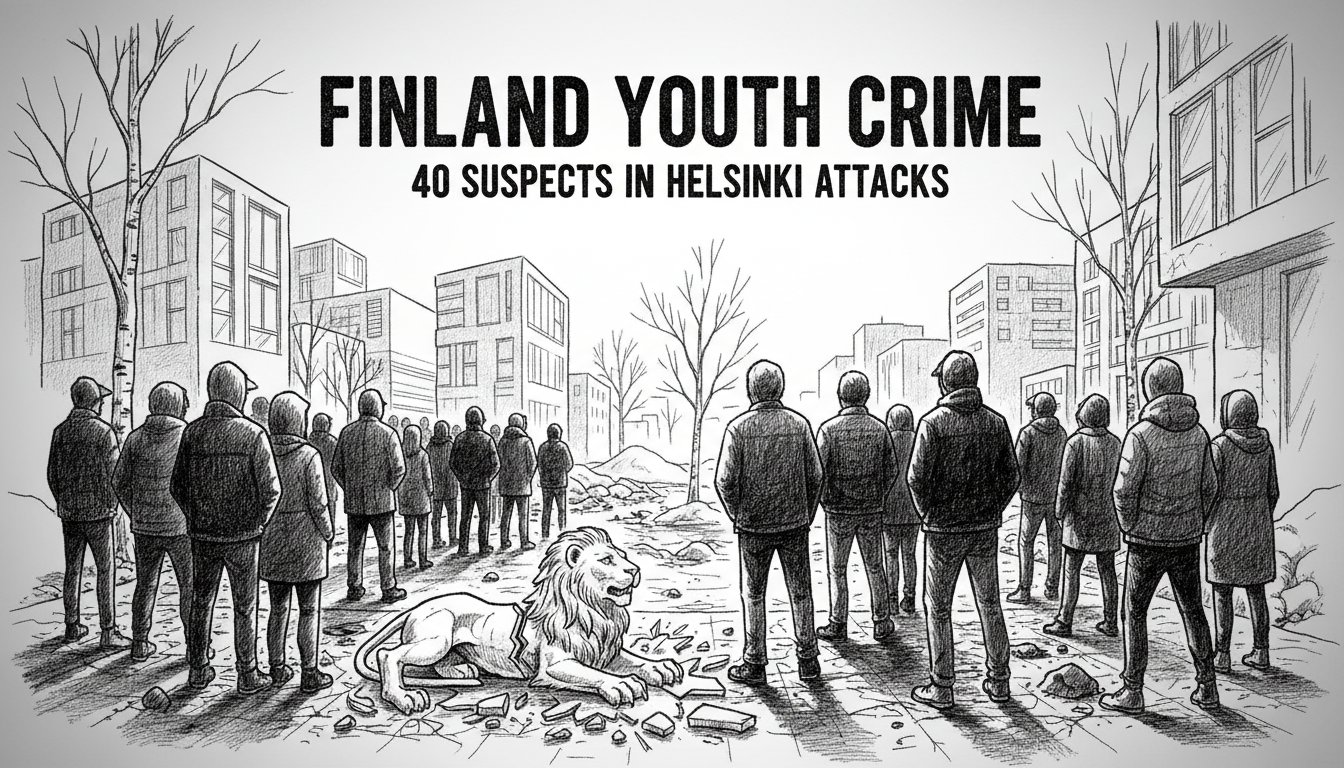
Helsinki youth crime has taken a disturbing turn with police revealing an exceptionally wide-ranging series of robberies and assaults across the capital. Approximately 40 young people, aged 14 to 18, are suspected of carrying out at least 25 crimes between late August and early November this year. The incidents, involving victims being surrounded, humiliated, and violently beaten by large groups, have shaken public confidence and ignited a fresh debate on juvenile delinquency in Finland.
Police described the pattern as a coordinated series of attacks. Groups of youths targeted individuals in popular weekend hangout spots, including Alppipuisto in Alppila, Malmi, Oulunkylä, and Mustikkamaa. The suspects operated in large packs, encircling their victims to commit robberies and physical assaults. A particularly alarming detail is that nearly half of the approximately 40 suspects were under the age of 15 at the time of the alleged offenses, highlighting the involvement of very young adolescents.
A Pattern of Coordinated Violence
The Helsinki Police Department's announcement points to a calculated, group-based criminal methodology. The crimes were not random, isolated incidents but part of two distinct series identified by investigators. The suspects allegedly moved through the city, targeting victims in public parks and recreational areas typically frequented by young people during evening hours. This choice of location and timing suggests a deliberate strategy to find vulnerable targets in less crowded settings.
Finnish law enforcement officials have expressed deep concern over the scale and nature of the violence. The acts went beyond simple theft, incorporating elements of public humiliation and physical intimidation. This escalation from petty crime to organized group violence represents a significant challenge for authorities. The police investigation, which pieced together the separate crime series, is now focused on identifying all participants and building strong evidential cases, a complex task given the number of suspects and their ages.
Juvenile Justice System Faces a Test
The case places immediate pressure on Finland's juvenile justice system, renowned for its rehabilitative focus. With so many suspects falling below the age of 15—the age of criminal responsibility in Finland—the primary tools are social and child welfare interventions, not traditional prosecution. For suspects aged 15-17, the system emphasizes corrective measures over punitive sentences, aiming to steer young offenders away from a life of crime. This philosophy, rooted in Nordic penal theory, is now facing a public test as communities demand safety and accountability.
Experts in criminology and youth work point to underlying social factors that may contribute to such group criminality. "While Finland's overall youth crime rates are moderate in a European context, concentrated outbreaks like this signal deep-seated issues in specific communities," said Dr. Elina Saarinen, a sociologist at the University of Helsinki. "We must look at factors like social exclusion, fractured family support, and a lack of positive engagement opportunities outside school hours. These are not excuses, but essential points for effective prevention."
Political Response and Policy Debates
The news has quickly migrated from police bulletins to the political arena in Helsinki. Members of the Eduskunta, Finland's parliament, are calling for statements from the Minister of the Interior and the Minister of Justice. The governing coalition, led by Prime Minister Petteri Orpo, is likely to face questions about resource allocation for youth outreach programs and police patrols in suburban areas. Opposition parties may critique perceived gaps in early intervention strategies.
This incident also touches on broader, ongoing debates about integration and equality in Finnish society. Some of the areas mentioned, like Malmi and Oulunkylä, are diverse suburbs. Politicians and commentators will be cautious not to stigmatize neighborhoods but will inevitably discuss how to strengthen community cohesion and provide constructive pathways for all young people. The government's upcoming budget negotiations may see increased proposals for funding youth centers, sports facilities, and social worker positions in municipalities.
A Search for Solutions Beyond Policing
Law enforcement alone cannot solve the problem, a point reiterated by many Finnish officials. A multi-agency approach, involving schools, social services, youth workers, and families, is considered crucial. Schools play a key role in identifying at-risk behavior early, while municipal social services are the frontline for supporting troubled minors and their families. The challenge is ensuring these systems are adequately resourced and communicate effectively with each other.
"The police can investigate and interrupt criminal activity, but sustainable prevention happens long before a crime is committed," noted a senior youth welfare coordinator from the City of Helsinki. "We need to reach these young people with positive alternatives and support structures. That requires consistent, long-term investment and cooperation across all levels of society." Some experts advocate for expanded mentoring programs and guaranteed access to recreational activities, arguing that idle time and a lack of positive peer groups can lead to destructive behaviors.
The Path Forward for Helsinki
As the judicial process begins for the older suspects and welfare measures are enacted for the younger ones, the city of Helsinki is left to grapple with the aftermath. The attacks have undoubtedly caused fear and anger among residents. Community safety walks and increased dialogue between police and neighborhood associations are likely short-term responses. The long-term solution, however, is more complex and less visible.
Finland has a strong history of addressing social problems through comprehensive, research-based policy. The current crisis will test whether that model can adapt to new forms of youth group violence. The coming months will reveal if policymakers can strike a difficult balance: holding individuals accountable for serious crimes while addressing the systemic issues that allow such group dynamics to flourish. The outcome will define not just the safety of Helsinki's parks, but the future of dozens of young lives now entangled in the justice and welfare systems. The true measure of success will be whether such a "wide-ranging series" of crimes becomes a tragic anomaly or a recurring headline.