
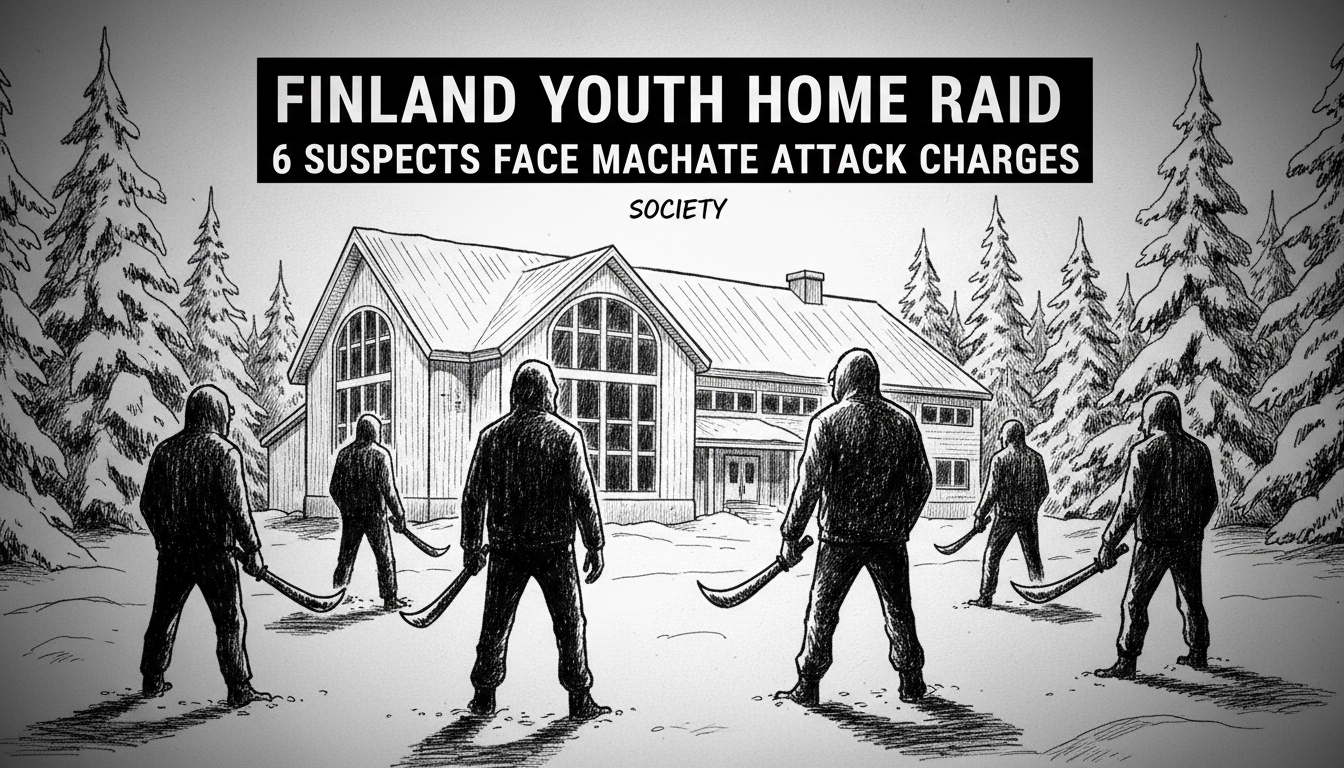
Finland's social care system faced a shocking security breach when a machete-armed group stormed a youth home in Hamina to forcibly extract a minor resident. The September 14 raid, described by police as unprecedented, has triggered a major investigation and raised urgent questions about youth violence and institutional safety. Six individuals, including the 17-year-old resident who was aware of the 'liberation plan,' now face charges including aggravated deprivation of liberty and assault.
An Unprecedented Act of Coordinated Violence
According to the Southeast Finland Police Department, the incident was a premeditated and coordinated attack. A group of young men, armed with machetes exceeding half a meter in length, forced their way into the state-run residential unit. They threatened staff with serious violence, coerced employees and other residents into a single room, and then broke into a locked room to remove the targeted minor. "Based on the preliminary investigation, it can be said that this is a unified group that carried out a pre-planned, serious crime against the unit's staff, residents, and the decision-making of the social authority," said Crime Commissioner Kimmo Kostiainen in a police bulletin.
The police emphasize the exceptional nature of the crime. No similar forced extraction from a youth care institution has occurred before in Finland. The perpetrators fled Hamina, a coastal city in southeastern Finland, for the Helsinki metropolitan area but were apprehended by police within days. All suspects have since been released from pre-trial detention as the investigation file moves to prosecutors for consideration of formal charges.
Systemic Alarms and a Normalization of Violence
The case extends beyond a single violent episode, pointing to deeper societal concerns. Commissioner Kostiainen's statement included a stark warning: "The case has disturbing indications that the use of violence is becoming normalized as a means of advancing one's own affairs, especially among circles of young people living or idolizing a criminal lifestyle." This assessment suggests police are observing a shift in attitudes towards violence among certain youth subcultures, where direct, armed action replaces other forms of conflict resolution or negotiation.
Finland's youth homes, or sijoitusyksikkö, are secure facilities operated by municipal social services under the Child Welfare Act. Minors are placed there via court order or social services decision when their home environment is deemed unsafe or when they pose a risk to themselves or others. These units are designed to provide care, supervision, and rehabilitation, not to withstand paramilitary-style assaults. The successful breach therefore exposes a critical vulnerability in the welfare state's infrastructure, designed for care rather than defense.
The Legal Reckoning and Charges Ahead
The police have completed their preliminary investigation, forwarding the case to prosecutors for charging decisions. The list of suspected crimes is extensive, reflecting the severity of the intrusion: aggravated deprivation of liberty, violent resistance against a public official, coercion, aggravated violation of domestic peace, property damage, and two counts of assault. The involvement of the minor resident as a suspect complicates the narrative, indicating alleged collusion between the resident and the external group.
Legal experts note that convictions on these charges, particularly aggravated deprivation of liberty which involves the use of a weapon, can carry significant prison sentences. The case will test the judiciary's response to this new form of organized violence targeting state care institutions. The fact that the suspects were known to each other and shared criminal backgrounds, as noted by police, aligns with patterns of gang-related activity, though authorities have not formally labeled it as such.
Broader Implications for Finnish Society and Policy
This attack forces a difficult conversation about the intersection of youth welfare, crime prevention, and public security. For decades, Finland's approach to youth delinquency has focused on social support and rehabilitation, with notable success in reducing gang violence through comprehensive social programs. This incident challenges that model, suggesting some groups are now willing to directly assault the state's care apparatus.
Security at youth homes is now under scrutiny. These facilities must balance an open, therapeutic environment with the safety of residents and staff. Increasing fortification could contradict their rehabilitative goals, yet failing to provide security undermines their basic function. The Ministry of Social Affairs and Health, which oversees child welfare, may need to issue new guidelines in collaboration with the Ministry of the Interior, which holds police authority.
Furthermore, the incident highlights potential failures in intervention. The fact that a minor in state care maintained close enough ties with an armed group to coordinate a raid suggests gaps in monitoring and intervention strategies. It raises questions about how social services and police share information regarding at-risk youth connected to criminal networks.
A Critical Juncture for Youth Intervention
The Hamina raid is a watershed moment. It is no longer an issue of street violence between individuals or groups; it is a direct assault on a foundational institution of the Finnish welfare state. The response from policymakers in Helsinki will be telling. Will it lead to a more securitized approach to youth care, or a renewed investment in early-stage social interventions to prevent young people from embracing violent criminal identities?
As the case proceeds through the district court, its details will reveal more about the motivations and networks behind the attack. The outcome will send a message about the consequences of such violence. More importantly, the policy and operational changes that follow will define whether this was a terrifying one-off event or a grim new trend that Finland must learn to manage. The core Finnish principle of caring for vulnerable youth now collides with the stark reality of protecting them, and those who care for them, from organized threats. The nation's ability to uphold its social values in the face of this violence is now being tested.