
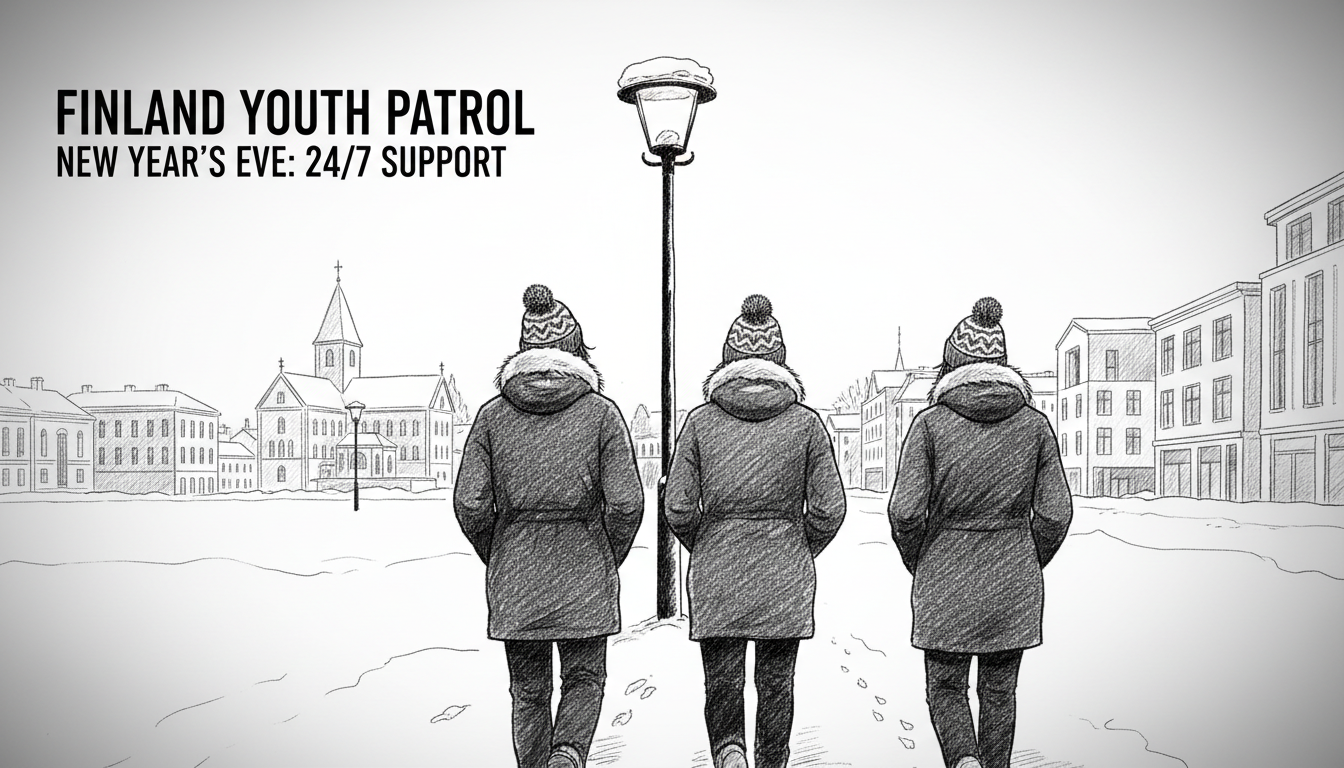
Finland's youth workers are mobilizing across the city of Porvoo this New Year's Eve, providing a visible, supportive presence in the spaces where young people gather. In a proactive initiative blending municipal and parish resources, trained professionals will walk the city center and residential areas, aiming to offer a sense of security and an open channel for help during the holiday's celebrations. This outreach represents a core tenet of the Finnish youth work system, which prioritizes accessibility and prevention over purely reactive measures.
"We bring a sense of security with our presence," stated a representative from the organizing bodies, encapsulating the mission's straightforward goal. The program is a collaboration between the Porvoo Finnish Parish and the City of Porvoo's youth services, deploying staff to locations identified as popular hubs for adolescent socializing. While fireworks and festivities define the night for many, youth workers understand the period can also amplify feelings of loneliness, social pressure, or lead to risky behavior.
A Proactive Approach to Holiday Well-being
This initiative is not an emergency response but a structured, preventive effort embedded in Finland's societal framework. Finnish youth work operates on the principle of meeting young people in their own environments, whether that's a youth club, a street corner, or a digital space. New Year's Eve, with its unique mix of excitement, late hours, and potential for alcohol use, is strategically identified as a time for enhanced, low-threshold support.
"The goal is to be approachable, to offer a friendly face and a listening ear if needed," explained a city youth coordinator involved in the planning. "It's about normalizing support. We're not there to police or spoil fun, but to ensure that if a situation feels overwhelming or unsafe to a young person, they see a familiar, trustworthy adult nearby." This approach aligns with national youth work guidelines that emphasize promoting participation, inclusion, and personal growth.
The Finnish Model: Municipal and Parish Partnership
The collaboration between the City of Porvoo and the Evangelical Lutheran Parish highlights a distinctive feature of Finnish welfare services. While Finland is a highly secular society, the church remains a significant provider of social and youth work, often in close partnership with municipalities. This public-civil society model extends resources and reach, ensuring coverage across different communities.
In Porvoo, a historic city on the southern coast, this partnership allows for a coordinated deployment. Parish youth workers often have deep community ties through local church activities, while municipal youth workers bring expertise from the city's official youth centers and schools. Their combined presence on December 31st sends a unified message of community care. The operation is funded through standard municipal youth service budgets and parish community activity funds, reflecting its status as a regular, planned service rather than a special project.
Expert Perspective on Visibility and Prevention
Social work and youth development experts strongly endorse this model of visible outreach. "During unstructured holiday time, the usual safety nets—school, regular club activities—are absent," notes Dr. Elina Saarelainen, a researcher in adolescent social work at the University of Helsinki. "A proactive, roaming presence fills that gap. It’s a form of universal prevention. For the majority, it’s just a reassuring background detail. For a vulnerable few, it could be a critical, immediate point of contact."
Research into youth well-being indicates that perceived adult support and community belonging are significant protective factors against mental health struggles and harmful behavior. By literally showing up, these workers make that support tangible. The intervention is subtle but psychologically significant: it communicates that young people are seen, that their community is invested in their safety, and that help is available without formal barriers.
Beyond Porvoo: A Nationwide Ethos
While this article focuses on Porvoo's specific New Year's Eve plan, similar initiatives unfold across Finland in various forms. In larger cities like Helsinki, Tampere, and Turku, youth outreach teams and low-threshold crisis services typically extend their hours during holidays. Many municipalities deploy "mobile youth work" units—vans or teams on foot—to patrol celebration areas.
The practice is rooted in Finland's Youth Act, which mandates municipalities to provide youth work and counseling services. The act's emphasis on promoting young people's social inclusion and functional capacity provides the legal and ethical foundation for these outreach efforts. It represents a societal choice to allocate resources to communal prevention, aiming to address issues before they escalate into crises requiring more intensive, costly interventions from health or police services.
The Unspoken Challenges and Silent Support
The work of these youth workers often involves dealing with unspoken challenges. They are trained to identify signs of distress, intoxication, or group dynamics that may be turning problematic. Their role can range from handing out hot drinks and sparklers to having a calming conversation with an anxious teen, mediating minor conflicts, or, in rare cases, connecting someone with urgent professional help.
Crucially, they operate with a principle of confidentiality and voluntary engagement. Young people are not compelled to interact with them; the service's power derives from its voluntary nature. This builds trust, a currency essential for effective youth work. For some teenagers, particularly those from troubled homes or feeling socially isolated on a family-centric holiday, these workers may be the only non-peer adults they have positive contact with that night.
A Contrast to Punitive Approaches
Finland's model presents a clear contrast to more punitive or purely security-focused approaches sometimes seen during mass celebrations elsewhere. While police are, of course, present in Porvoo to handle legal violations and serious emergencies, the youth workers represent a separate, supportive arm of the community response. Their uniform is not a badge of authority but likely casual winter gear marked with a reflective vest identifying them as "Nuorisotyö" (Youth Work).
This separation of functions is intentional. It allows young people to seek guidance without fear of automatic reprimand or legal consequences for minor issues. It acknowledges that adolescent experimentation and boundary-pushing are part of development, and that the community's first response should be guidance, not solely discipline. This philosophy has its roots in Finland's successful history with public health and harm-reduction strategies.
Looking Ahead: The Future of Outreach
As youth culture evolves, so too do these outreach services. Organizers in Porvoo and elsewhere now consider digital spaces as crucial environments. While physical presence remains vital, some youth services offer extended chat or message support on social media platforms during holidays, meeting young people in the virtual spaces where they also socialize.
The enduring success of these programs relies on consistent funding and political recognition of their value. In an era of tight municipal budgets, preventive social work can sometimes struggle to justify its cost against more immediately measurable services. However, advocates argue that the long-term benefits—reduced strain on healthcare, social services, and the justice system—are substantial, though harder to quantify.
As the clock strikes midnight in Porvoo this New Year's Eve, the fireworks will illuminate the sky and the crowds will cheer. Amidst the noise and color, a quieter, steadier presence will also be at work. The youth workers patrolling the streets embody a Finnish societal compact: a promise that the community watches out for all its members, especially the young, ensuring the transition into a new year is marked not just by celebration, but by collective care and security. Their work asks a simple, profound question: what does it mean to build a society where support is visible, accessible, and walks alongside you into the future?