
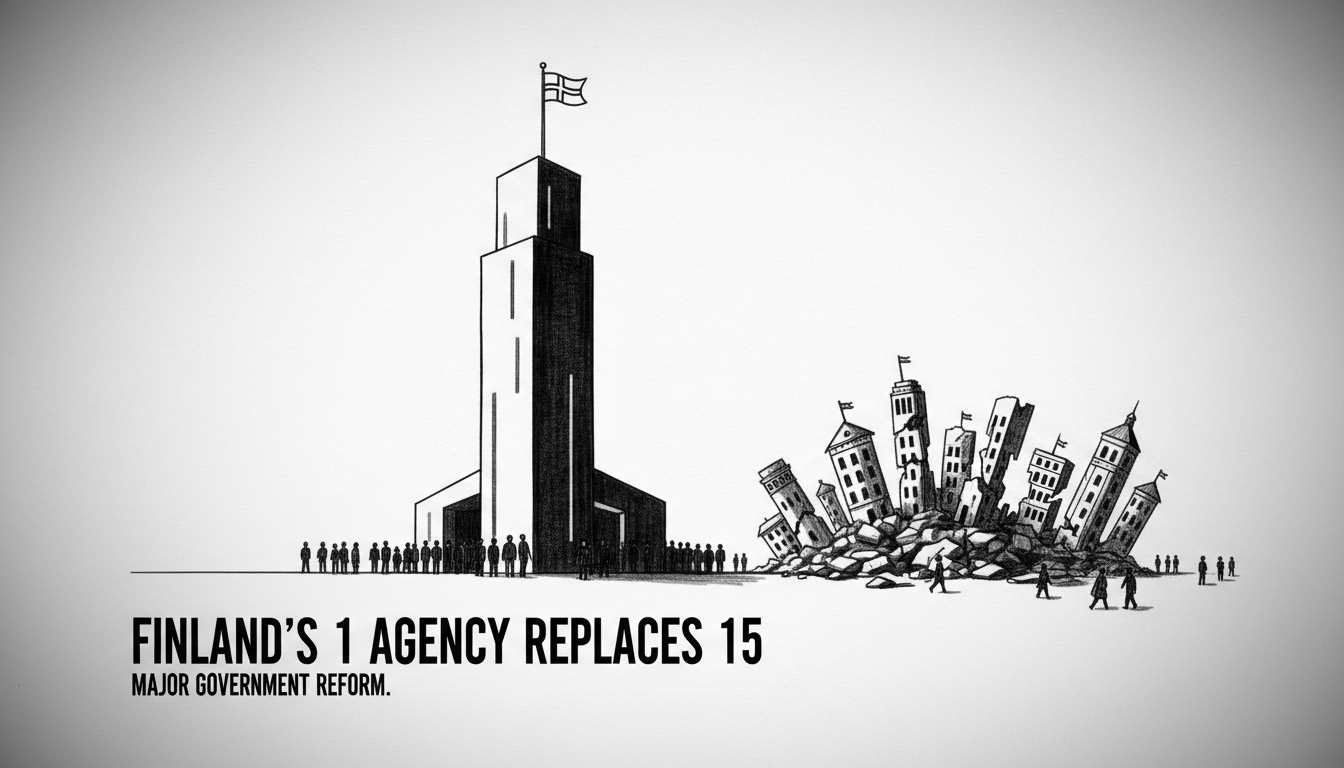
Finland's most significant public administration reform in decades will see 15 regional offices merge into a single new agency starting January 1st. The government appointed Marko Pukkinen on Thursday to lead the new Permit and Supervisory Authority, a powerful body tasked with centralizing environmental, economic, and transport oversight previously handled by Finland's AVI and ELY-keskus networks. This administrative consolidation forms a core part of Prime Minister Petteri Orpo's right-wing coalition program, aiming to cut bureaucracy and accelerate decision-making for businesses across the Nordic nation.
The End of an Era for Regional Administration
The reform marks the end for Finland's longstanding two-tier regional state administration system. The six Regional State Administrative Agencies (AVI offices) and the nine Centres for Economic Development, Transport and the Environment (ELY-keskus offices) will cease operations at year's end. Their combined workforce of approximately 6,000 officials and their broad portfolios—from business permits and environmental impact assessments to transport infrastructure oversight—will transfer to the new centralized body. The government argues this consolidation will eliminate duplicate processes and create clearer service paths. “Unifying these permit and supervisory tasks under one roof is a logical step for a modern state,” Finance Minister Riikka Purra stated during the parliamentary debate preceding the appointments. “It enhances predictability for companies and citizens who need decisions from the state.”
Critics within the opposition, particularly the Social Democratic Party and the Centre Party, have voiced concerns about the loss of regional expertise and local responsiveness. The Centre Party, which draws significant support from rural areas, has consistently warned against Helsinki-centric decision-making. “A single agency in Helsinki cannot understand the specific needs of Lapland's reindeer herders or the archipelago's fishermen with the same depth as a local office,” argued Centre Party MP Juha Pylväs during the Eduskunta session. The government has countered that the new agency will maintain a strong regional presence through local service points, though final details on the geographical distribution of staff remain under discussion.
Leadership for a Landmark Transition
The appointment of Marko Pukkinen, 52, signals the government's preference for an experienced administrator with deep regional knowledge to steer the challenging integration. Pukkinen currently serves as the Senior Director of the Regional State Administrative Agency for Western and Inland Finland, giving him direct experience with one of the structures being dissolved. His background as a Master of Science in Economics and Business Administration aligns with the reform's stated goal of improving service efficiency for the business sector. “The task is immense but clear: to build an effective, customer-oriented, and legally secure authority from two existing organizations,” Pukkinen said in a statement following his appointment. His first priority will be managing the operational launch and ensuring service continuity during the transition.
The government's appointment round on Thursday also confirmed leadership for two other key cultural and statistical institutions. Kimmo Levä, the current Director General of the Finnish National Gallery, will take the helm at the National Museum of Finland (Museovirasto). Meanwhile, Markus Sovala will continue as Director General of Statistics Finland, a post he has held since 2021. These simultaneous appointments underscore the coalition's active approach to shaping the upper echelons of the state's administrative machinery.
A Broader Push for Efficiency and Growth
This administrative overhaul cannot be viewed in isolation. It is a central component of the Orpo government's strategy to boost Finland's economic competitiveness and streamline public sector expenditure. The reform is explicitly linked to the government's “competitiveness pact” objectives, which seek to reduce regulatory burdens and accelerate investment projects. From a European Union perspective, a more efficient permitting system could help Finland faster channel EU recovery funds and meet green transition goals tied to the European Green Deal. The European Commission has previously noted lengthy permitting processes as a potential bottleneck for renewable energy investments in some member states.
However, administrative scholars urge cautious optimism. “History shows that large mergers in the public sector come with significant transition costs and risks of declining morale,” notes Professor Ilkka Väänänen, a public administration specialist at the University of Tampere. “The success of this reform will not be measured by the merger itself, but by whether it actually shortens permit processing times and maintains the quality of environmental oversight in five years' time. The centralization of expertise is an opportunity, but it must be managed carefully to avoid creating new, larger bottlenecks in Helsinki.”
| Old Structure (Ending Dec 2024) | New Structure (Starting Jan 2025) |
|---|---|
| 6 Regional State Administrative Agencies (AVI) | 1 Permit and Supervisory Authority |
| 9 Centres for Economic Development, Transport & Environment (ELY) | (Centralized agency with regional service points) |
| Decentralized decision-making across 15 offices | Centralized leadership under Director General Marko Pukkinen |
| Regional budgets and management | Unified national budget and strategy |
The Road Ahead and Unanswered Questions
With the legislative framework passed and the leader appointed, the focus now shifts to implementation. The coming months will involve intricate work merging IT systems, harmonizing administrative practices, and relocating staff. The government has allocated transition funding in its budget, but unions representing state employees have raised concerns about job descriptions and potential relocations. The true test will begin on January 2, 2025, when the new agency must handle its first permit applications and supervisory cases without disruption.
Will this historic consolidation achieve its goals of creating a more business-friendly Finland while safeguarding environmental and legal standards? The answer depends on execution. Marko Pukkinen’s agency will operate under intense scrutiny from industry, environmental groups, regional councils, and the EU. As Finland charts this new administrative course, it provides a compelling case study for other Nordic and European nations weighing the balance between centralized efficiency and decentralized local knowledge in the modern state.