
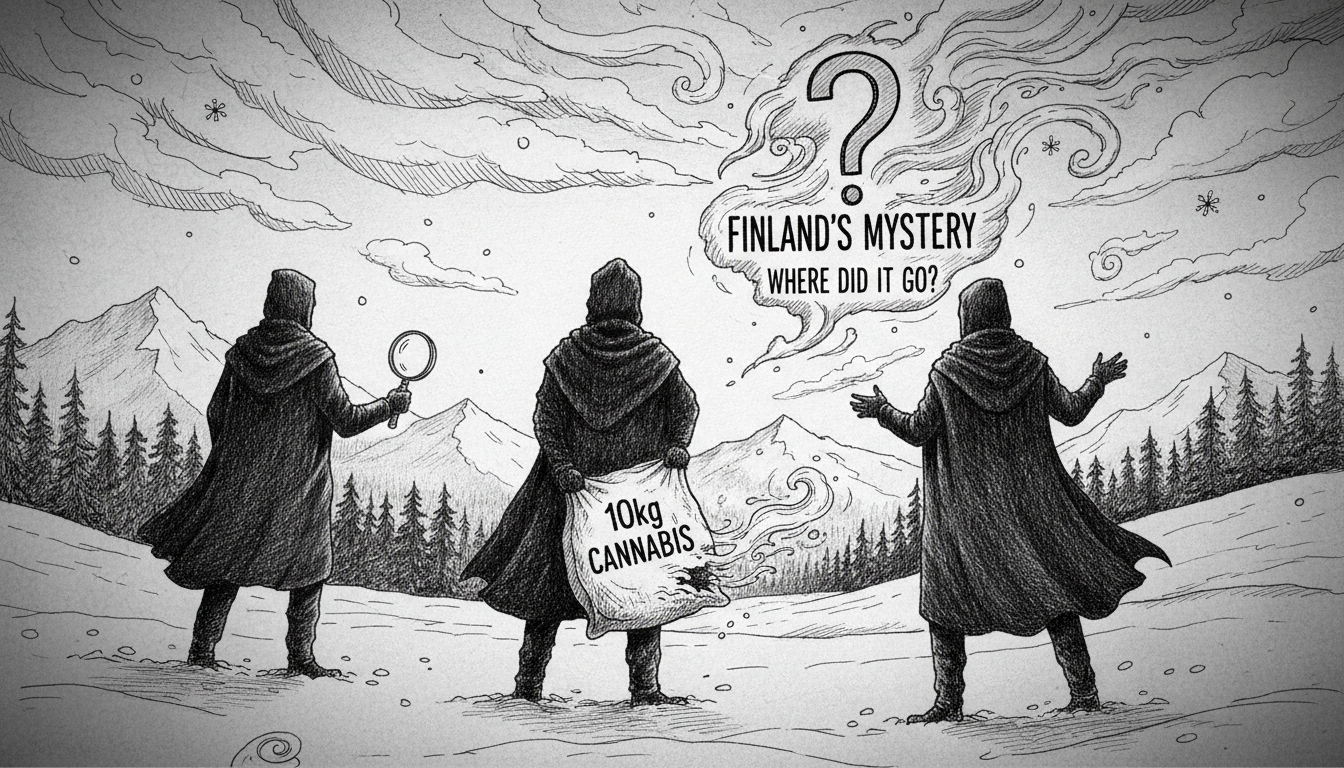
Finland's largest cannabis case this year has left authorities with an unsolved puzzle. A massive ten-kilogram haul of processed marijuana vanished without a trace from a suburban home, leaving prosecutors with a major case but no central piece of evidence. The disappearance has exposed a bizarre flaw in a major police operation and raised sharp questions about evidence handling protocols.
A Suburban Farm Uncovered
It began when the owner of a detached house in Kirkkonummi, a affluent municipality west of Helsinki, made a shocking discovery. The young man renting the property had not been cultivating tomatoes. Upon finding hundreds of cannabis plants, the landlord immediately contacted the police. Officers from the Western Uusimaa police department swiftly moved in, seizing the sophisticated indoor growing equipment and arresting the tenant in his twenties. In his initial police interview, the suspect was candid about his motives. "The operation got out of hand when money started coming in so fast," he stated, according to the pre-trial investigation report. His admission pointed to a commercial operation far beyond personal use.
The scale was significant. Hundreds of plants in various stages of growth filled the rooms, requiring specialized lighting, irrigation, and ventilation systems. For Finnish law enforcement, it represented a successful interception of a substantial illegal enterprise. The plants were documented, seized, and presumably secured as criminal evidence. This is where the standard procedure appears to have broken down. Between the initial seizure and the subsequent trial, the processed cannabis product—approximately ten kilograms—disappeared. The defendant later claimed in court that he believed the police had confiscated it all. The police, however, had no record of collecting the final, harvested product from the premises.
A Gap in the Chain of Custody
The case proceeded through the Kirkkonummi District Court with a central void. Prosecutors argued for a conviction based on the cultivation operation itself, which was well-documented with photographs and witness statements from the arresting officers. However, the absence of the physical drugs complicated the full assessment of the crime's severity and potential sentencing. Under Finnish law, drug offenses are penalized based on the type and quantity of the substance. The missing ten kilograms represented the most tangible proof of the operation's output and commercial intent. Without it, the court had to rely on expert estimates based on the number of plants seized.
This incident is not just a curious anecdote. It strikes at the core of judicial integrity—the chain of custody. This legal principle requires documenting the secure handling of evidence from the moment of seizure to its presentation in court. A break in this chain can compromise prosecutions. Senior legal experts in Helsinki suggest two plausible, yet troubling, scenarios. Either the evidence was misplaced or mislabeled within police storage—a serious administrative failure—or it was stolen from the property after the police left but before the defendant was fully in custody. The latter possibility hints at the involvement of other individuals connected to the operation.
Finland's Stance in a Changing Europe
The case unfolds against the complex backdrop of Finnish and European narcotics policy. Finland maintains some of the EU's strictest anti-cannabis laws. Possession, use, and cultivation are illegal, with no allowances for medical or recreational use. The country's approach emphasizes a dual track of law enforcement and harm reduction, focusing on public health. However, societal attitudes and the policies of neighboring countries are creating pressure. Estonia tolerates small-scale personal use, and Germany recently moved to legalize cannabis for adult recreational use. This shifting landscape makes cross-border trafficking and domestic black-market operations increasingly attractive and complex to police.
Organized crime groups are adept at exploiting such discrepancies. The scale of the Kirkkonummi operation—hundreds of plants yielding an estimated ten kilos—aligns with patterns of commercial, rather than hobbyist, cultivation. Detective Superintendent Marko Forss of the National Bureau of Investigation has previously noted that large-scale indoor grows in residential areas are often linked to criminal networks seeking to minimize risk. "These operations are business investments for organized crime," Forss said in a recent seminar on drug trends. The mystery of the missing harvest could point to the efficiency of such a network in recovering its assets, even after police intervention.
Policy Repercussions and Unanswered Questions
Beyond the courtroom, this incident forces a review of operational protocols. The Finnish Police Board has standard operating procedures for drug seizures, which include detailed logging, secure packaging, and immediate transport to designated evidence facilities. The Kirkkonummi case suggests a potential lapse in following these protocols at a critical stage. Parliament's Administrative Committee may request a report on evidence handling procedures if similar cases emerge. For the public, it risks eroding confidence in the system's ability to control the very illicit materials it confiscates.
The human element also remains. The young man, now convicted for aggravated drug offenses based on the cultivation evidence, faces a sentence reflecting a major production operation. Yet, the strange disappearance of the harvest's yield leaves a lingering question mark over the full story. Did an associate remove the processed cannabis? Was it a catastrophic bureaucratic error? The police have closed their investigation into the disappearance due to a lack of leads, according to court documents.
This case serves as a stark reminder of the challenges in enforcing rigid drug laws in an interconnected region. It highlights the logistical difficulties police face, from discovering hidden grows to securing every gram of evidence. As Europe's cannabis landscape fractures into a patchwork of different laws, Finnish authorities may find themselves investigating more high-volume, profit-driven operations. The ten-kilogram mystery in Kirkkonummi is more than a single evidence mishap. It is a symptom of the immense pressures and complexities surrounding drug enforcement in modern Scandinavia. The ultimate fate of the cannabis may never be known, but the case's impact on procedure and policy will likely be felt for years to come.