
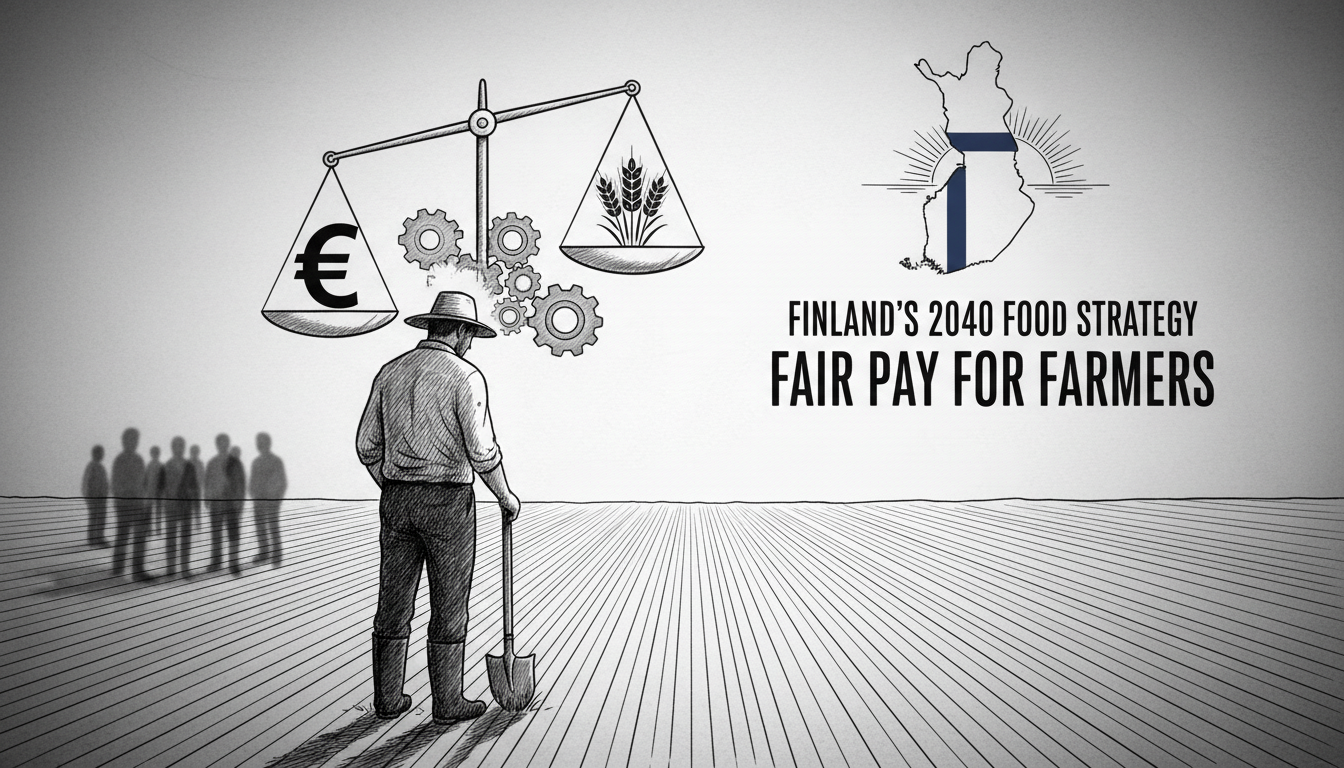
Finland's Ministry of Agriculture and Forestry has launched a new national food strategy designed to reshape the entire food system by 2040. The comprehensive roadmap prioritizes responsibility, sustainability, and collaboration across the supply chain, with a central goal of making farming economically viable and ensuring fair compensation for producers. This ambitious 15-year plan directly tackles the current imbalance where consumer spending on food does not translate into a livable income for many farmers.
A Vision for a Just and Sustainable Food Chain
The newly published strategy serves as a foundational blueprint for the future of Finnish food. It outlines four primary objectives, with the profitability and fairness for farmers positioned as a critical first step. The document states that agricultural production is currently not economically sustainable for many operators. The strategy's explicit target is to alter this dynamic so that within 15 years, farmers have genuine negotiating power to determine fair compensation for their products. This represents a significant policy shift towards rebalancing power within the food economy, moving beyond traditional subsidy models.
"The goal is to change the setup so that in 15 years, farmers will have a real opportunity to negotiate how much compensation they receive for their product," the strategy asserts. This focus on equity acknowledges a systemic flaw: the euros paid by consumers for food are not distributed fairly back to the primary producers. The strategy frames a future where Finland is a "country of happy food," implying satisfaction and fairness at every link, from field to fork.
Navigating the EU Framework and National Ambitions
Finland's agricultural policy does not exist in a vacuum; it is deeply integrated within the European Union's Common Agricultural Policy (CAP). The CAP provides a framework of income support for farmers, market measures, and rural development funding, all with increasing emphasis on environmental and climate goals. Finland's national strategy must therefore operate within this EU structure while addressing specific national challenges, such as its short growing season, remote northern regions, and high production costs.
Experts point out that the success of the Finnish strategy will depend on its alignment and potential tension with evolving CAP directives. "The ambition to enhance farmer profitability and negotiating power is commendable, but the mechanisms matter," says Dr. Elina Järvensivu, a research fellow specializing in sustainable food systems at the University of Helsinki. "Will this come from mandatory EU-level supply chain fairness regulations, from national fiscal tools, or from fostering new cooperative business models? The strategy sets the direction, but the policy instruments are yet to be fully detailed."
The strategy's other pillars—focusing on responsibility, sustainability, and collaboration—directly mirror the EU's Farm to Fork strategy, which aims to make European food systems fair, healthy, and environmentally friendly. This synergy suggests Finland is positioning itself as an active implementer of broader European green transition goals, potentially seeking to lead by example in the Nordic context.
The Consumer Conundrum: Will Food Prices Rise?
A central question emerging from the strategy's focus on farmer income is the potential impact on consumer prices. If a greater share of the food euro is to be redirected to the producer level, it could necessitate higher retail prices unless efficiencies are found elsewhere in the supply chain. The strategy emphasizes sustainability and responsibility, which often involve production methods that have higher upfront costs than conventional intensive farming.
"There is an inherent tension between fair producer prices, environmental sustainability, and affordable food," explains Järvensivu. "The strategy implicitly asks whether Finnish consumers are willing to pay more for food that is locally produced, environmentally sound, and supports a fair livelihood for farmers. Public education and transparency will be crucial." The document likely anticipates this by framing the future of Finnish food as a collective national project, where consumer choice supports domestic resilience and ethical standards.
This approach aligns with existing Finnish consumer trends that show growing interest in organic produce, local origin, and animal welfare. The strategy may aim to accelerate this shift, creating a premium market for Finnish food that justifies its cost structure. However, it also raises questions about socio-economic equity and ensuring access to healthy, sustainable food for all income groups—a challenge the strategy will need to address.
From Blueprint to Reality: The Road to 2040
The publication of the strategy is only the first step. Translating its vision into concrete legislation, business practices, and consumer behavior will require sustained political will and cross-sector cooperation. The Ministry of Agriculture and Forestry will need to work closely with other ministries, including those for Economic Affairs, Environment, and Social Affairs and Health.
Key measures to watch for in the coming years will include potential legislative proposals on supply chain contracts to prevent unfair trading practices, increased investment in agricultural research and innovation for sustainable productivity gains, and support for farmer cooperatives to strengthen their market position. The role of digital platforms and direct sales from farms to consumers is also likely to be expanded as a way to shorten the supply chain and increase producer margins.
Furthermore, the strategy's success is tied to Finland's ability to advocate for its priorities at the EU level. Pushing for stronger EU-wide regulations that ensure fairness in the food supply chain would create a level playing field and prevent market distortions. Finnish ministers and MEPs are expected to use this national strategy as a mandate in Brussels negotiations, particularly during the next reform of the Common Agricultural Policy.
A Nordic Model for Food?
Finland's strategy enters a landscape where other Nordic countries are also re-evaluating their food systems. Sweden and Denmark have strong agricultural export sectors with different structural challenges, while Norway maintains high tariff barriers to protect its domestic production. Finland's approach appears distinct in its explicit, time-bound commitment to recalibrating economic power within the chain as a prerequisite for overall sustainability.
If successful, Finland could present a "Nordic model" for food that balances market economics with strong social and environmental safeguards. This model would be characterized by high levels of trust, transparency, and collaboration between farmers, processors, retailers, and consumers. It leverages the country's reputation for clean nature and good governance to build a brand for Finnish food that commands value both domestically and in export markets.
The journey to 2040 will test Finland's capacity for long-term systemic planning. The vision of a "country of happy food" is compelling, but its realization hinges on navigating complex trade-offs, securing stable funding, and maintaining consensus over multiple electoral cycles. The strategy sets a bold destination; now the difficult work of building the road begins. Will Finland's farmers finally get their fair share, and will consumers buy into this new food future? The next few years of policy implementation will provide the first concrete answers.