
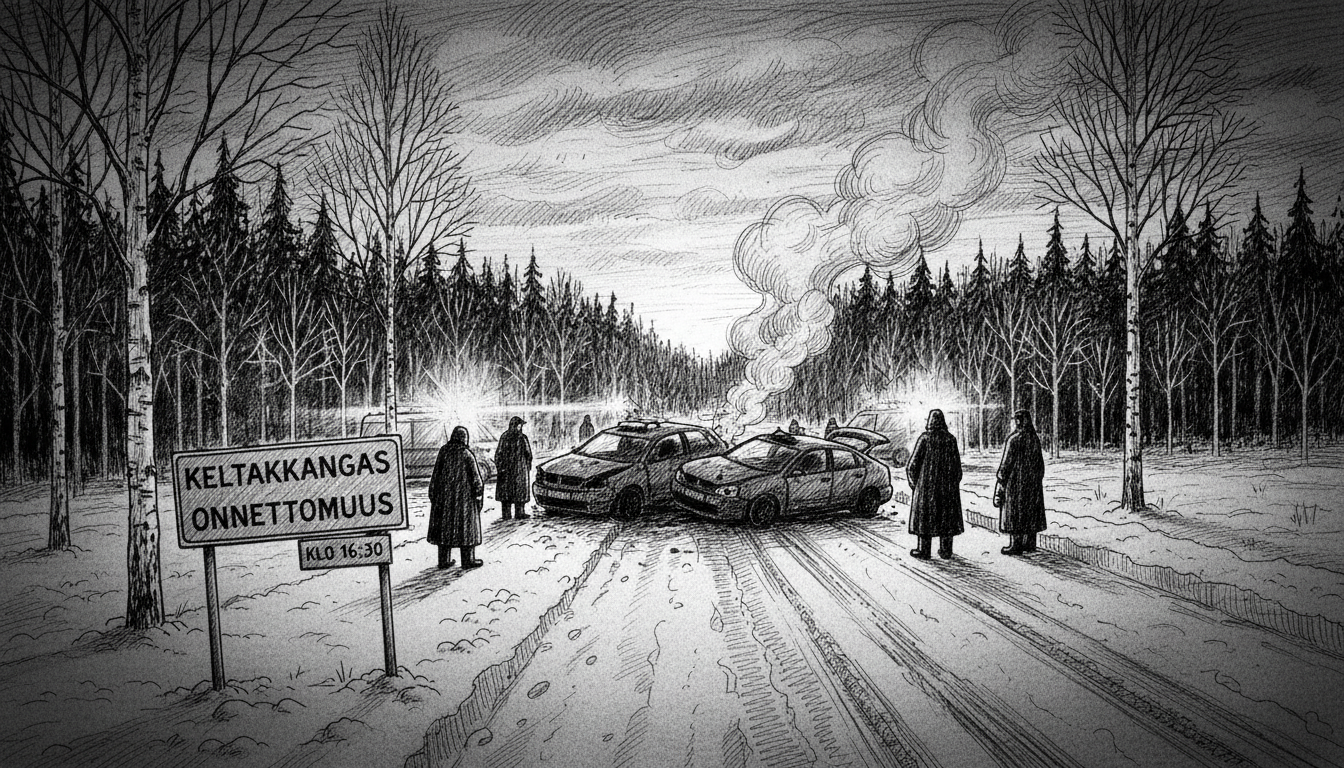
Finland traffic accident on Matarojantie saw a passenger car and bus collide laterally on Wednesday afternoon, causing material damage but no injuries. The Keltakangas area incident, occurring around 4:30 PM, highlights routine road safety challenges even in a nation with globally recognized safe infrastructure. Police attended the scene to document the collision between the two vehicles traveling in different directions, a common investigation procedure for all road incidents regardless of severity.
A Collision Without Casualties
The specifics of the Keltakangas collision point to a side-impact, or broadside, event. This type of accident often occurs at intersections or when vehicles merge, though the official police report will determine the exact cause. The passenger car sustained what was described as 'some damage,' while the bus, a larger and heavier vehicle, was likely less affected. The fact that no one was injured, despite the force required to damage a car's side panels, speaks to both modern vehicle safety standards and perhaps fortunate circumstances. All occupants were able to exit their vehicles without requiring medical attention, a key detail that separates this from more serious traffic reports.
Finland's extensive protocol for traffic incident management would have been activated. Local police from the Pirkanmaa region secured the scene, facilitated any necessary traffic diversion, and began preliminary documentation. This data feeds into national statistics maintained by Trafi, the Finnish Transport and Communications Agency. Even minor accidents are logged, creating a comprehensive picture of road safety that informs infrastructure spending and policy adjustments.
The Broader Context of Finnish Road Safety
This incident in a residential area of Tampere occurs against the backdrop of Finland's long-term, systematic approach to road safety. The country is consistently ranked among the safest in the world for road travel, a result of strict legislation, extensive driver education, and continuous infrastructure investment. The national goal, aligned with the EU's Vision Zero strategy, is to eliminate all traffic fatalities and serious injuries. Every accident, including non-injury ones like the Keltakangas collision, is analyzed as part of this preventative framework.
Official statistics provide crucial context for understanding this single event. In 2023, Finland recorded 242 fatal road accidents, a number that authorities work relentlessly to reduce. The same year saw 4,193 injury-causing road accidents reported nationwide. While these figures are low by international comparison, they represent the core focus of agencies like Trafi and the Finnish Road Safety Council (Liikenneturva). Their work includes analyzing accident blackspots, promoting winter tire use, and campaigning against distracted and impaired driving.
'Every incident holds information,' explains a traffic safety analyst familiar with Finnish methods. 'The time—4:30 PM—places it in the afternoon rush hour, a period of increased traffic density and potential driver fatigue. The location on Matarojantie, a local road, will be examined for sight lines, signage, and road surface conditions. The fact it was a bus and a car raises questions about right-of-way and visibility. No injury is a positive outcome, but the mechanism of the crash is still valuable data for prevention.'
Infrastructure and the Human Factor
Finland's climate and geography pose unique challenges to road safety, making its achievements more notable. Roads like Matarojantie must be designed and maintained for extreme winter conditions, including ice, snow, and limited daylight for much of the year. The government allocates significant portions of its transport budget to maintenance and safety upgrades, such as improved lighting, better road markings, and safer pedestrian crossings. These investments aim to create a forgiving road system that reduces the consequence of human error.
The human factor remains central. Finnish driver's education is rigorous, and traffic law enforcement is strict, with a low tolerance for speeding or driving under the influence. The cultural attitude toward traffic safety is deeply ingrained, with most citizens viewing strict regulations as a collective social responsibility rather than a personal imposition. This shared culture is a critical, if intangible, component in maintaining low accident rates. It emphasizes that safety is not solely the government's duty but a daily commitment by every road user.
From Local Incident to National Policy
The pathway from a Wednesday afternoon crash in Keltakangas to national policy is systematic. Data from this incident will be anonymized and aggregated. If Matarojantie or similar junctions see repeated incidents, even minor ones, it can trigger a local safety review. This might lead to low-cost measures like trimming vegetation for better visibility, repainting road markings, or adjusting speed limits. In more complex cases, it could contribute to evidence for larger infrastructure projects.
This data-driven approach is a hallmark of Finnish governance. The Eduskunta, Finland's parliament, bases transport funding and legislative changes on empirical evidence collected from across the country. Recent government debates have focused on further reducing serious accidents, with discussions around lower urban speed limits and enhanced pedestrian protections. Each debate is grounded in the statistical reality provided by reports following incidents like the one in Keltakangas.
A Reminder of Constant Vigilance
The Keltakangas collision serves as a microcosm of modern traffic safety: a routine event with no tragic outcome, yet still a point of analysis in a system striving for perfection. It underscores that road safety is a continuous process of improvement, not a fixed achievement. For Finnish authorities, the goal is not just to react to accidents but to predict and prevent them through design, education, and regulation.
As traffic resumes its normal flow on Matarojantie, the work of prevention continues in offices and planning meetings across Finland. The ultimate question remains: how can the lessons from a minor, non-injury collision be applied to prevent a major one elsewhere? The answer lies in the meticulous Finnish practice of leaving no road incident unexamined, ensuring every piece of data contributes to the larger mission of protecting lives on the move.