
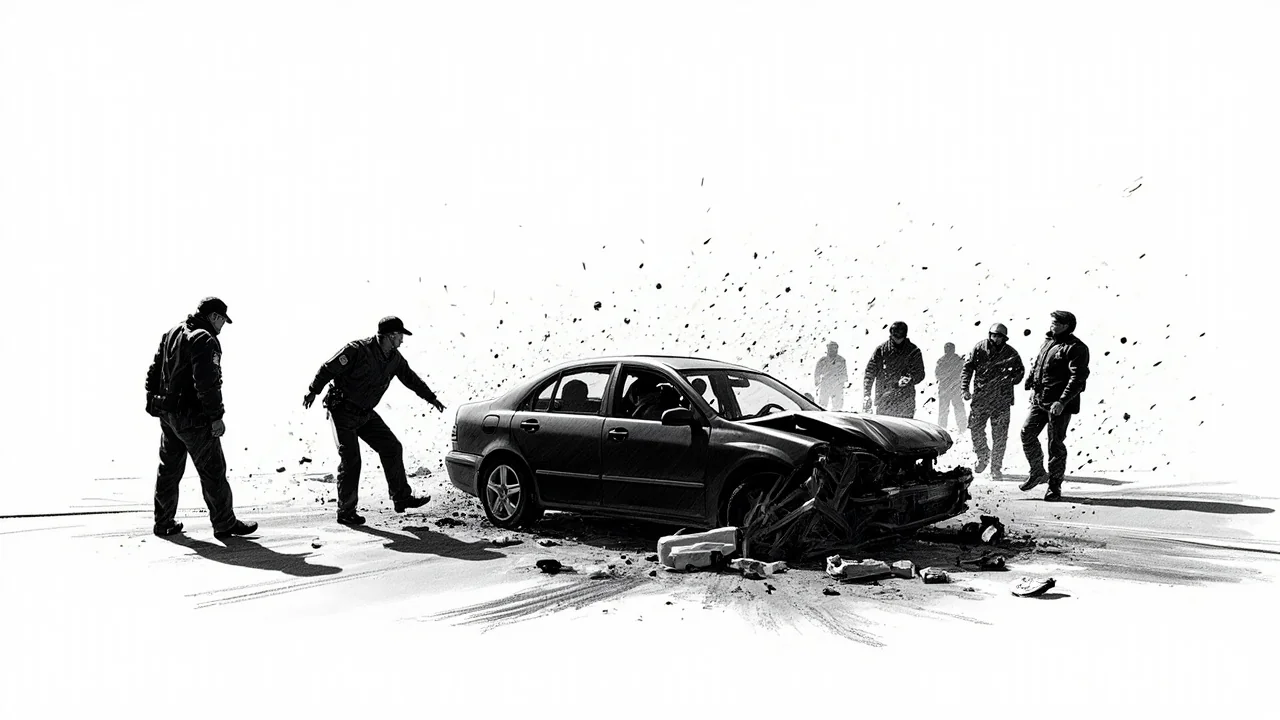
Finland's Häme Police District logged 548 emergency calls over a single weekend, a workload snapshot revealing traffic dangers from impaired driving to a serious collision. The most dramatic incident occurred on Oitintie road in Hausjärvi, where a car driver crashed into a parked truck trailer, sustaining injuries in the Friday morning accident. Police reported the crash on Sunday amid a broader weekend operation that caught multiple drivers under the influence of drugs and alcohol.
A Weekend of High Police Demand
The 548 tasks handled by police across the Kanta-Häme and Päijät-Häme regions illustrate the constant pressure on Finnish law enforcement. Patrols were required across a wide spectrum of incidents, from traffic monitoring to intervening in disruptive behavior in public spaces and private homes. This volume of calls, while not unprecedented for a weekend, underscores the operational tempo maintained by local police departments. The data provides a concrete example of the daily challenges faced in maintaining public order and road safety across Finnish municipalities, far from the political debates in Helsinki's government district.
The Hausjärvi Collision: A Failure to Perceive
The Hausjärvi crash on Oitintie presents a stark case of failed situational awareness. According to police, the driver was traveling along the road and did not notice that something was parked on the side. By the time the driver realized it was a stationary truck trailer, it was too late to avoid a collision. The car impacted the trailer and remained lodged there, requiring emergency response. The driver suffered injuries in the crash, though the police statement did not specify their severity. This incident immediately raises questions about driver attention, road design, and the regulations governing the parking of large vehicles on public roadways, especially in areas with potentially limited visibility.
Such accidents, while often categorized as single-vehicle incidents, frequently point to systemic issues. Analysts examining traffic safety note that the parking of large, potentially low-contrast objects like trailers on road verges can create significant hazards, particularly in low-light conditions or on roads without adequate lighting. The Finnish Transport and Communications Agency, Trafi, continuously collects data on these types of collisions to inform safety regulations and driver education campaigns. This crash will likely be added to that dataset, contributing to the ongoing national effort to reduce serious traffic injuries.
The Broader Trend: Impaired Driving Detections
Parallel to the crash investigation, police patrols made several traffic stops that resulted in arrests for impaired driving. The weekend's operations revealed a concerning pattern: most of the apprehended drivers showed positive results in rapid drug tests. Only one of those caught was detained specifically for alcohol intoxication. This ratio highlights a persistent and shifting challenge in Finnish traffic safety—the prevalence of drug-impaired driving.
For years, Finnish authorities have tracked a gradual increase in drug-related traffic offenses, even as alcohol-related incidents have shown a general decline due to strict enforcement and cultural shifts. The possession of drug test equipment in patrol cars has become standard, allowing officers to conduct preliminary screenings at the roadside. A positive rapid test typically leads to a blood test for confirmation and precise quantification of substances. The high number of positive tests from a single weekend's targeted patrols suggests that drug use among a segment of drivers remains a serious and common risk factor on the roads.
Policy Context and Enforcement Challenges
This weekend's events occur against a backdrop of ongoing political and legislative discussion in the Eduskunta about resourcing for police and strategies for combating substance abuse. The Finnish government's current program emphasizes public safety, but local police districts often operate with stretched resources. Handling 548 diverse calls—from domestic disputes to traffic enforcement and accident response—demonstrates the wide mandate of the police force. Each drug-driving arrest involves a time-intensive process of testing, documentation, and legal procedure, diverting officer hours from other patrol duties.
Traffic safety experts point to the need for a multi-pronged approach. Enforcement acts as a critical deterrent, but it must be coupled with public education about the severe impairment caused by illicit drugs and certain medications. The penalties for drug-driving in Finland are severe, including heavy fines, mandatory loss of driving license, and potential imprisonment for aggravated offenses. Furthermore, the EU's road safety policy framework, which Finland actively helps shape, increasingly focuses on tackling drug-impaired driving through cross-border research and harmonized best practices for detection.
Analysis: A Snapshot of Provincial Policing
The release of this weekend tally by Häme Police serves a dual purpose: it informs the public and provides a transparent look at operational realities. Unlike major metropolitan areas like Helsinki, districts covering regions like Kanta-Häme manage vast geographical areas with smaller, dispersed populations. This necessitates strategic patrol deployment and can sometimes mean longer response times. The 548 tasks represent not just 548 incidents, but hundreds of decisions, reports, and interactions that define community policing in Finland.
The Hausjärvi crash, while unfortunate, is a statistically predictable event within national road safety models. Finland has made tremendous progress in reducing traffic fatalities over decades, but single-vehicle collisions and those involving stationary objects remain a stubborn category. Each such event triggers a standard investigation to determine if road conditions, vehicle factors, or driver error were the primary cause. The findings contribute to micro-level adjustments, such as improved signage or parking restrictions, and macro-level policy discussions in the Ministry of Transport and Communications.
Similarly, the drug-driving arrests are a direct outcome of intelligence-led policing. Patrols are often directed to specific times and locations based on historical data about impaired driving. The high yield from these efforts validates that strategy but also paints a sobering picture of driver behavior. It suggests that despite known risks and consequences, a segment of the population continues to engage in this dangerous activity. This challenges policymakers to look beyond enforcement to the root causes of substance abuse and mobility patterns in rural and semi-rural areas.
The Human and Systemic Cost
Behind the number 548 are individuals in distress, victims of accidents, and officers managing complex situations. The injured driver in Hausjärvi now faces a recovery process and a likely insurance investigation. Each detained driver faces life-altering legal repercussions. The police officers involved balance the demands of procedure with the need for public service and safety. The system itself bears the cost in resources, from fuel for patrol cars to laboratory fees for blood analysis.
This weekend snapshot from Häme is not an anomaly but a regular occurrence across Finland. It reflects the unglamorous, essential work of maintaining a safe society. It also highlights the intersection points where individual choices—to use drugs, to not pay full attention to the road—collide with public safety systems. The effectiveness of those systems is measured in response times, detection rates, and ultimately, in the prevention of tragedies. As Finland continues to debate national budgets and police funding, data-driven reports from the front lines of provincial policing provide crucial evidence for where investments in manpower, technology, and prevention programs are most urgently needed. Will the lessons from weekends like this one translate into more targeted resources and smarter safety strategies, or will they remain just another statistic in an endless cycle of response?