
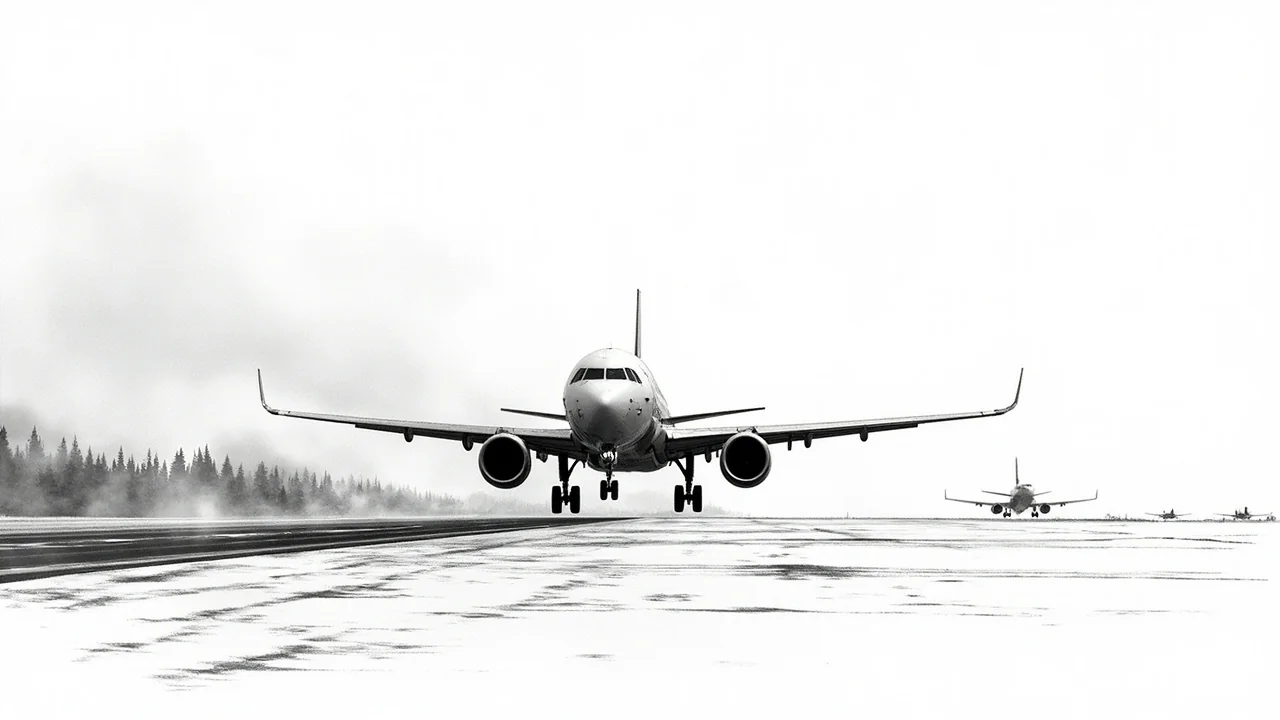
Finland's extreme winter weather has grounded flights in Lapland with temperatures of -34 degrees Celsius, revealing a critical operational paradox: commercial aircraft routinely cruise at altitudes where temperatures plummet below -50C, yet cannot safely depart from a frozen runway. This week, all arriving and departing flights at Kittilä Airport were cancelled as the mercury dipped to -39.1C, stranding travelers and highlighting a precise, temperature-dependent safety procedure that few passengers consider.
Finnair's operational control center chief, Jari Paajanen, explains the science behind the standstill. "Before an aircraft takes off, its wings and other aerodynamically critical surfaces are cleaned of frost, ice, and snow," Paajanen said. This de-icing ensures smooth airflow over the wings, guaranteeing proper lift. The specific fluid used in this process has a manufacturer-mandated minimum operating temperature of -34C, a limit airlines strictly follow. In extreme cold, the fluid becomes viscous, compromising its effectiveness and making safe de-icing impossible.
The Crucial Ground-to-Air Transition
The core issue lies in the different physical conditions during takeoff versus high-altitude flight. On the ground, a stationary or slow-moving aircraft is susceptible to precipitation—snow, frost, or freezing fog—adhering to its surfaces. If these contaminants are not completely removed, they disrupt laminar airflow, which can drastically reduce lift during the critical takeoff phase. Once airborne at cruising speed and altitude, the physics change completely. The high velocity prevents new accumulation, and the extremely cold, dry air at 30,000 feet does not pose the same icing risk as moist, snowy conditions on the tarmac.
This creates the seemingly illogical scenario passengers in Kittilä faced. An aircraft designed for the harsh environment of the upper atmosphere was rendered immobile by Lapland's deep freeze. The problem is not the plane's capability but the procedural safety net required to launch it. "De-icing is not automatically needed just because it is cold," Paajanen noted. Dry, cold weather might not require treatment, but any snowfall necessitates the procedure, tying operations directly to the specific fluid's physical limits.
Economic and Logistical Ripple Effects
The cancellations at Kittilä Airport, a major gateway for Lapland's vital tourism industry, demonstrate how a precise technical limit can trigger broad economic disruption. Lapland's economy is heavily seasonal, relying on winter tourism centered around resorts like Levi and Ylläs, which are serviced by Kittilä. Flight cancellations during peak season directly affect hotel bookings, tour operators, and local businesses, underscoring the region's vulnerability to extreme weather events that are becoming more frequent.
For airlines like Finnair, which markets itself as a specialist in northern conditions, these events test operational resilience and communication strategies. Rerouting passengers, managing aircraft rotations, and providing timely information become immense logistical challenges. The situation also exposes the limitations of infrastructure. While airports in colder climates may use more cold-resistant fluids, these come at a higher cost and may have other trade-offs, such as environmental impact or different handling requirements.
A Nordic Operational Reality
This incident is not unique to Finland but is a stark example of the operational realities faced by all Nordic aviation sectors. Airports in Norway, Sweden, and Iceland similarly contend with harsh winter conditions, each with their own protocols aligned with fluid manufacturer specifications. The Finnish case is particularly illustrative due to the severity of the cold and the clarity of the -34C threshold. It raises questions about adaptation and innovation. Are there technological solutions on the horizon, such as new de-icing fluid chemistries, heated surface technologies, or improved forecasting that could minimize disruptions?
From a policy perspective, the event highlights the silent, non-negotiable regulations that govern aviation safety. These protocols, often invisible to the public, are dictated by global standards and manufacturer testing, leaving airlines and airports with little flexibility. The Finnish Transport and Communications Agency (Traficom) oversees these operations, ensuring strict adherence to safety regulations that prioritize risk mitigation over convenience, even when the economic stakes for a region are high.
The Human Element in the Deep Freeze
Beyond the technical explanations and economic impacts, the grounding of flights is ultimately a human story. Travelers, including families on holiday and workers commuting to and from the north, found themselves stranded, requiring rebooking and accommodation. For local residents, such disruptions are part of life in the Arctic, but they underscore the region's relative remoteness and dependence on air bridges that remain susceptible to the elements. The incident serves as a reminder of the human dependency on complex technological systems that function within very narrow environmental parameters.
Finnair's communication, citing the specific -34C limit, is part of a broader effort to educate the public on aviation safety's uncompromising nature. In an age where passengers often view air travel as a routine commodity, extreme weather events reveal the intricate safety architecture that makes flight possible. The airline's decision to cancel all operations, rather than attempt marginal operations, reflects a deeply ingrained safety culture where procedural compliance is paramount.
Looking Ahead: Climate and Adaptation
As climate patterns shift, the frequency and intensity of extreme weather events may increase, posing ongoing challenges for Arctic and sub-Arctic aviation. This incident in Kittilä provides a case study in climate adaptation for critical infrastructure. It forces a conversation about whether current technologies and protocols are sufficient for future conditions. Investment in airport infrastructure, research into more robust de-icing solutions, and enhanced contingency planning will be crucial for maintaining reliable connectivity to northern regions.
The paradox of the aircraft that can conquer the cold of the stratosphere but is defeated by a Lapland winter morning is a powerful illustration of context. It underscores that engineering marvels operate within ecosystems of supporting technologies, each with its own breaking point. For Finland, a nation adept at navigating winter, the event is a testament to respecting the absolute boundaries of safety, even when it means accepting the temporary triumph of nature over technology. The silence at Kittilä Airport was not a failure of engineering, but a rigorous, if inconvenient, affirmation of its success.