
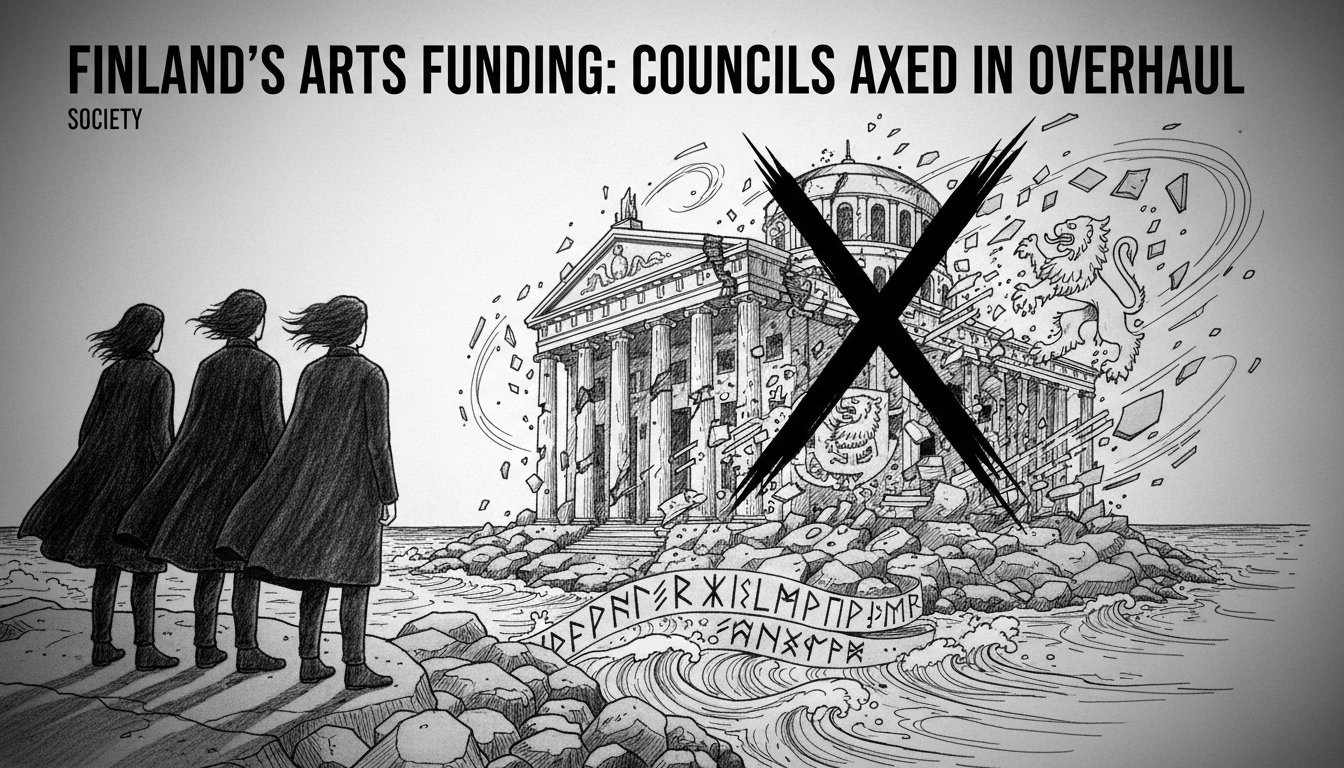
Finland's arts funding system is undergoing its most significant reorganization in decades, phasing out regional arts councils in favor of a centralized panel model. The Arts Promotion Centre Finland (Taike) confirmed that its 20 specialized and regional arts committees will cease operations next summer, a move the government says will streamline decision-making but that artists fear may homogenize support and disconnect it from local realities. This restructuring is part of a wider push for administrative efficiency led by Prime Minister Petteri Orpo's coalition, raising fundamental questions about how a nation priding itself on cultural accessibility distributes its resources.
Artists Fear Loss of Local Voice
The decision to dissolve the regional arts councils (alueelliset taidetoimikunnat) strikes at a core principle of Finland's cultural policy: decentralized access. For years, these councils, composed primarily of working artists from their regions, assessed applications and distributed state grants. Their impending closure this summer means decisions for artists in Lapland, Southwest Finland, or Kainuu will now be made by temporary evaluation panels assembled in Helsinki. "Taide- ja kulttuurineuvosto (The Arts and Culture Council) makes decisions on grants and awards based on the preparation of the panels," the new Arts and Culture Agency (Kuvi) stated in a release. Critics argue this severs a vital feedback loop where local practitioners understood local needs, from Sami cultural projects in the north to Swedish-language theatre on the coast.
The Government's Efficiency Drive
This shift is not an isolated event but a deliberate policy choice embedded in the current government program. The Ministry of Education and Culture, led by Minister Sari Multala (National Coalition Party), is executing a broader mandate to consolidate agencies and reduce administrative overlap. The establishment of the independent Arts and Culture Agency (Kuvi) – which operates separately from Taike – is a central part of this architecture. Officials frame the move from permanent regional councils to ad-hoc expert panels as a modernization effort, promising more flexible and dynamic evaluation processes. The government assures that the total funding pool for regional arts, approximately 7 million euros annually, is not under immediate threat. The core argument from Helsinki's government district is one of agility: why maintain 20 standing committees when you can convene specialized panels as needed from a national expert bank?
How the New System Will Operate
Under the new framework, Taike will manage the grant application process, but the evaluative heavy lifting will transfer. Instead of a painter in North Ostrobothnia applying to a council familiar with their regional scene, their work will be assessed by a panel drawn from Kuvi's national "expert bank." These panels will be assembled for specific grant rounds, with members selected for their professional expertise rather than regional representation. Proponents say this will heighten quality and objectivity, ensuring the best art is funded regardless of geography. The Arts and Culture Council, a higher-tier body, will then make final awards based on panel recommendations. This system mirrors practices in some other European countries but marks a stark departure from Finland's traditionally regionalized approach. The Eduskunta's Education and Culture Committee has largely endorsed the model, seeing it as a necessary administrative rationalization.
Expert Warnings and Historical Context
Cultural policy scholars and arts union representatives are sounding alarms. "The risk is a centralization of taste and perspective," says Dr. Elina Juntunen, a researcher at the University of the Arts Helsinki. "A panel in Helsinki may intellectually understand the context of a community-based project in rural Etelä-Savo, but will they feel its necessity with the same urgency? The regional councils had that embodied knowledge." This change also disrupts a career path for artists, where serving on a local council was both a service role and a professional development opportunity. Historically, Finland's post-war cultural policy actively worked against Helsinki-centricity, building a network of institutions and funding streams to ensure creative life flourished nationwide. This move is seen by some as a step back from that commitment, potentially reinforcing the cultural dominance of the capital region. The Finnish Artists' Association (Suomen Taiteilijaseura) has expressed concern over the loss of peer-to-peer evaluation at the local level.
The Road Ahead for Finnish Culture
The true test of this overhaul will come in late 2025 when the first grant decisions under the fully new system are announced. Will the distribution maps show a continued geographic spread, or will funding begin to cluster around established networks and urban centers? The Ministry of Education and Culture has promised monitoring, but artists seek guarantees. Furthermore, the separation of functions between Taike, which continues to exist and promote the arts broadly, and the decision-making authority of Kuvi's panels creates a new bureaucratic divide. As Finland simultaneously navigates its EU cultural partnerships and domestic budget pressures, the equilibrium between efficiency and equity remains fragile. The dissolution of the regional councils is more than an administrative tweak; it is a recalibration of who decides what Finnish art is and where it deserves to live. The coming years will reveal whether a centralized expert bank can truly hold the diverse landscape of Finnish creativity, or if local voices will become harder to hear above the consensus of a national panel.