
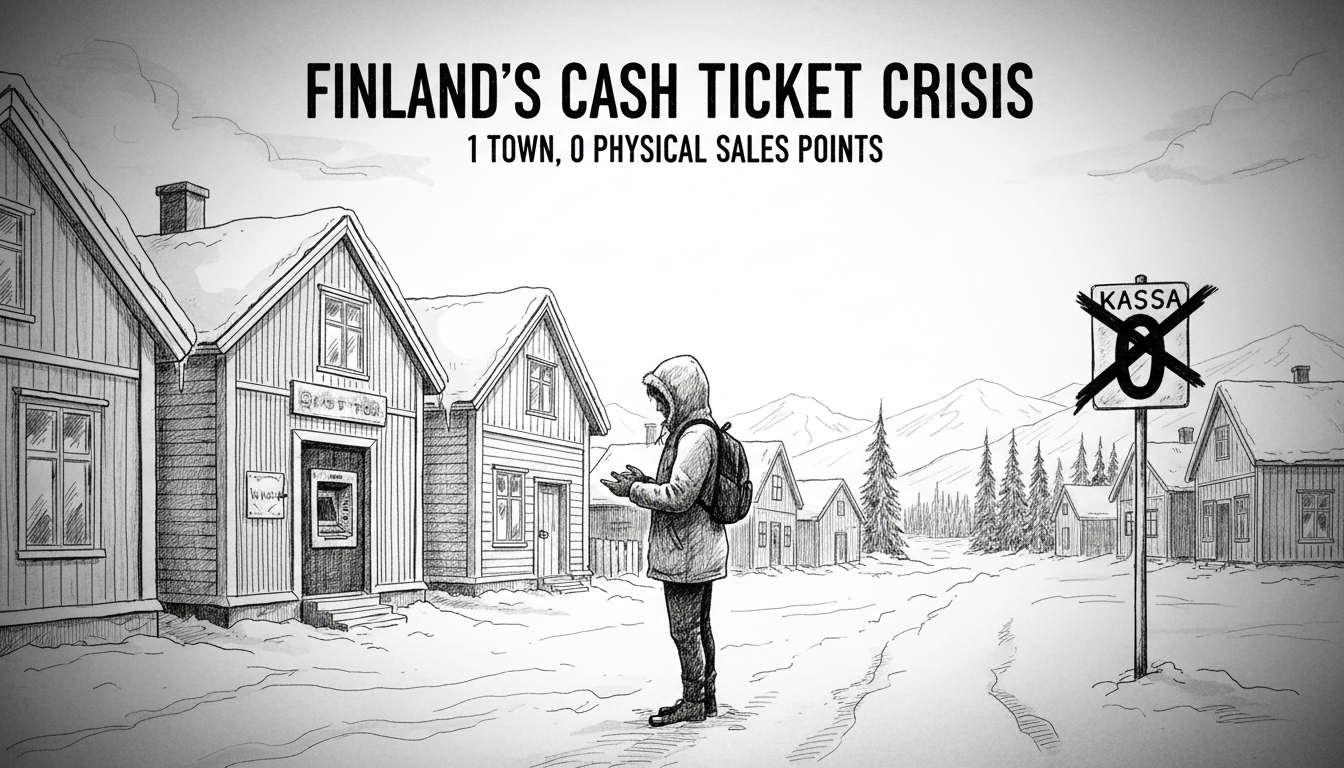
Finland's state railway operator VR has eliminated its last physical ticket sales point in the town of Hyvinkää, forcing all passengers to use digital channels. The closure of the Hämeenkatu R-kioski on December 2nd marks a significant step in VR's nationwide shift away from cash transactions and physical sales networks, raising urgent questions about accessibility in an increasingly digital public transport system.
For residents like elderly pensioners or those without smartphones, the disappearance of the familiar R-kioski counter represents more than an inconvenience. It is a barrier to mobility. "I've bought my tickets here for twenty years," said one local resident, who asked not to be named. "My phone is just for calls. Now I have to ask my grandson for help, or I can't visit my sister in Helsinki." This sentiment echoes across smaller Finnish municipalities as VR accelerates its digital transition.
The Vanishing Network of Physical Sales Points
VR's partnership with the R-kioski chain has been a cornerstone of Finnish transport infrastructure for decades. These ubiquitous convenience stores acted as de facto satellite ticket offices, especially in towns without major manned stations. The closure in Hyvinkää, a town of 47,000 people located 50 kilometers north of Helsinki, is not an isolated incident. It is part of a deliberate strategy. VR's Director of Regional Traffic, Pekka Mäntyniemi, confirmed the trend in a statement. "Ticket sales are moving strongly to digital channels," Mäntyniemi said. "We are constantly developing our service network based on customer behavior and sales figures."
This development means evaluating the profitability of each physical outlet. When an R-kioski closes for business reasons, as happened in Hyvinkää, VR does not automatically seek a replacement vendor. The decision is economic. Digital tickets cost less to administer and eliminate the handling of cash. For the company, the logic is clear. For the customer without a bank card or digital literacy, the options are vanishing.
Digital Divide or Inevitable Progress?
The policy exposes a growing rift between urban and regional service expectations. In Helsinki, passengers have multiple options: digital apps, ticket machines at stations, and service counters. In smaller towns like Hyvinkää, the ecosystem is more fragile. Remove one element, and the entire structure for a segment of the population collapses. Experts point to this as a critical challenge in national transport policy.
"Public transport must be public in the truest sense, accessible to all," argues Dr. Laura Heikkilä, a researcher in transport equity at the University of Helsinki. "When a state-owned monopoly like VR makes a commercial decision to reduce physical access points, it is also making a social policy decision. It is deciding that the convenience of the majority outweighs the mobility rights of the minority. This requires a broader political discussion." Heikkilä's research indicates that the groups most affected are the elderly, low-income individuals, and some people with disabilities.
VR does offer alternatives, but they come with caveats. Tickets can be purchased online with a bank ID or credit card. The VR app is the primary promoted tool. For those who cannot or will not use these methods, tickets can be bought from the conductor on the train—but at a significantly higher price. This surcharge effectively penalizes cash users, creating a two-tier fare system.
A Microcosm of a National Trend
Hyvinkää's situation is a preview of a wider Finnish reality. VR's annual reports consistently highlight the growth of digital sales, which now account for the overwhelming majority of transactions. The remaining R-kioski sales points are under perpetual review. Each closure in a small or medium-sized town pushes the system further toward a fully digital model. The Finnish Transport and Communications Agency, Traficom, oversees these services but generally intervenes only on broad accessibility standards, not sales point density.
This trend aligns with broader European Union directives on digitalizing transport and promoting multimodal ticketing through smartphones. Finland, often a leader in digital adoption, is at the forefront of this shift. The question is whether the pace of change is leaving vulnerable citizens behind. The Finnish Parliament, the Eduskunta, has seen occasional questions on the matter from concerned MPs, but no major legislative push has emerged to mandate a minimum level of physical sales infrastructure.
The Human Cost of a Cashless Society
Beyond the statistics lies a simple human problem: trust and habit. For many, a paper ticket bought with cash from a known clerk is a tangible product. A digital ticket on a phone screen is an abstract concept, vulnerable to a dead battery or a software glitch. The removal of the cash option also removes a layer of anonymity and budget control for those who operate on a physical cash economy.
Local politicians in Hyvinkää have expressed concern. "We understand the direction of the world, but we must ensure no one is excluded," said Hyvinkää city councilor Mirja Tolonen from the Social Democratic Party. "The train connection to Helsinki is a lifeline for work, healthcare, and family. We are in dialogue with VR to explore solutions, perhaps a ticket machine at the station, but these talks are ongoing." The Hyvinkää railway station itself currently has no ticket machine, making the closure of the R-kioski particularly acute.
What Comes Next for Regional Connectivity?
The path forward is uncertain. VR's trajectory is firmly set toward digital efficiency. The company highlights environmental benefits like reduced paper use and operational streamlining. The potential solutions for towns like Hyvinkää are limited and often costly. Installing and maintaining a ticket machine at a station is an expense VR seems reluctant to bear for lower-volume locations. Partnering with a new retail chain is possible but unlikely in a shrinking physical retail market.
This leaves municipal governments and social services in a bind. They may need to step in to provide digital assistance services, effectively using public funds to bridge the gap created by a state-owned company's policy. It is an ironic situation: one branch of the state withdraws a service, and another must compensate. The ultimate test will be whether Finland's famous consensus model can find a balance. Can it protect the principle of universal service while embracing technological progress?
As the electric trains continue to speed through Hyvinkää station, the answer for some residents remains stuck on the platform. The closure of a small kioski counter is more than a business decision. It is a signal of who is included in the future of Finnish mobility—and who risks being left watching it depart without them.