
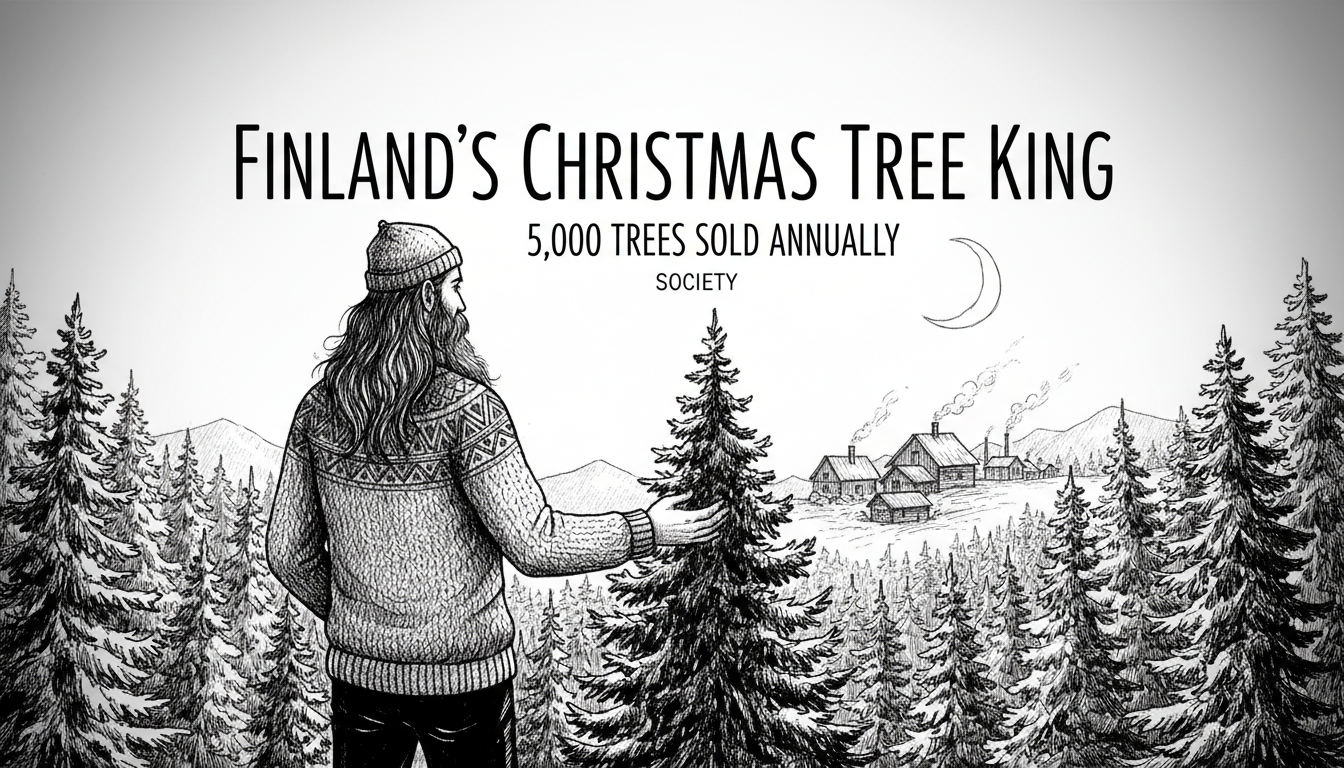
Finland's Christmas tree tradition is a multi-million euro seasonal industry, and for growers like Harri Koponen from Kuopio, the next few weeks represent the entire year's payoff. Koponen, who has cultivated Christmas trees since 1997, is now in his busiest period, preparing to sell roughly 5,000 trees from his farms in Leppävirta and Kuopio. The intense sales window is brutally short, with the peak expected just days before Christmas Eve, compressing a year's worth of cultivation into a frantic few weeks of harvest and hustle.
The Short, Sharp Season of a Finnish Tree Farmer
Harri Koponen's annual cycle is defined by a dramatic crescendo of activity. While the trees grow silently across his land for eleven months, November and December are a whirlwind. "The Christmas tree season lasts only a few weeks," Koponen explains, highlighting the precarious nature of the business. His most crucial task begins well before the first customers arrive. In November, his team cuts approximately 80 percent of the trees destined for sale. This pre-emptive harvest is essential logistics; it allows for processing, bundling, and distribution to sales points before the ground freezes solid and the December darkness makes fieldwork difficult.
This year, Koponen anticipates the single busiest sales day will be the Sunday immediately preceding Christmas. On that day, families across Finland make their final festive preparations, and the demand for the perfect centerpiece for their living room spikes. The timing is everything. A warm autumn can delay the feel of the season, while an early, harsh winter can push sales forward. Koponen must read these subtle shifts in public mood and weather patterns, as his product is profoundly perishable and tied to a fixed calendar date.
A Tradition Rooted in Finnish Soil and Society
The Christmas tree is not a recent import to Finnish culture. The tradition took root in the 19th century, initially flourishing in urban drawing rooms before spreading to every corner of the nation in the early 1900s. Today, it is an indispensable part of joulu, the Finnish Christmas. For many, the ritual of selecting a tree—whether from a local grower like Koponen, a supermarket lot, or from one's own forest—marks the true beginning of the holiday. The scent of pine resin and the process of decorating the tree with lights, flags, and handmade ornaments are sensory anchors of the season.
This deep cultural embedding is what sustains growers. Despite the availability of convenient, reusable artificial trees, a significant portion of Finnish households still prefers a real tree. The preference is often generational and aesthetic, linked to authenticity and a connection to nature. "Some households get their tree already around Independence Day," Koponen notes, referring to December 6th. This early adoption by a segment of consumers helps to slightly extend the selling window, but the core pressure remains concentrated in the final ten days.
The Economics of Pine and Spruce
Finland's Christmas tree market is a quiet but substantial segment of its agricultural and forestry sector. While no single official figure aggregates the total national value, estimates from the Natural Resources Institute Finland (Luke) and agricultural committees suggest it runs into tens of millions of euros annually. It provides crucial winter income for hundreds of small-scale farmers and forest owners, particularly in rural regions where other winter revenue streams may be scarce.
Experts point to a stable, if not growing, demand for locally grown trees. "Consumers are increasingly conscious of provenance," says Dr. Eeva-Liisa Tikkanen, a researcher specializing in rural economies at the University of Helsinki. "A tree grown in Finnish soil, often on a family farm, carries a narrative of sustainability and support for local communities that resonates strongly. It's a direct, tangible connection between the consumer and the producer." This local advantage insulates farmers like Koponen from some competition from mass-produced imports, which may face higher transportation costs and lack the same regional appeal.
For Koponen, the economics are straightforward but demanding. The investment is long-term; a Norway spruce, the most popular species, takes 8-12 years to reach the ideal height of around two meters. During that time, the trees require careful management: planting, weeding, shaping, and protecting from pests and frost. The return on that decade of work is entirely dependent on a flawless product and perfect timing during a three-week retail period. A single bad frost that damages needle retention or a warm, dry summer that stunts growth can impact quality years down the line.
Sustainability and the Future of the Festive Forest
The conversation around Christmas trees inevitably touches on environmental impact. The industry in Finland argues strongly for the sustainability of real trees over plastic alternatives. Christmas tree farms are typically cultivated on marginal agricultural land. During their growth, the trees act as carbon sinks, absorbing CO2. After the holidays, municipalities across Finland organize collection points where trees are chipped into biodegradable mulch for parks and gardens, creating a closed-loop cycle.
Growers like Koponen emphasize their role as stewards of the land. The farms provide habitat for wildlife during the trees' growth cycle and are often managed with minimal pesticide use. "We are growing a renewable crop," Koponen states. "For every tree cut, several more are planted." This model of sustainable cultivation is a key marketing point and aligns with Finland's strong national identity tied to its forests and responsible forestry practices, governed by some of the world's strictest forestry laws.
However, the industry faces future challenges. Climate change presents a significant uncertainty. Milder, wetter winters can affect tree health and harvest conditions. Changes in snowfall patterns can impact the traditional "Christmas card" aesthetic customers desire. Furthermore, the demographic shift toward urban living, particularly in apartment buildings, has boosted the market for smaller trees and potted varieties, requiring growers to adapt their product mix.
A Family Business in the Finnish Countryside
Behind the statistics of 5,000 trees sold lies a classic Finnish story of self-reliance and connection to the land. Harri Koponen's operation is not a vast industrial enterprise but a family-run business deeply embedded in the local landscape of North Savo. The farms in Leppävirta and Kuopio represent a personal investment of over 25 years. This long-term commitment is common in the sector, where knowledge is passed down and the rhythm of the year is dictated by the slow growth of conifers.
The work is physically demanding, especially during the November harvest. Teams work in cold, often damp conditions, selecting, cutting, and moving thousands of trees. It requires a specific resilience. Yet, for those involved, there is a profound satisfaction in providing the centerpiece for a nation's most cherished holiday. Each tree sold represents a family's gathering, a moment of light in the dark Finnish winter.
As Koponen looks ahead to his busiest weekend, his success is measured not just in euros but in the continuation of a tradition. The 5,000 trees leaving his farms will stand in living rooms across the region, adorned with lights that pierce the long winter night. In a world of rapidly changing traditions and digital distractions, the enduring demand for a real, fragrant Christmas tree suggests a deep-seated Finnish desire for authenticity and a tangible link to the natural world—a need that growers like Harri Koponen, with mud on his boots and an eye on the weather, continue to fulfill one tree at a time.