
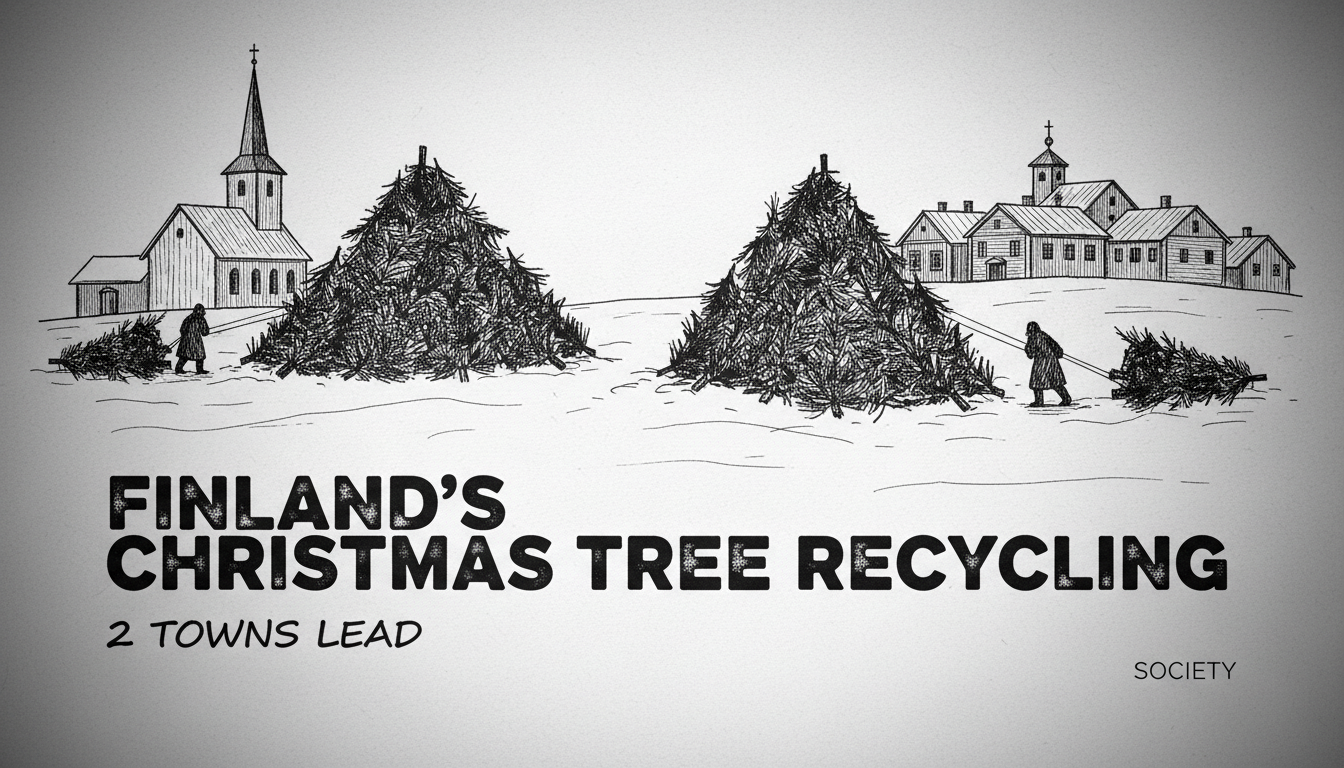
Finland's annual post-holiday ritual of recycling over 1.5 million Christmas trees is entering its decisive phase this week in Kouvola and Iitti. Municipal collection trucks are traversing residential streets, offering a free, efficient service that prevents thousands of tonnes of biodegradable waste from entering landfills. This organized system, replicated across Finnish municipalities, transforms a festive symbol into compost for public parks or biofuel for district heating, reflecting a deeply ingrained culture of practical environmentalism.
Municipal Logistics in Action
In Kouvola and Iitti, located in the southeastern Kymenlaakso region, the local waste management authorities have published precise schedules for their keräysauto, or collection vehicle. Residents are instructed to place their bare spruce trees at designated collection points by 7 a.m. on their area's specified day. The service is funded through municipal waste fees, ensuring no direct cost to residents for disposal. This logistical operation requires careful route planning to cover diverse residential areas efficiently, a task managed by local environmental offices. The simplicity of the process—place the tree out, and it disappears—belies a complex municipal service underpinned by Finland's Waste Act, which mandates responsible management of biodegradable waste.
‘This isn't just about waste collection; it's a circular economy service in action,’ explained a Kouvola city environmental official. ‘We are closing the loop for a natural product, ensuring it returns to the earth or provides energy.’ The official noted that participation rates are consistently high, with most residents adhering to the schedule, demonstrating strong public trust in and cooperation with municipal systems.
From Festive Fir to Fuel and Fertilizer
Once collected, the trees embark on a second, utilitarian life. In many municipalities, including Kouvola, the primary destination is a composting facility. The trees are chipped and mixed with other green waste, decomposing over months into nutrient-rich soil conditioner. This compost is often used in municipal landscaping, nourishing flower beds and parks that residents enjoy come spring. This process directly supports Finland's national goals to increase the recycling of biological waste, a key component of the country's climate strategy.
The alternative path is energy recovery. Some facilities process the trees into biofuel, feeding combined heat and power plants. This contributes to Finland's impressive district heating networks, where over 40% of residential heating comes from renewable sources like biomass. By converting Christmas trees into energy, municipalities replace fossil fuels and reduce carbon emissions. Experts in environmental technology stress that while composting has clear benefits for soil health, energy recovery provides immediate carbon savings, making both pathways valuable.
A Nationwide Model of Efficiency
Finland's approach to Christmas tree recycling is decentralized but uniformly effective. Each of the country's over 300 municipalities organizes its own system, often offering both curb-side collection and designated drop-off points at recycling centres. The practice is so commonplace it rarely makes national news, yet it exemplifies the Finnish principle of ‘jätelaitos,’ or waste management, as a fundamental public service. This system contrasts with many other countries where trees are often left for general waste collection, ending up in landfills where they decompose anaerobically and produce methane, a potent greenhouse gas.
‘The Finnish model works because it's convenient, free at the point of use, and people understand the environmental reason for it,’ said a sustainability researcher from the University of Helsinki. ‘It’s a small but meaningful civic ritual that reinforces environmental responsibility.’ The researcher pointed out that this annual exercise in resource recovery aligns with broader Nordic commitments to a circular economy, where waste is minimized and materials are kept in use for as long as possible.
EU Directives and Local Practice
Local collection schedules in towns like Kouvola and Iitti are directly influenced by European Union waste framework directives. Finland, as an EU member state, is obligated to meet strict targets for recycling municipal waste and reducing landfill use. The meticulous sorting and recycling of Christmas trees contribute to these national metrics. The EU's Landfill Directive actively discourages the disposal of biodegradable waste, making the Finnish composting and energy recovery model not just preferable but increasingly a regulatory necessity.
This connection between Brussels directives and a collection truck on a snowy street in Iitti highlights how EU environmental policy translates into tangible local action. Finnish municipalities often exceed EU targets, viewing them as a baseline rather than a ceiling. The efficient handling of seasonal waste streams like Christmas trees is one part of a comprehensive national waste management strategy that enjoys broad political support across the spectrum, from the Green League to the Centre Party.
The Bigger Picture for Finland's Green Ambitions
While Christmas tree recycling is a seasonal event, it fits into Finland's year-round environmental policy landscape. The current government, led by Prime Minister Petteri Orpo, has set ambitious goals for a carbon-neutral economy by 2035. Every tonne of biowaste diverted from landfills and every cubic metre of fossil fuel replaced by biofuel counts toward this target. The humble Christmas tree, therefore, becomes a small but symbolic component of national climate action.
The practice also reflects a societal consensus on environmental stewardship. In Finland, practical sustainability is seldom a partisan issue; it is viewed as common sense. The coordinated effort between residents who neatly place their trees curbside and the municipal workers who collect and process them demonstrates a functional social contract around shared responsibility for the environment. As the collection trucks complete their routes in Kouvola and Iitti this week, they leave behind cleaner streets and provide raw material for Finland's continued green transition. This annual cycle prompts a question: if a society can so efficiently manage millions of seasonal trees, what greater environmental challenges can it systematically address next?