
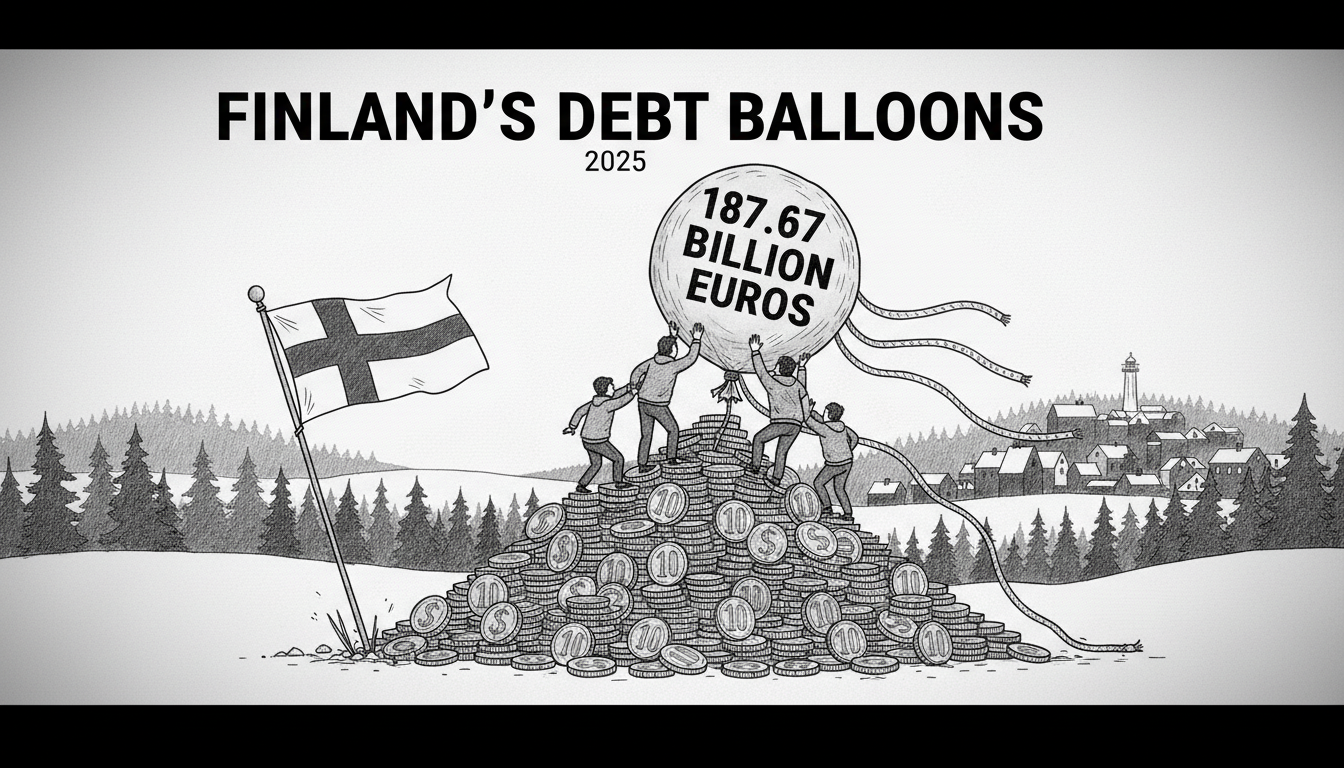
Finland's national debt surged to 187.67 billion euros by the end of December 2025, according to new figures published by the State Treasury. The figure confirms a significant acceleration in government borrowing, with the debt stock growing by 18.26 billion euros in a single year. This sharp rise from the 2024 year-end total of 169.41 billion euros intensifies the political debate in Helsinki over fiscal sustainability. The data underscores a persistent trend of deficit spending as the government grapples with multiple economic pressures.
The Mechanics of a Growing Debt Burden
The State Treasury, which manages the nation's debt and cash reserves, released the official statistics on Monday. The increase is driven by the government's need to finance its budget deficit and refinance maturing debt. According to the state's current budget proposal from December 19, 2025, this year's budget will be patched with an additional 8.66 billion euros in new debt. This calculation notably excludes a one-time 2.4 billion euro revenue injection from the State Housing Fund. The Ministry of Finance's pre-Christmas economic review offered a sobering outlook, projecting net borrowing by the central government to reach 14.298 billion euros in 2026.
This relentless borrowing occurs within a complex fiscal framework. Finland's state finances encompass not only the core budget but also off-budget funds and state-owned enterprises. The published national debt figure aggregates the liabilities from all these entities. While the Ministry of Finance provides annual guidance on debt and cash management, the State Treasury executes the actual borrowing on financial markets. It also maintains the crucial relationships with international credit rating agencies, a role that gains importance as debt levels climb.
EU Rules and Domestic Political Tension
The escalating debt trajectory places Finland on a collision course with European Union fiscal rules. The EU's revamped Stability and Growth Pact demands that member states with debt above 60% of GDP design credible plans for gradual reduction. Finland's debt-to-GDP ratio is now a primary concern for policymakers in Helsinki and Brussels. The Ministry of Finance projects the general government debt-to-GDP ratio will exceed 86 percent this year and is on a path to reach more than 90 percent by 2029. This projection starkly contradicts any notion of imminent stabilization.
Within the Eduskunta, the Finnish Parliament, the opposition has seized on the numbers. The Social Democratic Party and the Left Alliance argue the government's tax policies are eroding the revenue base while failing to control spending. "These are not just numbers on a spreadsheet; they represent a future tax burden on our children and a limitation on our ability to fund welfare, education, and green transition," said Annika Saarikko, chairperson of the Centre Party. Finance Minister Riikka Purra of the Finns Party has defended the government's strategy, citing necessary investments in defense following NATO accession and support for a sluggish economy. She has promised a mid-term review to assess spending but has ruled out major tax hikes.
Expert Analysis: A Structural Challenge Ahead
Economists point out that while Finland's debt level remains below the Eurozone average, its rapid growth and the structural nature of the deficit are alarming. "The COVID-19 pandemic and the war in Ukraine were external shocks that justified exceptional spending," said Juha Honkatukia, Director of the Labour Institute for Economic Research. "But the current deficit is increasingly structural. The aging population is pushing up healthcare and pension costs, while economic growth remains too weak to generate sufficient tax revenue. We need a serious conversation about reforming public services and the sustainability of our social model."
The cost of servicing this growing debt mountain is another key risk. With the European Central Bank maintaining higher interest rates to combat inflation, Finland's interest expenditures are consuming a larger portion of the annual budget. This diverts funds away from productive public investments and creates a vicious cycle where new borrowing is needed to pay interest on old debt. Experts warn that without a credible consolidation plan, Finland risks a negative reaction from bond markets or credit rating downgrades, which would further increase borrowing costs.
A Comparative Look at Debt Accumulation
The following table illustrates the recent acceleration in Finland's debt growth, highlighting the year-on-year change.
| Period | National Debt (Billion EUR) | Annual Increase (Billion EUR) |
|---|---|---|
| End of 2024 | 169.41 | - |
| End of 2025 | 187.67 | +18.26 |
| Projected Net Borrowing 2026 | - | +14.298 |
The Road Ahead: Hard Choices Loom
The government's upcoming framework negotiations for the 2026 budget will be a critical test. Coalition partners must agree on a path that balances defense commitments, welfare expectations, and the imperative of fiscal responsibility. The EU Commission will be watching closely, expecting a credible medium-term fiscal structural plan. Options on the table include deeper spending cuts across ministries, reforms to index-linked social benefits, or revisiting the government's opposition to raising certain taxes.
The debt figures for 2025 are not just a snapshot of the past; they are a down payment on Finland's future. As the political debate intensifies in the government district around Helsinki's Senate Square, the question remains: Can Finland's tradition of consensus politics produce a sustainable plan to rein in its debt, or will the borrowing rally continue unchecked? The answer will define the nation's economic sovereignty for the next generation.