
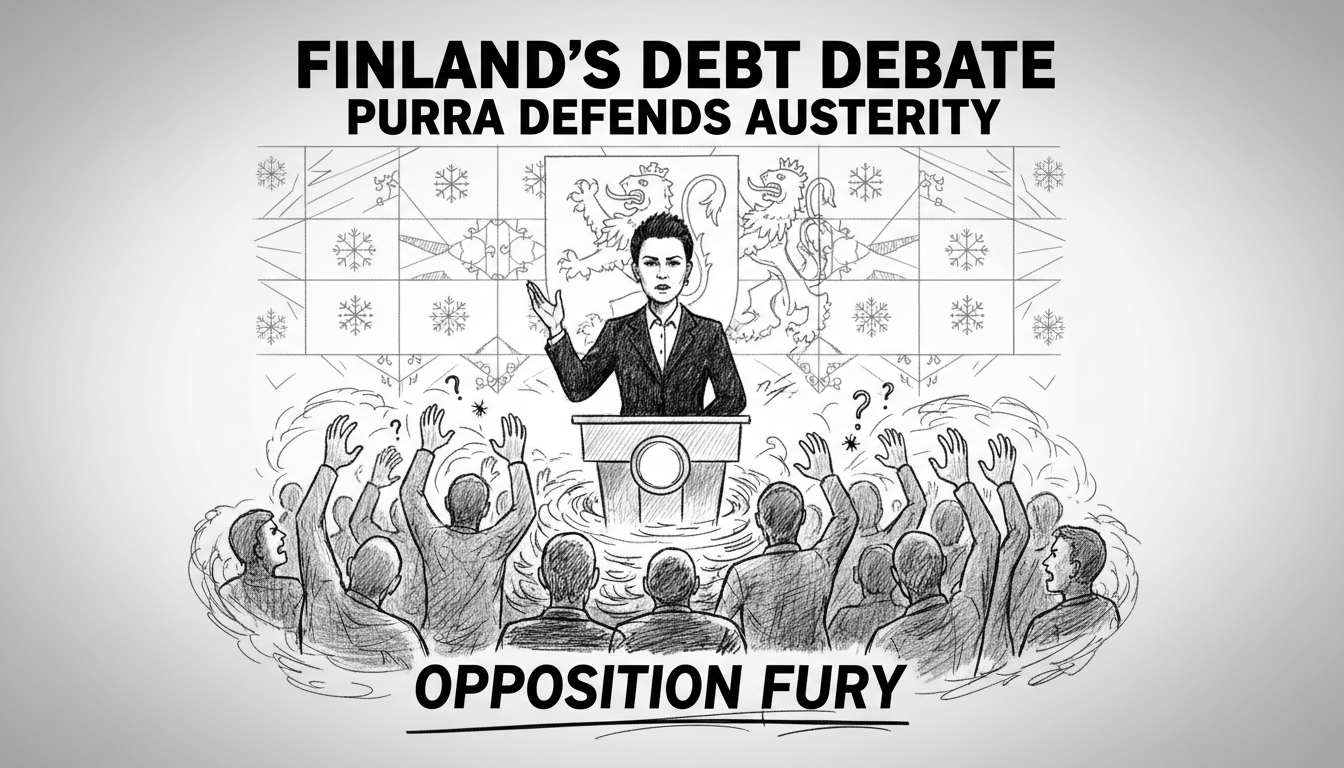
Finland's government debt debate erupted in the Eduskunta on Monday, with Finance Minister Riikka Purra defending deep budget cuts as opposition parties launched a fierce critique of the government's economic policy. The parliamentary session, marking the start of debate on next year's budget, showcased a fundamental clash over Finland's fiscal future as the national debt approaches a critical threshold of 90% of GDP.
"There is no economic situation where a socialist would implement austerity," Purra declared from the podium, delivering a sharp ideological retort to her critics. Her statement crystallized the government's position that fiscal consolidation is a non-negotiable imperative, regardless of the economic cycle. The Finance Minister warned that Finland's debt burden is set to surpass 200 billion euros, a situation she attributed to the "euphoric spending" of previous administrations.
Opposition speeches, however, painted a starkly different picture. Social Democratic, Left Alliance, and Green League MPs condemned the cuts as damaging to social trust and counterproductive for growth. They argued the government's austerity measures are exacerbating unemployment and undermining public confidence in the future. This established the familiar parliamentary dynamic: government coalition members from the National Coalition Party and Finns Party staunchly defended the budget as necessary, while the opposition bloc rejected its core premises.
The Weight of the Debt Figure
At the heart of Purra's argument was a single, looming statistic: Finland's debt-to-GDP ratio is soon to break the 90% barrier. This figure, drawn from government projections, served as the central justification for the ongoing and planned austerity measures. Purra stated bluntly that Finland is in trouble unless it can generate economic growth, yet acknowledged her government's own cuts are themselves a drag on that very growth. This admission highlights the difficult trade-off at the core of the government's strategy—short-term pain for promised long-term stability.
The debt trajectory represents a significant shift from recent history. In 2022, Finland's general government debt stood at 73.5% of GDP. The rapid approach to 90% underscores the fiscal pressures from an aging population, sustained defense spending, and the lingering impacts of pandemic-era support. The government's 2024 budget projects a continued deficit, reinforcing Purra's argument that corrective action cannot be delayed.
A Clash of Economic Philosophies
The debate transcended mere number-crunching, revealing a deep ideological divide. Purra's quip about socialists and austerity framed the disagreement as one of core belief. From the government's perspective, led by Prime Minister Petteri Orpo's National Coalition Party, the state must live within its means and create conditions for private-sector-led growth. The so-called "debt brake" principle—though not a formal EU-style rule—was invoked as a forcing mechanism for fiscal discipline.
"The debt brake forces parties to acknowledge the facts, but no brake makes the decisions for you," Purra said, emphasizing that political courage is required to make unpopular cuts. She projected that further adjustments will be necessary even in the next parliamentary term, signaling a long road of fiscal consolidation ahead. Her closing metaphor was evocative: "We will get our dear country back in shape, as long as we continue the work consistently and do not trust the treacherous sirens."
Opposition rhetoric focused on the human and economic cost. Critics challenged the notion that austerity is the only path, arguing for strategic public investment in education, green technology, and infrastructure to stimulate growth. They contend that cutting during a fragile economic period risks a downward spiral, reducing demand, increasing unemployment, and ultimately harming the state's revenue base.
Expert Perspectives on a Narrowing Path
Economists observing the debate note that Finland's policy options are constrained. "Both sides are grappling with a genuinely difficult equation," says Dr. Elina Berghäll, a senior fellow at the Finnish Institute of Economic Research. "The debt level is a credible concern for long-term sustainability, particularly with rising age-related expenditures. However, the growth impact of consolidation is real. The key is the composition of the cuts and whether parallel growth-enhancing policies are effectively deployed."
Supporters of the government's approach point to the need to maintain market confidence and prepare for future shocks. They argue that pre-emptive consolidation is wiser than waiting for a debt crisis to force more drastic measures. Critics, however, cite economic studies suggesting that fiscal multipliers are higher in downturns, meaning cuts do more damage to GDP when the economy is weak. They advocate for a more nuanced approach that protects critical investments in future productivity.
The EU context is ever-present in Helsinki's budgetary discussions. While Finland is not in an Excessive Deficit Procedure, the EU's revised economic governance rules encourage medium-term fiscal plans that ensure debt sustainability. Purra's stance aligns with this broader EU shift towards stricter fiscal monitoring post-pandemic, though she frames it as a domestic necessity rather than an external imposition.
The Political Calculus in Helsinki
The heated exchange in the Eduskunta is more than a one-day debate; it sets the stage for the 2024 budget's passage and the political battles leading to the next national election. The governing coalition holds a majority, ensuring the budget will be approved. However, the opposition's forceful critique aims to shape public opinion and define the government's reputation.
The political risk for Purra and Prime Minister Orpo is that sustained austerity erodes their political capital before economic results become visible. The benefit they are betting on is that by the next election, the economy will be on a firmer footing, allowing them to claim credit for making tough but necessary choices. The opposition's strategy is to link every factory closure, every rise in unemployment, and every reduced service directly to the government's budget decisions.
Janne Jukkola of the National Coalition Party exemplified the government coalition's defense, arguing in his speech that the measures are essential to redirect Finland's economic trajectory. This unity is crucial for the government's stability, as any significant internal dissent over the budget could threaten its majority.
Looking Beyond the Budget Year
Finance Minister Purra's warning that more adjustments will come in the next parliamentary term is a significant political statement. It effectively tells the Finnish public that the current period of consolidation is not a one-off but a new phase of fiscal policy. This long-term view suggests a fundamental re-calibration of the Finnish welfare state's scale and funding.
The coming months will test whether the government's prescription is working. Key indicators to watch will be GDP growth figures, unemployment trends, and crucially, whether the debt-to-GDP curve begins to flatten. The opposition will meticulously track any negative social outcomes, from child poverty rates to regional service gaps, attributing them directly to the budget.
Ultimately, the debate in the glass-walled Eduskunta chamber reflects a national soul-searching. Finland is wrestling with how to preserve its high-quality society and economic model in an era of slower growth, greater geopolitical expense, and demographic strain. Purra's austerity represents one clear answer. The opposition offers a different path. The Finnish electorate, over time, will deliver the final verdict on which vision they trust to secure their future prosperity. For now, the only certainty is more heated debates in Helsinki, as the nation's economic direction remains its most contentious political question.