
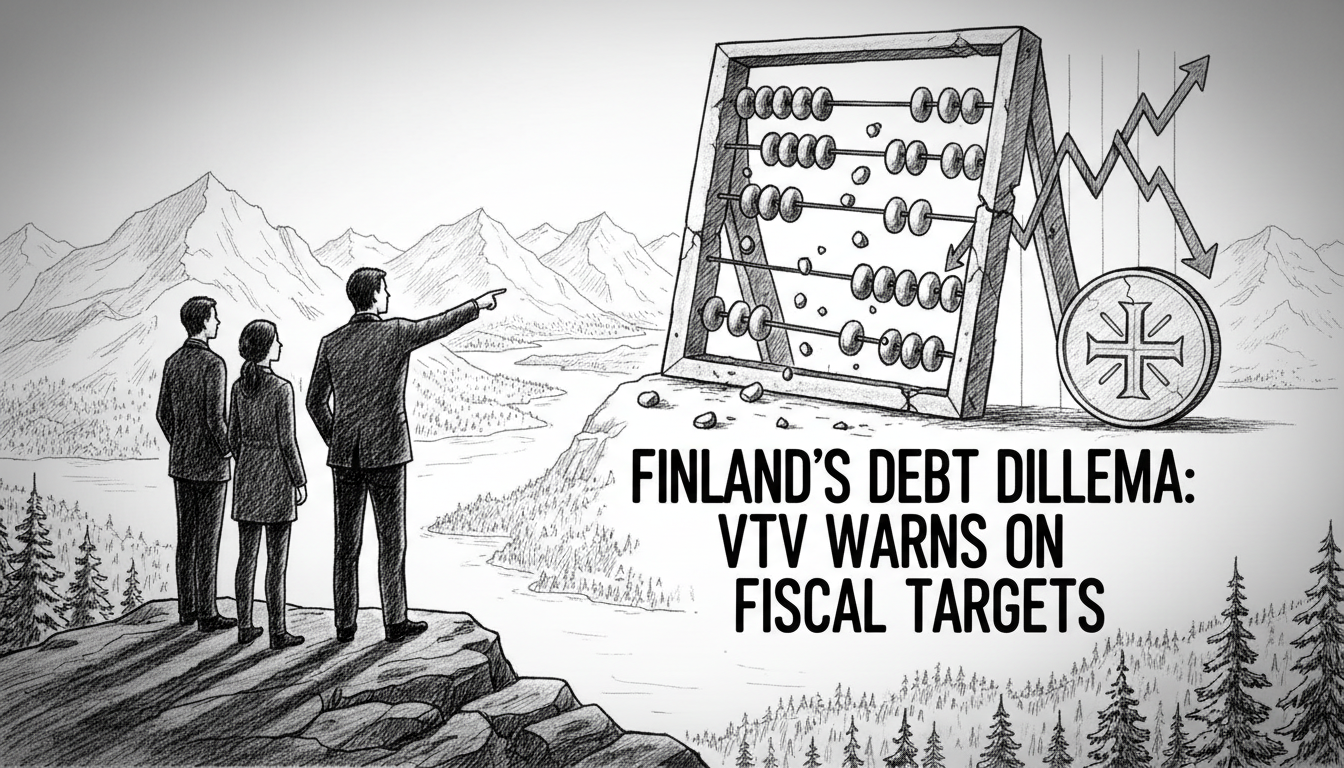
Finland's government is on track to miss its core public finance targets, according to a stark new assessment from the State Audit Office (VTV). The report, published this week, concludes that based on current Ministry of Finance forecasts, Prime Minister Petteri Orpo's coalition will fail to achieve its goal of reducing the public deficit to a maximum of 1% of GDP and will not succeed in reversing the rising debt-to-GDP ratio during its term. This finding strikes at the heart of the right-wing government's economic agenda, casting serious doubt on its flagship policy of fiscal consolidation just over a year into its mandate.
"Based on these targets, only the stabilization of the debt ratio in 2027 would be achieved according to the Ministry of Finance's forecast – and even that only temporarily," the VTV stated bluntly in its financial policy monitoring report. The independent fiscal watchdog's analysis presents a significant credibility challenge for the government, which has anchored its entire policy program on restoring balance to the nation's books. The revelation comes as Finland continues to grapple with the long-term pressures of an aging population, sluggish economic growth, and the lingering aftershocks of the pandemic and war in Ukraine.
A Forecast of Shortfalls
The VTV's critique centers on the realism of the government's own economic projections. While the audit office found the Ministry of Finance's forecast for 2026 to be realistic, it singled out the 2025 outlook as "very optimistic" regarding domestic demand. This optimism, the VTV implies, underpins forecasts that are already showing the government falling short of its legally defined fiscal policy objectives. The central goal, as outlined in the government program, is a structural deficit no greater than 1% of GDP by the end of the parliamentary term, alongside a stabilization and eventual decline in the debt-to-GDP ratio.
Current trajectories suggest neither will be met. The deficit is projected to remain above the 1% threshold, and the debt ratio, while potentially stabilizing briefly in 2027, is not forecast to enter a sustained downward path. This creates a policy gap that the government must now address. Finance Minister Riikka Purra of the Finns Party has consistently argued that deep spending cuts and welfare reforms are essential to secure Finland's economic future. However, the VTV report suggests that even the current aggressive austerity drive may be insufficient to hit the stated targets, raising questions about what further measures might be politically feasible.
The Roots of a Persistent Problem
Finland's fiscal challenges are not new. For over a decade, successive governments have wrestled with a structural deficit exacerbated by demographic trends. A shrinking working-age population supports a growing number of retirees, placing immense strain on pension, healthcare, and social care systems. This structural headwind has been compounded by a series of external shocks: the decline of the Nokia-led ICT sector, the stagnation of the European economy, the COVID-19 pandemic, and the energy and security crisis triggered by Russia's invasion of Ukraine.
The Orpo government came to power in 2023 with a clear promise to break this cycle. Its program, titled "A Strong and Committed Finland," is built on substantial cuts to public spending, reforms to social security to incentivize work, and a freeze on development aid. The aim was to correct the course swiftly. Yet, the VTV's assessment indicates that the scale of the challenge may be greater than the government's remedy. The report forces a public conversation about whether the targets were ever achievable within a single four-year term, or if they represented more of a political aspiration than a grounded fiscal plan.
Expert Scrutiny and Political Repercussions
The VTV's role is to provide non-partisan, expert oversight of fiscal policy, and its reports carry significant weight in Finnish political discourse. Economists and policy analysts are now dissecting its conclusions. Some experts argue that the government's growth forecasts are indeed too rosy, given global uncertainty and the dampening effect of its own austerity measures on domestic consumption. Others question whether the focus on debt reduction is overly rigid, suggesting that strategic investments in green technology and digital infrastructure could do more for long-term growth and fiscal sustainability than cuts alone.
Opposition parties in the Eduskunta have seized on the report. The Social Democratic Party and the Left Alliance have criticized the government's approach as economically damaging and socially unfair, arguing that the VTV's findings prove their point. "This report shows that the government's harsh cuts are not even achieving their own stated economic goals, while they are causing real hardship for families," said one opposition finance committee member. The political pressure is now on Finance Minister Purra and Prime Minister Orpo to explain how they will respond to the shortfall.
The EU Dimension and Future Choices
Finland's fiscal policy does not exist in a vacuum; it is closely watched within the framework of the European Union's economic governance rules. Although the EU's stability and growth pact rules have been temporarily suspended, new fiscal rules are coming. Finland, traditionally a champion of fiscal discipline within the EU, now faces the prospect of missing its own national targets. This could weaken its negotiating position in Brussels and its ability to advocate for strict rules for other member states.
The government now faces a series of difficult choices. It can attempt to double down on its current strategy, proposing further rounds of spending cuts that would likely face fierce political and public resistance. It could revise its targets, accepting a slower path to fiscal balance—a move that would be seen as a major political retreat. Alternatively, it could seek to stimulate growth through other means, though this would conflict with its core ideology of reducing the state's economic footprint. The upcoming budget negotiations for 2025 will be the first major test of its response.
A Defining Challenge for the Coalition
The VTV report is more than a technical assessment; it is a political event that defines the challenges for the remainder of Orpo's term. The government's credibility is tied to its economic management. Failing to meet its central fiscal promises could erode public trust and undermine its broader reform agenda. The coming months will reveal whether the coalition can adjust its course, find new levers for growth, or if it will be forced to defend a record of missed targets. For a nation proud of its fiscal responsibility, the path back to balance is proving steeper and longer than anyone in the halls of government in Helsinki hoped.