
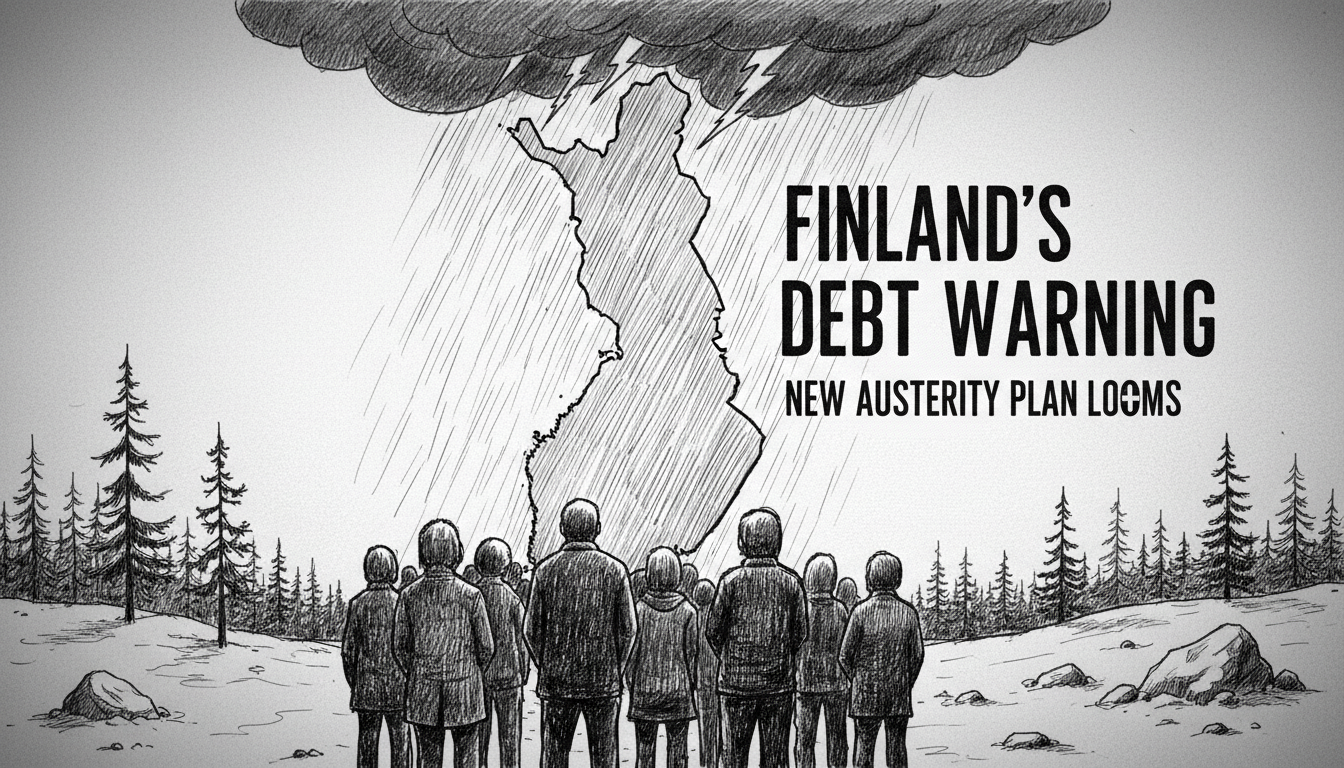
Finland's Ministry of Finance has issued a stark new assessment of the country's public finances, warning that significant fiscal adjustments will be required in the next government term. The ministry's updated forecast, presented today, downgrades economic growth expectations and projects a continued rise in the debt-to-GDP ratio. This fresh analysis forms the critical foundation for a government-appointed 'debt brake' working group tasked with designing the necessary austerity measures.
"The updated calculations provide a realistic, if sobering, picture of the challenges ahead," a senior ministry official said in a briefing. The working group's central mandate is now to quantify the exact scale of the coming adjustment need, a figure that will dominate political debate ahead of future budget negotiations. The ministry's economic review, published yesterday, served as the basis for this more severe fiscal outlook.
A Deepening Fiscal Challenge
The latest numbers confirm a troubling trend for Finnish public finances. The debt-to-GDP ratio, a key measure of national fiscal health, is now expected to keep growing in the coming years. This persistent increase comes despite repeated efforts by successive coalitions to balance the books. The aging population continues to strain pension and healthcare systems, while slower-than-expected economic growth reduces tax revenue. External shocks, including the aftermath of the pandemic and the energy market turmoil following Russia's invasion of Ukraine, have further exacerbated these structural issues.
Finland has not recorded a budget surplus since 2008. The sustainability gap—the difference between future revenue and expenditure commitments—remains wide. "Each new forecast seems to push the goal of fiscal stability further into the distance," said Professor Juha Honkatukia, a public finance economist at the Labour Institute for Economic Research. "The conversation has shifted from returning to surplus to simply slowing the rate of debt accumulation. That in itself is a significant change in the narrative."
The Mechanics of the 'Debt Brake' Working Group
The newly empowered working group operates with a specific, technical mission. It must translate the Ministry of Finance's macroeconomic forecasts into a concrete fiscal adjustment figure. This number, often expressed in billions of euros, will represent the total spending cuts or tax increases needed over the next parliamentary term to put the debt ratio on a sustainable downward path. The group's composition typically includes officials from the Finance Ministry, the Bank of Finland, and independent fiscal policy experts.
Their work is intensely scrutinized because the final adjustment target directly influences every ministry's budget. A larger target means deeper cuts to welfare, education, defense, and infrastructure spending. The political sensitivity of this process cannot be overstated. "The working group provides the ammunition," noted political commentator Laura Korpela. "Its report gives the Finance Minister the independent, technical justification to demand tough measures from cabinet colleagues. The real political battle begins once that number is on the table."
The European Context and Binding Rules
Finland's fiscal dilemma is not occurring in a vacuum. It is framed by the European Union's revised economic governance rules, which demand member states present credible, multi-year plans to reduce high public debt. While Finland's debt level remains below the EU average, its steady upward trajectory is a clear concern in Brussels. The country has long positioned itself as a model of fiscal prudence within the Eurozone, and losing that reputation could carry political weight beyond mere economics.
"There is a strong normative pressure from EU institutions and fellow northern member states to get your house in order," explained Dr. Emilia Palonen, a political scientist at the University of Helsinki specializing in EU affairs. "Finland's influence in debates about EU fiscal discipline is undermined if its own numbers are moving in the wrong direction. This provides an additional, external driver for the government to act." The new assessment will be a key document when Finnish officials negotiate their fiscal plan with the European Commission.
Political Reactions and the Road to Difficult Decisions
Initial reactions from political parties highlight the coming clash. The opposition has seized on the report as evidence of government failure. "This is the cost of poor economic management and misplaced priorities," argued Harry Harkimo, chair of the Movement Now party. Meanwhile, parties within the governing coalition are emphasizing the need for responsibility. "These figures confirm that we cannot avoid difficult decisions," said Annika Saarikko, chair of the Centre Party. "The next government program must have fiscal sustainability at its core."
The true political test will come when specific measures are proposed. Options include further efficiency cuts across municipalities, adjustments to index-linked benefits, increases in certain consumption taxes, or reforms to the pensionable age. Each possibility carries significant social and political risk. The working group's report will list options but not make political choices; that burden falls squarely on the politicians.
Expert Analysis: Growth Versus Austerity
Economists are divided on the best path forward. Some argue that aggressive consolidation—sharp spending cuts—is the only way to restore confidence and stop the debt spiral. Others warn that excessive austerity could stifle the very economic growth needed to improve the debt ratio organically. They advocate for a more balanced approach that combines moderate adjustment with strategic investments in productivity and green technology.
"The key is the quality of adjustment," argued Professor Mika Maliranta of the Research Institute of the Finnish Economy (ETLA). "Blunt, across-the-board cuts can be damaging. We need smart reforms that protect future growth potential while stabilizing finances. For example, reforms that increase employment participation have a double benefit: they boost GDP and reduce social expenditure." The ministry's downward revision of growth forecasts adds urgency to this debate, suggesting the economy may not generate enough organic revenue to solve the problem.
What Comes Next for Finnish Taxpayers and Services?
For Finnish citizens, the abstract discussion of debt ratios and adjustment needs will eventually translate into tangible changes. The scale of the coming adjustment will determine whether local libraries see further hour reductions, if university tuition fees for non-EU students rise, how much patients pay for prescriptions, and whether planned transport projects are delayed. The debate over Finland's famous welfare model is entering a new, more constrained phase.
The 'debt brake' working group is expected to complete its initial assessment in the coming months. Its findings will immediately become the central economic document in the negotiations to form the next government after the 2027 parliamentary elections, if not sooner. The political parties will be forced to craft their electoral platforms around their response to this fiscal challenge. Can Finland maintain its social contract while bending the debt curve downward? The ministry's latest assessment confirms that the country is running out of time to find an answer.