
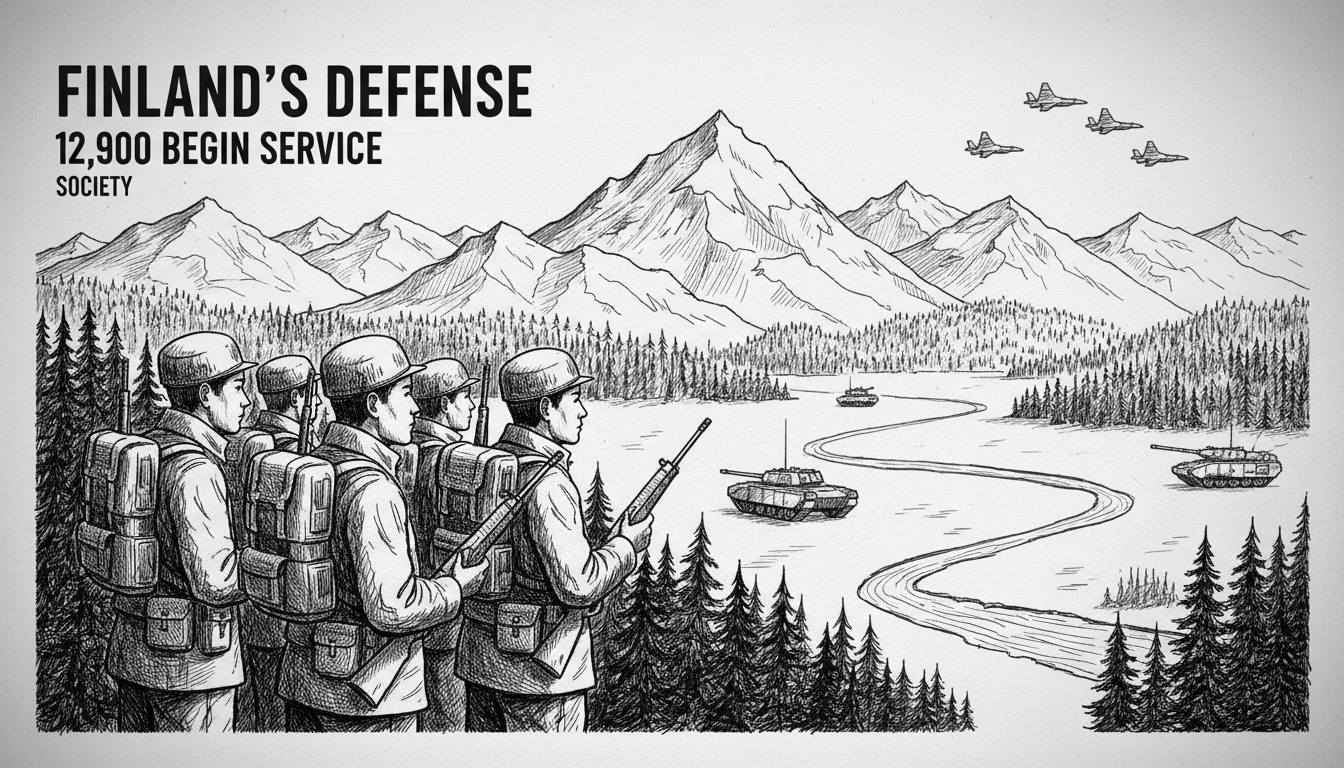
Finland's conscription system will mobilize approximately 12,900 new recruits for mandatory military service starting this January. This annual intake forms the backbone of the nation's territorial defense strategy, a system receiving renewed global attention since the country joined NATO. The Finnish Defence Forces confirmed the figures, detailing that around 10,000 conscripts will report to army units, with 1,700 joining the navy and the remainder split between the Border Guard and Air Force.
This process represents a continuous and well-organized national undertaking. For generations, Finnish men have received call-up papers in the mail shortly after their 18th birthday, instructing them to report for service. The length of service varies significantly, from a minimum of 165 days to nearly a full year for those training for specialist or leadership roles. This tiered system ensures a deep and skilled reserve force, a concept central to Finnish security planning.
The Engine of Finland's Defense Doctrine
The January intake is not an isolated event but the steady heartbeat of Finland's comprehensive defense model. The country maintains a small standing army of career soldiers but relies on a wartime strength of 280,000 soldiers drawn almost entirely from the reserves. Each year's conscript cohort replenishes this vital reserve. After completing their initial service, conscripts become reservists who can be called upon in a crisis until they reach the age of 50 or, in some cases, 60.
Analysts describe this as a cost-effective deterrent. "It's about credible national defense," explains Dr. Charly Salonius-Pasternak, a leading defense researcher at the Finnish Institute of International Affairs. "Finland has chosen a model where a large portion of the population has military training and can be mobilized rapidly. This sends a clear message about the nation's resolve and capability to defend itself." The system's efficiency is notable; Finland spends roughly 1.6% of its GDP on defense, a figure that is rising, yet maintains one of Europe's largest potential military forces.
A System Forged by History and Consensus
The widespread public support for conscription is deeply rooted in Finland's 20th-century history. The experiences of the Winter War and Continuation War against the Soviet Union forged a national consensus on self-reliance. This is not a partisan issue in Helsinki. Across the political spectrum, from the left-wing Left Alliance to the right-wing National Coalition Party, the compulsory service model is seen as a fundamental civic duty and the fairest way to share the burden of defense.
Defence Minister Antti Häkkänen has repeatedly emphasized the system's importance in the current security climate. "Our service is based on equality and universal obligation," Häkkänen stated in a recent parliamentary debate. "It creates a strong bond between the defense forces and society. In today's world, this comprehensive security approach is more valuable than ever." This societal integration is visible; conscripts come from every region and socioeconomic background, creating a shared national experience for hundreds of thousands of Finns.
Inside the Conscript's Experience
For the new recruits, the first days of January mark a profound life transition. They swap civilian clothes for uniform, receive their first military haircut, and are assigned to a unit. The initial weeks focus on basic military discipline, physical training, and weapon handling. Training then branches into specialized fields like infantry, artillery, communications, or logistics. The conditions are famously Spartan, designed to build resilience and teamwork under pressure.
The system also includes an alternative civilian service path, which lasts 347 days, for conscientious objectors. While only men are subject to the draft, women have been able to volunteer for military service since 1995. Their numbers have grown steadily, with women now comprising a small but significant percentage of each year's volunteer intake and serving in all roles including special forces. Debate about making the draft fully gender-neutral surfaces periodically but has not yet led to legislative change.
The NATO Dimension and Future Challenges
Finland's accession to NATO in April 2023 did not alter its core conscription model. Instead, it provided a new framework for the nation's deterrence. The Finnish Defence Forces are now integrating with NATO command structures and standards while maintaining their distinct, reserve-based character. Exercises with allied troops are becoming more frequent, and Finnish conscripts may increasingly train alongside soldiers from other member states.
This evolution presents both opportunities and challenges. The system must now ensure its training is interoperable with NATO allies while preserving the unique skills, like winter warfare and forest combat, that make Finnish forces so effective in their own terrain. Logistics and command systems are being adapted. The underlying principle, however, remains untouched: a nation ready to defend itself. As Minister Häkkänen noted, "NATO membership strengthens our defense, but it does not replace it. Our own strong will and capability to defend our country form the foundation."
The annual influx of conscripts is a powerful symbol of that enduring principle. As 12,900 young Finns begin their service this winter, they are not just individuals starting a new chapter. They are the latest component in a vast, living system of national defense—a system tested by history, supported by consensus, and now operating within the world's most powerful military alliance. In an era of heightened European tension, Finland's quiet, methodical mobilization each January represents a formidable statement of preparedness, made not with rhetoric, but with action.