
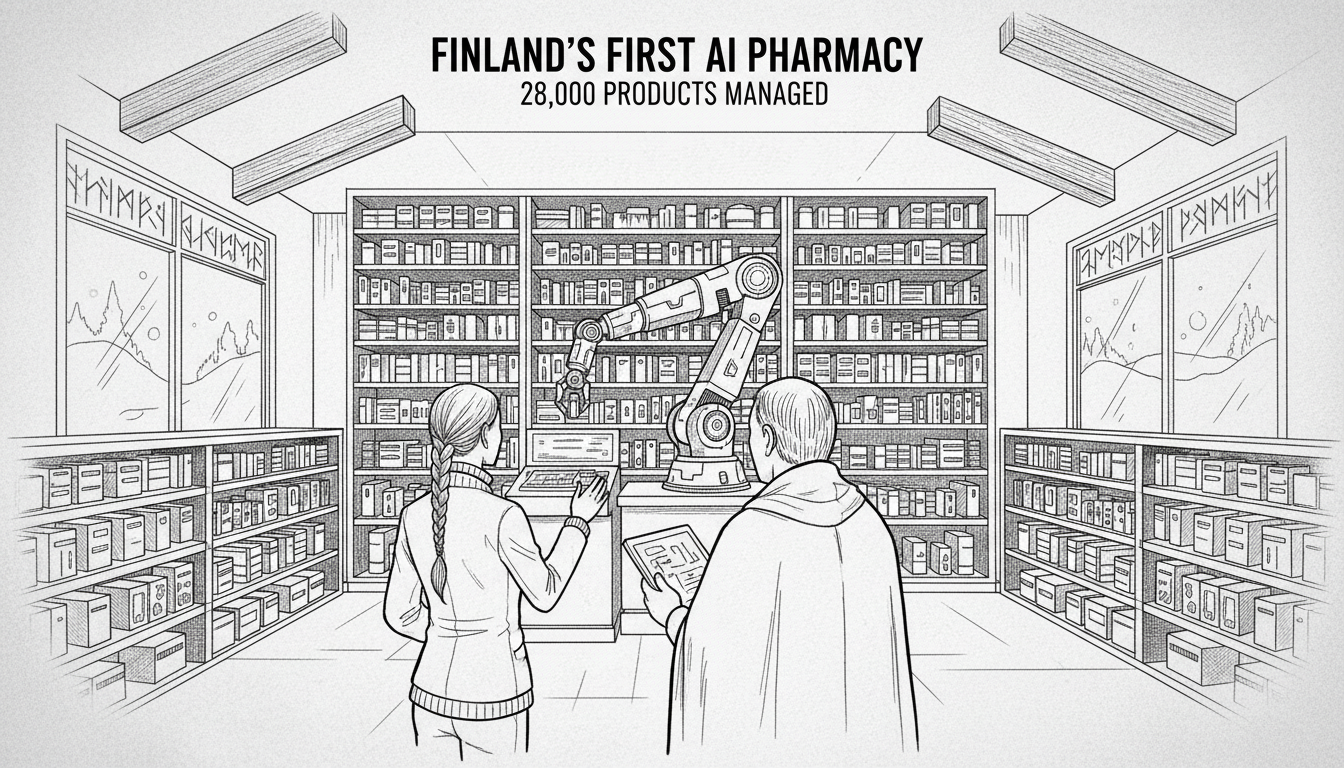
Finland pharmacy AI adoption has reached a new milestone in the city of Hyvinkää. Kehrä Apteekki, located in the Willa shopping center, has become the first pharmacy in the country to implement an artificial intelligence-powered training system for its entire staff. The system is designed to keep pharmacists current on a staggering inventory of 28,000 different products, from prescription medications to over-the-counter health supplies.
Pharmacist and owner Janne Nissilä spearheaded the initiative. He argues that in modern pharmacy, up-to-date knowledge is the primary defense against serious, even fatal, dispensing errors. "Pharmacists' information must be current," Nissilä stated. "That's how we avoid the worst possible mistakes." This move positions a midsize Finnish city, not the capital Helsinki, at the forefront of pharmaceutical tech. "Hyvinkää is at the cutting edge of technology in the field of pharmacy," Nissilä declared.
A Proactive Solution to an Immense Challenge
The core challenge is one of sheer scale and constant change. A typical Finnish pharmacy stocks thousands of items. Each has specific usage guidelines, potential side effects, drug interactions, and storage requirements. New products enter the market regularly, while existing product information is frequently updated by manufacturers and regulators like the Finnish Medicines Agency (Fimea).
Manually ensuring a team of pharmacists and technicians is perfectly synchronized with this vast, evolving dataset is nearly impossible. Traditional training methods—seminars, bulletins, manuals—can be slow and inconsistent. The AI-driven platform creates personalized, adaptive training modules for each staff member. It identifies knowledge gaps based on role and experience, then delivers targeted content to fill them. The system continuously updates its own training material as new data becomes available, creating a dynamic learning loop.
The Finnish Tech Ecosystem's Role in Healthcare Innovation
This development did not occur in a vacuum. It is a direct product of Finland's robust technology sector intersecting with its highly regulated, quality-focused healthcare system. While Helsinki and Espoo are famous for gaming giants like Supercell and Rovio, and telecommunications leaders like Nokia, the Finnish tech ethos of practical problem-solving permeates smaller cities and niche industries.
Finland's strong digital infrastructure, high trust in institutions, and culture of innovation create a fertile ground for applying AI in sensitive fields like healthcare. Companies specializing in health tech, such as Oura (known for its smart ring) and Klinik (a digital healthcare platform), have demonstrated the market's readiness. The pharmacy AI system likely leverages expertise from Finland's world-class data analytics and educational technology sectors, repurposing it for a critical public health function.
"This is a logical next step for Finland," said Dr. Elina Saari, a Helsinki-based health technology analyst. "We have the technical talent, a regulated but progressive medical environment, and a societal willingness to adopt digital solutions if they prove safe and effective. The key here is that the AI is not replacing the pharmacist's judgment; it is systematically enhancing their foundational knowledge, which is exactly where technology should assist."
Regulatory Hurdles and the Path to Adoption
The Finnish Medicines Agency (Fimea) maintains strict oversight over all pharmaceutical activity. Any new technology used in a pharmacy's core operations must comply with regulations designed to guarantee patient safety, data security, and professional accountability. The successful implementation at Kehrä Apteekki suggests a collaborative dialogue between the innovator and the regulator.
Fimea's approach is typically based on risk assessment and evidence. For an AI training tool, the agency would scrutinize the accuracy of its information sources, the integrity of its algorithms, and how its use is documented. The fact that a pharmacy is now operating with this tool indicates it has passed significant regulatory scrutiny. This sets a precedent that other pharmacies across Finland's network of approximately 800 outlets will likely follow.
"The first mover always faces the toughest regulatory journey," commented Mikael Gronlund, a consultant specializing in Finnish medtech compliance. "Kehrä Apteekki has effectively helped create a framework for approval. Other pharmacies will benefit from this. The focus for Fimea will now shift to scalability and ensuring consistent standards as the technology spreads."
The Human Element in an Automated System
A critical aspect of this story is what the AI does not do. It does not dispense pills, diagnose patients, or offer medical advice. Those responsibilities remain firmly with the qualified human pharmacist. The AI acts as a super-powered, tireless reference librarian and training coordinator. It ensures that when a pharmacist consults their own expertise, that expertise is built on the most complete and recent information available.
This addresses a common concern about automation in healthcare: the fear of losing the human touch. In this model, the human professional is empowered, not replaced. The time saved from manually cross-referencing databases or attending generic training sessions can be redirected to patient consultation, medication reviews, and providing personalized care—the aspects of the job that require empathy and complex communication.
"Our goal was never to remove the pharmacist from the process," Nissilä explained. "It was to make the pharmacist better, faster, and more confident. The final decision, the conversation with the customer, that is irreplaceable. But that conversation must be informed by perfect data."
Market Implications and the Future of Finnish Pharmacies
The Finnish pharmacy sector, while stable, is competitive. Differentiation often comes through service quality, location, and specialization. Adopting advanced technology like AI training presents a clear competitive advantage in terms of accuracy, staff competency, and operational efficiency. It reduces the risk of costly errors and builds greater trust with the local community.
If the model proves successful in Hyvinkää, a wave of adoption across the country is probable. This could spur growth for Finnish edtech and AI startups that develop similar compliance and training solutions for regulated industries. The "proof of concept" in a pharmacy validates the technology for use in other high-stakes fields like veterinary medicine, industrial chemical handling, or even aviation maintenance.
Looking ahead, the next integration points are clear. The AI training system could link directly with electronic prescription systems, providing real-time alerts and information as a prescription is processed. It could also generate anonymized data on common knowledge gaps across the sector, informing national training priorities for the University of Helsinki's Faculty of Pharmacy and other educational institutions.
Finland's first AI-powered pharmacy is more than a local novelty. It is a test case for the thoughtful integration of artificial intelligence into a trusted public health institution. By focusing on augmenting human expertise rather than replacing it, and by navigating the rigorous Finnish regulatory landscape, Kehrä Apteekki has charted a course that others will soon follow. In the quiet aisles of a Hyvinkää pharmacy, the future of pharmaceutical care is being quietly, but decisively, upgraded.