
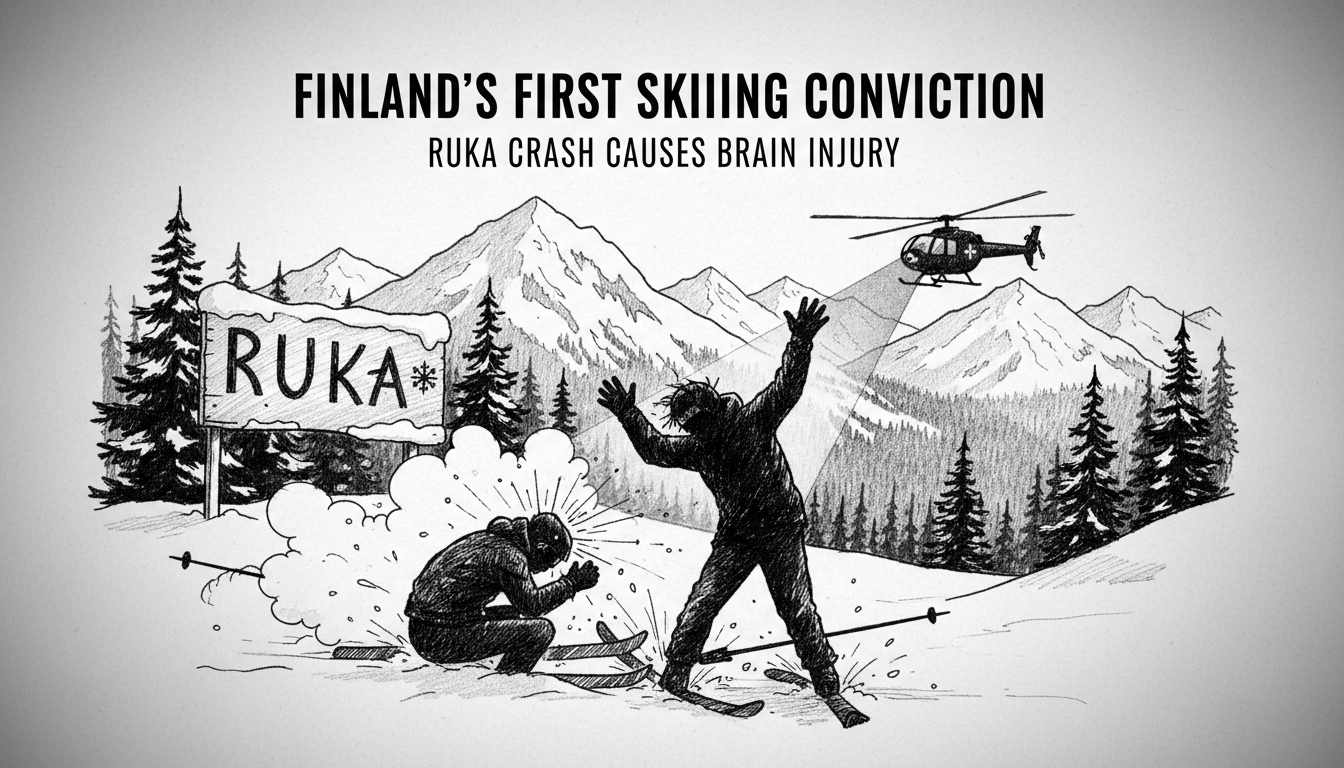
Finland's Ruka ski resort has become the site of a landmark legal case after a high-speed collision left a young man with a permanent brain injury. The Helsinki District Court's recent conviction of another skier for causing bodily harm through negligence marks what appears to be the first criminal penalty in Finland for reckless behavior on the slopes. The case centers on Joonas, a Helsinki man whose life was permanently altered during what should have been a routine day of snowboarding in Kuusamo.
A Routine Day Turns to Tragedy
Joonas was standing on his snowboard at the edge of a run at Ruka, one of Finland's most popular winter sports destinations. According to police investigation materials, visibility on the slope was clear. An orange-jacketed man in a police diagram marks the spot where Joonas was stationary before the impact. Another skier, traveling at high speed, failed to avoid him. The resulting collision was violent. Joonas sustained a severe traumatic brain injury, a type of damage that often leads to lifelong cognitive, physical, and emotional challenges. The court found the other skier's actions to be criminally negligent, handing down a sentence that included both a fine and compensation payments to the victim.
Legal Precedent on the Finnish Slopes
This conviction establishes a significant legal precedent in a country with a deep cultural connection to winter sports. While civil lawsuits over ski accidents have occurred, a criminal conviction for causing bodily harm through negligent skiing is unprecedented in Finnish jurisprudence. The ruling sends a clear message: the slopes are not a lawless zone. Finnish law holds individuals accountable for their actions, and a claim of mere accident does not absolve one of responsibility if recklessness or a clear disregard for the safety of others is proven. Legal experts note the case hinges on the principle of culpa, or negligence, where a person fails to exercise the care expected in a given situation.
"This judgment clarifies that the duty of care applies equally on a ski slope as it does on a road," said a Helsinki-based legal analyst familiar with sports liability law. "Skiers and snowboarders must adapt their speed and behavior to the conditions, their own ability, and the density of other people on the piste. Failing to do so, with tragic consequences, can now clearly lead to criminal liability."
The Lasting Impact of Head Trauma
The human cost of the collision extends far beyond the courtroom. Brain injuries are a devastating and common outcome of high-impact winter sports accidents. According to a 2017 study published in Wilderness & Environmental Medicine, while head injuries account for only about 4% of all injuries among skiers and snowboarders, they are responsible for a staggering 40% of fatalities in these sports. The effects are often invisible but permanent, potentially including memory loss, difficulty concentrating, personality changes, and physical impairments.
Data from the Finnish Institute for Health and Welfare (THL) underscores that winter sports contribute notably to the nation's injury burden. A 2021 THL report highlighted that a significant proportion of these serious injuries involve trauma to the head. For Joonas, the court-ordered compensation, while necessary, cannot reverse the neurological damage. His case is a stark reminder that a momentary lapse in judgment on the slopes can have irreversible, life-altering consequences for multiple people.
Safety, Responsibility, and Resort Operations
The case raises broader questions about safety culture at ski resorts. Ruka, located in Kuusamo, boasts one of the longest ski seasons in Finland, typically running from October into May. It attracts thousands of domestic and international visitors annually, ranging from beginners to experts, all sharing the same terrain. The International Ski Federation (FIS) has established ten rules for conduct on the slopes, which are often posted at resorts. The primary rule states that every skier and snowboarder must behave in such a way that they do not endanger or prejudice others.
Sports safety analysts point to a combination of factors that lead to accidents: excessive speed, poor visibility, failure to yield to downhill skiers, and skiing beyond one's ability level. While ski patrols and signage play a role, the ultimate responsibility lies with the individual. "Resorts can mark hazards and set rules, but they cannot police every turn," commented a Finnish sports safety researcher. "This court decision reinforces that the responsibility for safe passage is personal and non-delegable. It's a powerful deterrent message that your fun should not come at the expense of someone else's safety."
A New Era of Slope Accountability
The ripple effects of this ruling are likely to be felt across Finland's winter tourism industry. For skiers and snowboarders, the judgment is a sobering reminder to ski in control. For resort operators, it may prompt reviews of how safety rules are communicated and enforced. Insurance companies may also scrutinize policies related to recreational liability more closely. The case establishes a legal framework that other victims of serious slope collisions may now look to, potentially leading to more criminal investigations where gross negligence is evident.
Yet, at its heart, this is a human story of a life fractured in an instant. Joonas's permanent injury illustrates the fragile boundary between a holiday activity and a catastrophic event. The Finnish court has drawn a clear line, stating that the thrill of speed does not override the fundamental duty to avoid harming others. As the snow continues to fall on Ruka's slopes, this precedent stands as a permanent marker, warning that reckless abandon now carries not just moral weight, but explicit legal consequences. Will this landmark case change the behavior of skiers in Finland, or will it take further tragedies to cement a new culture of responsibility on the hills?