
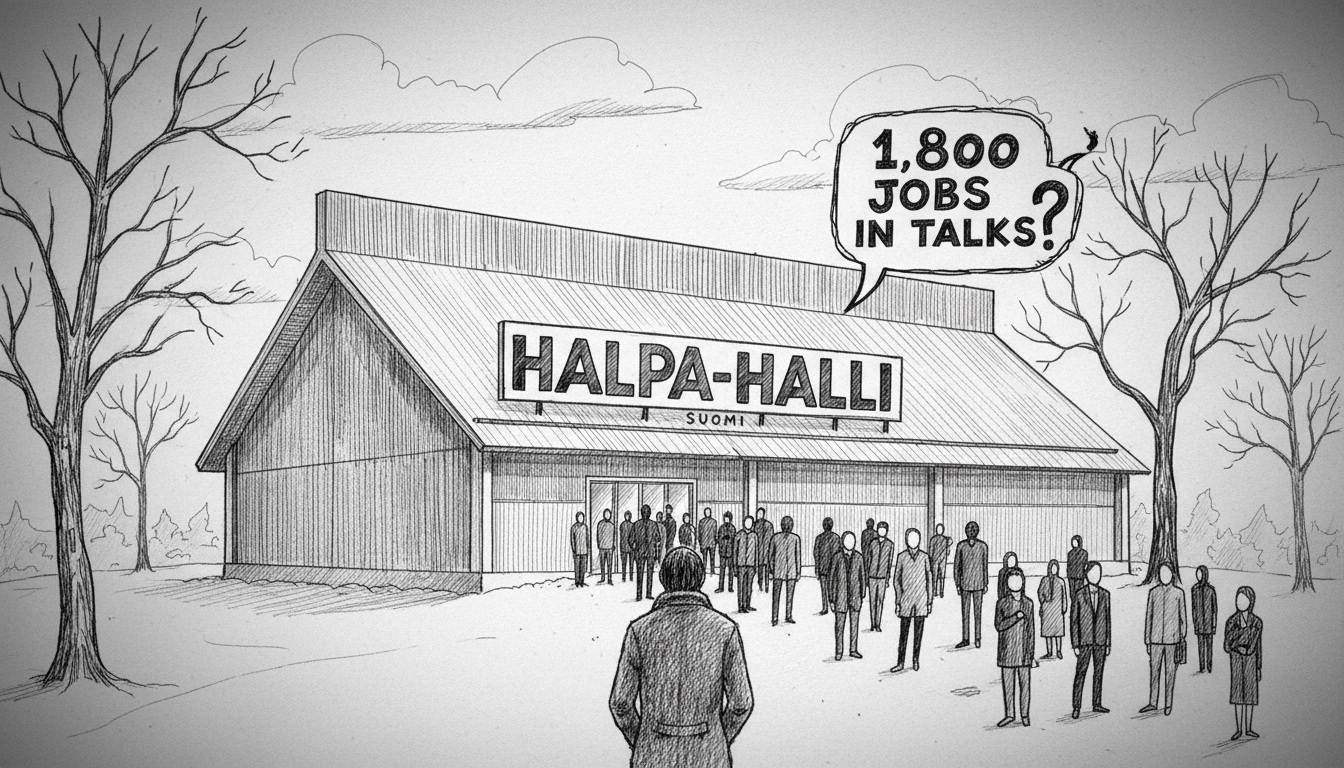
Finland's retail chain Halpa-Halli has placed 1,800 jobs on the line with its first-ever company-wide change negotiations. This formal process, mandated by Finnish law, requires the company to negotiate with employee representatives before any restructuring or layoffs. For a staple of Finnish shopping with 34 stores since 1969, the move highlights the intense struggle of brick-and-mortar retail against e-commerce and shifting consumer habits.
A Retail Institution Under Pressure
Halpa-Halli's decision to enter change negotiations affects every one of its 1,800 employees. The chain, whose name translates to 'Cheap Hall,' has been a familiar presence in Finnish towns for over five decades. Its stores are often located in suburban areas, serving cost-conscious shoppers. The initiation of company-wide talks indicates that previous adaptive measures have proven insufficient against systemic market changes.
The Finnish retail sector has been contracting for years. Data from the Finnish Commerce Federation shows online sales capturing a larger share of total retail revenue annually. Traditional stores face dual pressures from international e-commerce giants and domestic online competitors. Halpa-Halli's 34 stores now represent not just assets but potential liabilities in a landscape where foot traffic is declining.
Navigating the Finnish Change Negotiation Process
Change negotiations, or 'muutosneuvottelut,' are a cornerstone of Finnish labor law. They are not a decision but a mandatory consultative process. Companies must negotiate with employee representatives, typically trade unions, when considering changes that could affect staff numbers, working conditions, or organizational structure. The goal is to find mutually agreeable solutions, but layoffs are a common outcome.
This process is governed by the Co-operation Act, which emphasizes transparency and employee involvement. For Halpa-Halli, negotiations will likely explore various cost-saving measures. These could include store closures, reduced hours, voluntary resignation packages, or outright layoffs. The company has not specified a target number for job cuts, leaving the outcome open to the negotiation table.
The timing is critical. The Finnish economy has shown signs of stagnation, with consumer spending under pressure from inflation and economic uncertainty. Retailers are caught in a squeeze between rising operational costs and cautious customers. Halpa-Halli's move may be a proactive attempt to secure its future before conditions worsen.
The E-Commerce Onslaught and Consumer Shifts
Online sales in Finland have grown steadily, accelerated by the pandemic. Consumers now expect convenience, price transparency, and omnichannel experiences. Halpa-Halli, like many mid-sized chains, has invested in an online presence, but competing with well-funded international platforms remains a challenge. The chain's value proposition of low prices in physical stores is increasingly matched by online discounters.
Analysts point to a broader trend in Nordic retail. Stores must offer more than just products; they need experiences and seamless integration between online and offline channels. Halpa-Halli's store network, while extensive, may require significant transformation. Some locations could be repurposed, while others might close entirely. The change negotiations will force a hard look at the viability of each outlet.
Finnish consumer behavior has also shifted towards sustainability and local sourcing, areas where Halpa-Halli has room to innovate. However, such strategic pivots require investment at a time when cost-cutting is the immediate priority. This tension between long-term adaptation and short-term survival is at the heart of the negotiations.
Expert Analysis: A Bellwether for Finnish Retail
Retail experts view Halpa-Halli's situation as a bellwether for the entire sector. 'This is not just about one chain,' says a Helsinki-based retail analyst who requested anonymity due to client relationships. 'Halpa-Halli is a canary in the coal mine for mid-sized, family-oriented retail in Finland. Their challenges with cost structure and digital transformation are echoed across the industry.'
The success of these negotiations will depend heavily on change management and employee engagement. Morale among staff is likely low, with uncertainty hanging over their livelihoods. Effective communication and fair treatment during the process are essential to maintain operational stability. Finnish labor laws provide strong protections, but the human impact of potential job losses is significant, especially in smaller communities where Halpa-Halli stores are major employers.
From a policy perspective, this case underscores the need for supportive measures for traditional retailers. The Finnish government and EU regional development funds have programs for digitalization and restructuring, but accessing them can be complex. Halpa-Halli's negotiations may prompt broader discussions in the Eduskunta, Finland's parliament, about the future of retail employment and competition policy.
What Comes Next for Halpa-Halli and Its Workers?
The change negotiation process typically lasts several weeks. Employee representatives will meet with management to review financial data, explore alternatives to layoffs, and negotiate terms for any necessary reductions. The outcome must be documented and reported, with a minimum consultation period enforced by law.
Possible scenarios include a partial restructuring where some stores are modernized, while others are closed. Another option is a shift towards a more centralized logistics model to reduce costs. Investments in e-commerce infrastructure might be part of a deal, funded by savings from workforce adjustments. However, given the scale of the talks, significant job losses seem probable.
For the 1,800 employees, the waiting period will be stressful. Finnish unemployment benefits and retraining programs, supported by the social security system, offer a safety net. Yet, the loss of a job in a tight market is a personal crisis. The negotiations will test the strength of Finnish social dialogue, where employers and employees seek balanced solutions.
Looking ahead, Halpa-Halli's actions could inspire similar moves by other retailers. If the chain emerges leaner and more focused, it might set a precedent for managed decline and transformation. If the negotiations fail to produce a viable plan, it could signal deeper troubles for the brick-and-mortar model in Finland.
The EU context adds another layer. Cross-border e-commerce within the single market has made it easier for consumers to shop from abroad, putting additional pressure on domestic retailers. Halpa-Halli's struggle is a microcosm of wider European retail trends, where adaptation is no longer optional but essential for survival.
In the end, Halpa-Halli's story is about more than jobs and stores. It is a test of whether a familiar Finnish brand can reinvent itself for a new era. The negotiations will reveal much about the resilience of traditional retail and the effectiveness of Finland's labor market institutions. As the talks proceed, all eyes will be on Helsinki's government district and the boardrooms where retail's future is being decided.