
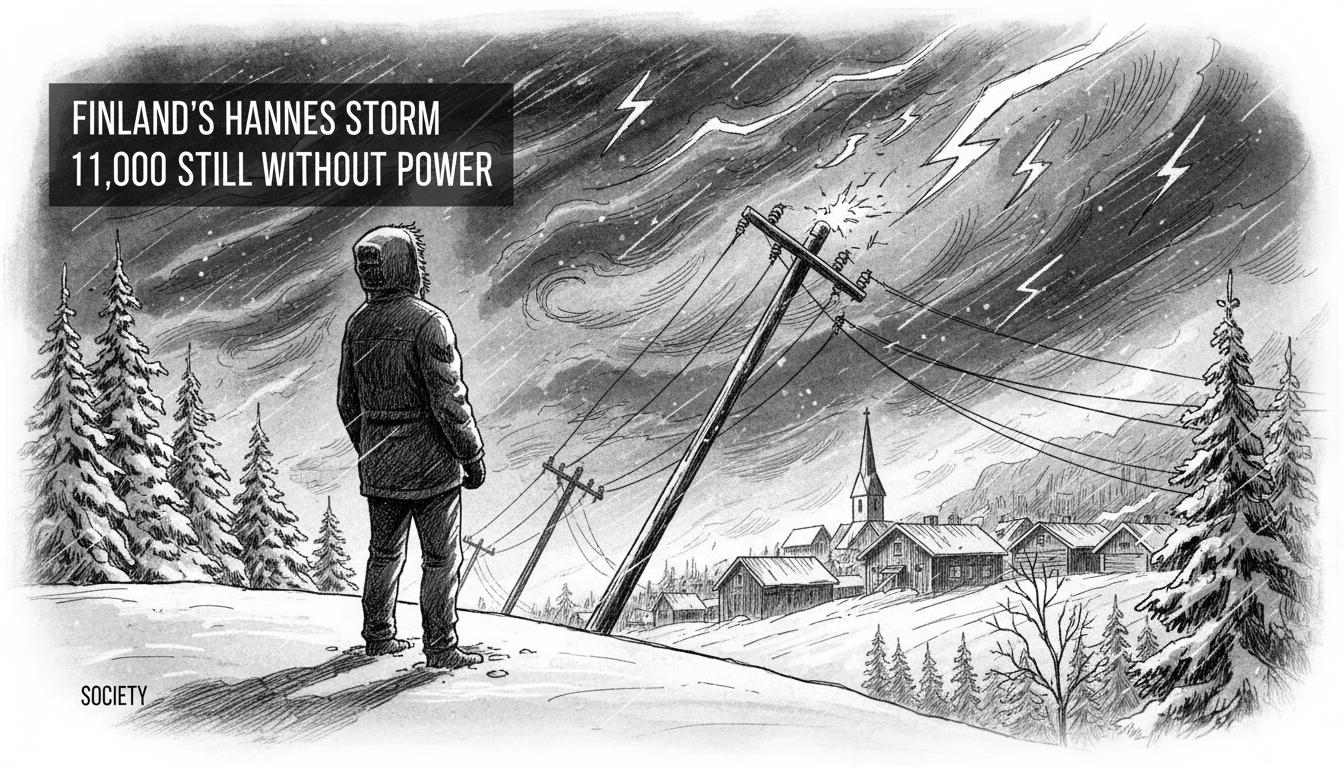
Finland's Hannes storm aftermath has left approximately 11,000 customers without electricity as difficult weather conditions continue to frustrate repair efforts. The powerful storm, which struck before the ground froze solid, has caused extensive damage to the power grid, primarily through fallen trees and broken lines. Energiateollisuus, the energy industry association, now states that completing repairs will take several more days due to persistent strong winds and hazardous working conditions. This ongoing disruption highlights the vulnerability of critical infrastructure to increasingly volatile Nordic weather patterns.
A Perfect Storm of Challenging Conditions
The timing of Storm Hannes has proven particularly problematic for repair crews. The ground had not yet entered its deep winter freeze, a state Finns call 'routa.' This meant tree root systems were less anchored in the soft, unfrozen soil, making them far more susceptible to being toppled by high winds. Once down, these trees bring power lines with them. Mikael Söderlund, a Communications Manager at Energiateollisuus, explained the compounding difficulties in a statement. 'The hard wind itself complicates repair work. Crews cannot safely work aloft on poles or in bucket trucks when gusts remain strong, and accessing remote damage sites through forest roads is slower,' he said. This combination—widespread physical damage and unsafe repair conditions—has created a logistical bottleneck, extending outages for thousands in predominantly rural areas.
The Human and Economic Impact of Prolonged Outages
For the affected households, often in scattered communities across central and southern Finland, the lack of power is more than an inconvenience. As temperatures hover around freezing, the failure of electric heating systems poses a real challenge. Many rely on electricity for water pumps, meaning outages also cut off running water. Local municipalities have opened emergency shelters and distributed warnings about the use of alternative heating sources due to carbon monoxide risks. The economic ripple effect is also significant. Small businesses, farms, and remote workspaces face operational halts. While Finland's population is generally well-prepared for winter emergencies, the duration of this outage tests the limits of personal preparedness, with reports of increased demand for portable generators and fuel.
Climate Change and Grid Resilience: A Growing Policy Debate
This event is reigniting a critical discussion in the Eduskunta, Finland's parliament, and within the Ministry of Economic Affairs and Employment about long-term infrastructure investment. Professor Laura Ekholm, an infrastructure resilience expert at Aalto University, connects these outages to a broader trend. 'The data is clear. We are observing a pattern of more frequent and intense autumn and early winter storms in the Baltic region,' she states. 'While our grid is built for cold and snow, these pre-freeze storms with heavy, wet snow and strong winds present a different type of threat.' The core policy question is the cost-benefit analysis of hardening the existing network. Options include more aggressive tree trimming along rights-of-way, installing more resilient poles, and significantly expanding underground cabling—a very expensive solution especially in Finland's vast, sparsely populated forest regions.
The Coordination of Crisis Response
The response to Storm Hannes is being coordinated through a well-established but now strained system. Energiateollisuus acts as a central information hub and coordinator between the various regional energy companies, such as Fortum, Caruna, and Elenia, which own and operate the distribution networks. The Finnish National Emergency Supply Agency (NESA) monitors the situation closely, ready to escalate support if critical services are threatened. This public-private crisis model is standard in Finland, but its effectiveness is being tested by the scale of the damage and the persistent bad weather preventing a swift resolution. Social media channels of the energy companies are constantly updated with estimated restoration times, though these are frequently pushed back as crews encounter more damage than initially assessed.
Looking Ahead: A Test for Winter Preparedness
As repair teams work in shifts around the clock, the focus is on restoring power to the largest number of customers first before addressing smaller, isolated faults. The coming days will be a critical test. A drop in wind speeds is forecast, which should allow crews to operate more efficiently and safely. However, meteorologists are also watching another low-pressure system forming over the North Atlantic. For Finnish policymakers, the aftermath of Hannes serves as a stark case study. It underscores the need to integrate climate projections into national infrastructure planning. Investments in smart grid technology, which can isolate faults and reroute power automatically, and improved resilience for critical nodes are likely to move higher on the political agenda in Helsinki. The storm is a blunt reminder that in the Nordic climate, resilience is not just about withstanding the cold dark of winter, but also the violent storms that herald its arrival.
Ultimately, the slow recovery from Storm Hannes poses a fundamental question for one of the world's most technologically advanced societies: How much are we willing to invest to keep the lights on as our weather becomes more unpredictable? The answer will define Finland's infrastructure strategy for decades to come.