
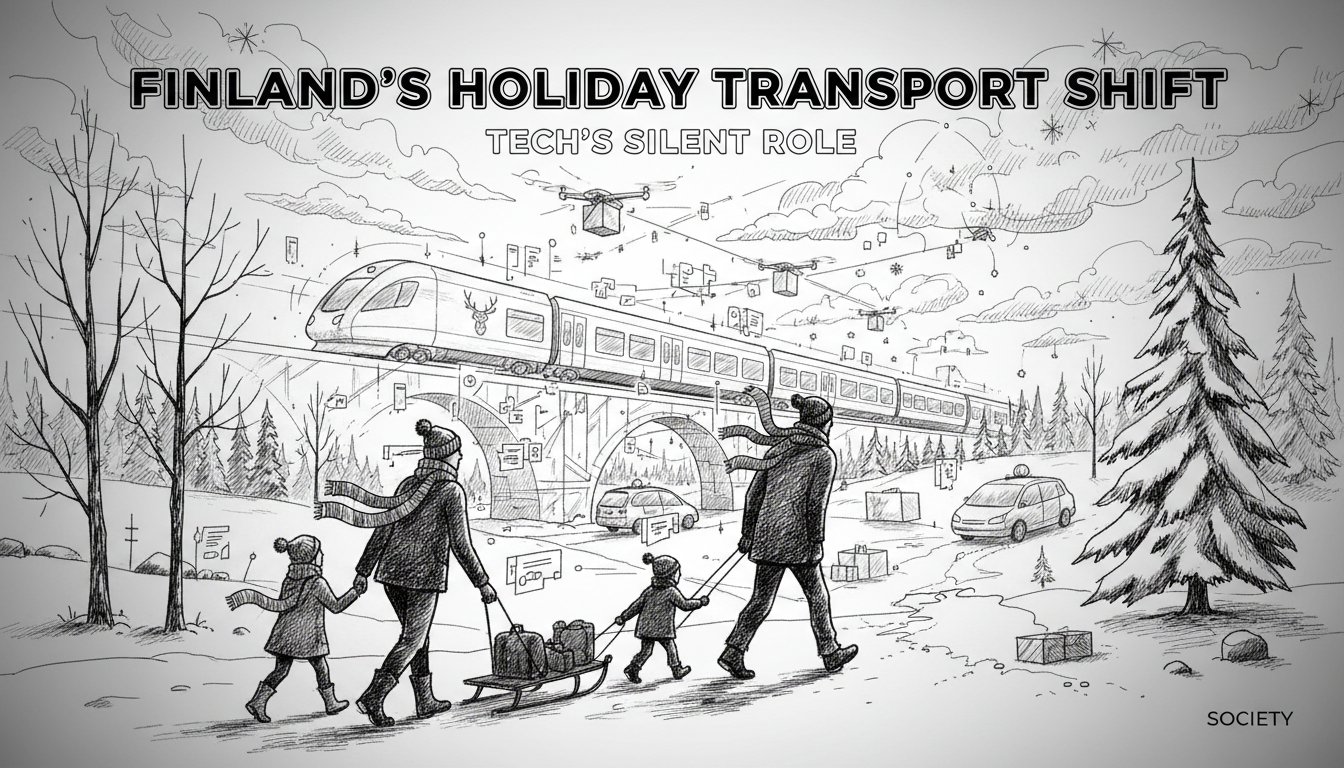
Finland's public transport schedules are undergoing their annual festive transformation, a logistical shift increasingly orchestrated by domestic technology. In Jyväskylä, Linkki bus services will follow a Saturday schedule until 4 PM on Christmas Eve before halting for the holiday. Services resume on Boxing Day with a Sunday timetable. This predictable annual change masks a deeper story of how Finnish software and data analytics are quietly managing the mobility of a nation during its most important holiday.
For international observers, the suspension of bus services on Christmas might seem unusual. In Finland, it is a deeply ingrained societal norm. Demand plummets as the country essentially shuts down. Families gather in homes, cities empty, and the focus shifts inward. The operational decision by Linkki and other regional carriers like Helsinki's HSL or Tampere's Nysse is economically rational. Running near-empty buses is financially unsustainable. However, the seamless execution of this nationwide scale-down, and the critical communication of it to the public, is where Finnish tech plays a pivotal role.
The Logistics Engine Behind the Holiday Pause
Transport companies are not making these decisions in a vacuum. They rely on vast historical datasets analyzed by sophisticated software, much of it developed domestically. Companies like MaaS Global, the Helsinki-based pioneer behind the Whim mobility app, and various logistics software firms provide the analytical backbone. They process years of ridership data for Christmas Eve, Christmas Day, and Boxing Day. This analysis doesn't just suggest suspending service; it precisely identifies the last economically viable departure time—4 PM in Jyväskylä's case.
"The holiday period is the ultimate stress test for predictive modeling in public transport," explains a data analyst from a Finnish mobility startup, speaking on background due to company policy. "We're not just predicting commuter flow; we're predicting societal behavior. The algorithms must account for family traditions, weather impacts on travel, and even the timing of the national 'Peace of Christmas' broadcast. Finnish companies are world leaders in this niche of applied logistics AI."
This tech-driven approach minimizes waste and operational cost. It also creates a standardized framework. The pattern of 'Saturday schedule until early evening, followed by a full stop, then a Sunday schedule' is replicated across many Finnish cities. This consistency is itself a product of data sharing and best-practice software platforms adopted by regional transport authorities.
Communication Tech: Ensuring No One Is Left in the Cold
The second critical tech layer is communication. Announcing a service halt is useless if the message fails to reach passengers. This is a multi-platform challenge tackled by Finnish digital communication firms. Schedule changes are pushed in real-time to apps like HSL's, Whim, and Google Maps via standardized GTFS (General Transit Feed Specification) data feeds. These integrations are managed by local developers and API specialists.
Furthermore, the information must be accessible to all demographics. While digital natives check their apps, others may rely on updated PDFs on transport authority websites or integrated displays at smart bus stops. Companies like Helsinki's WaitTimes, which manufactures digital passenger information displays, ensure their systems can seamlessly toggle to holiday schedules. The clean, user-centric design of these interfaces is a hallmark of Finnish digital design philosophy, seen in companies like Rovio and Supercell.
"The user experience challenge is absolute clarity," says Tiina Lammi, a UX designer who has worked on transport apps. "During holidays, stress is higher. People are traveling with gifts or children to see grandparents. The information about the last bus must be unambiguous, in multiple languages, and accessible within two taps. It's a public service mandate enabled by good tech."
The Economic and Social Algorithm
Beneath these operational adjustments lies a complex economic algorithm. Transport is a cost-heavy industry with significant personnel expenses. By legally mandating reduced service on national holidays, Finnish labor agreements help control these costs. The technology enables the most efficient implementation of these agreements. It allows for precise scheduling of driver shifts, aligning workforce availability with the legally reduced service requirement.
Socially, the tech-enabled schedule change reinforces a Finnish cultural priority: family time. By making public transport less available, it subtly discourages commercial activity and encourages domestic celebration. This is not an accident but a reflection of values coded into the system's parameters. The technology executes a policy choice that prioritizes collective well-being and tradition over 24/7 availability.
However, the system must also account for critical mobility. While regular buses stop, pre-booked "candlelight rides" (kynttiläkyyti) to cemeteries are often arranged for Christmas Eve—a poignant tradition. Coordinating these special services requires a separate logistical layer, often handled by smaller, specialized software or even direct municipal coordination, showing the limits of full automation.
A Model for the Connected Society
Finland's holiday transport shift is a microcosm of its tech-driven society. It showcases efficiency, foresight, and a commitment to equitable communication. The silent work of data analysts in Espoo, software developers in Helsinki, and UX designers in Oulu ensures the country can pause without plunging into chaos. It is a practical application of the famous Finnish concept of "jokamiehenoikeus" (everyman's right)—the right to move freely—temporarily recalibrated by technology for communal benefit.
As mobility evolves with on-demand services and potential autonomous vehicles, this holiday model will be further tested. Will future AI-powered transport networks still shut down for Christmas, or will they offer sparse, on-demand pods? The current balance, managed by human-centric technology, suggests that even in a high-tech future, some Finnish traditions, enabled by clever code, will stubbornly and beautifully remain.