
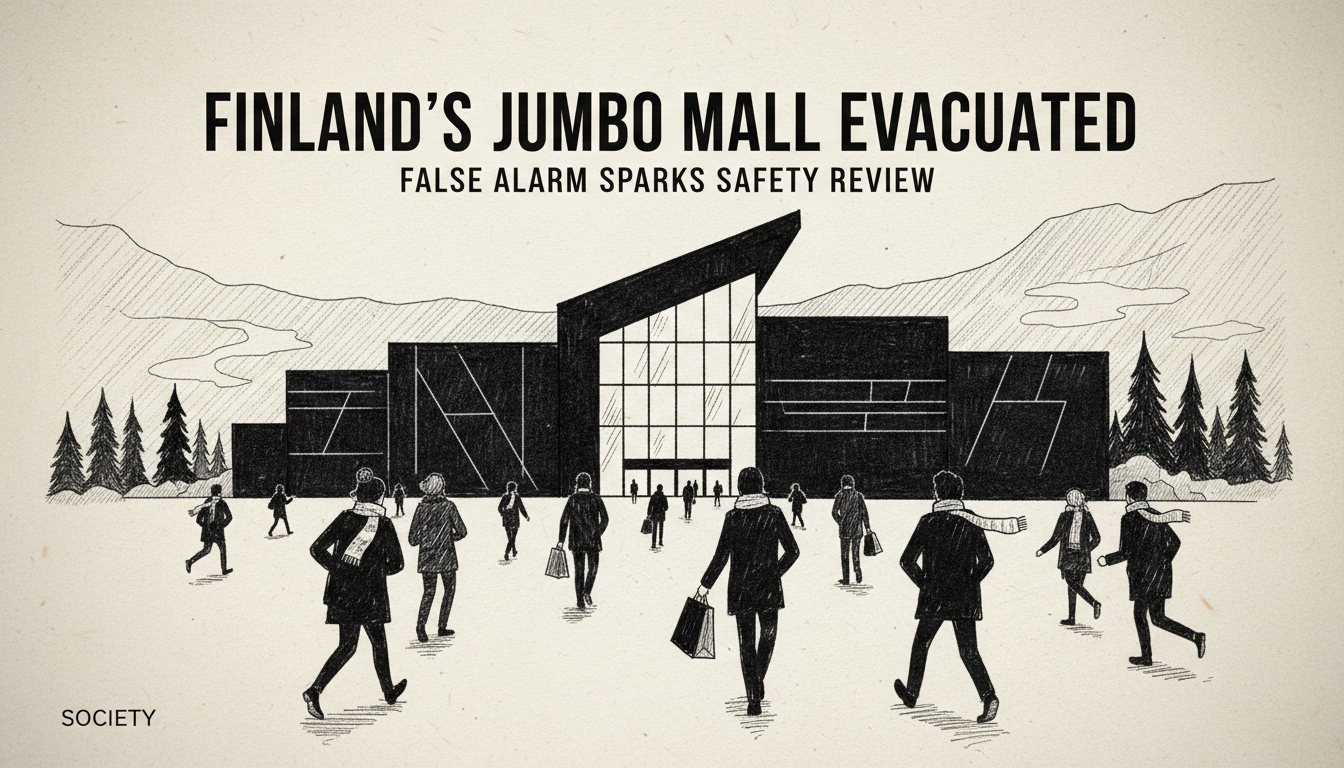
Finland's Jumbo shopping center in Vantaa was abruptly evacuated on a busy Sunday afternoon, sending thousands of shoppers into the parking lots under a clear autumn sky. The Central Uusimaa Rescue Department confirmed the incident was triggered by a false alarm, allowing people to return to the Nordic region's largest retail complex within hours. This disruption at a key hub near Helsinki-Vantaa Airport highlights the delicate balance between public safety protocols and commercial continuity in Finland's vast network of covered shopping centers.
A Routine Sunday Turned Chaotic
Shoppers and employees at the sprawling Jumbo complex experienced sudden confusion when evacuation orders sounded through the mall's public address system. Security personnel and store staff initiated standard procedures, directing the flow of people toward designated exits. The scene outside, captured on numerous mobile phones, showed crowds gathering at a safe distance while rescue service vehicles arrived with lights flashing. For many families, this interrupted a typical weekend ritual of shopping and dining at one of the country's most popular retail destinations, which anchors the larger Aviapolis district.
Initial uncertainty gripped the crowd as rumors spread about a potential fire or security threat. The presence of multiple rescue units from the Central Uusimaa Rescue Department suggested a serious response. However, within approximately ninety minutes, authorities completed their systematic checks of the 170,000 square meter facility. Officials then gave the all-clear, confirming no actual emergency existed. Mall management reopened the doors, and business gradually resumed, though some smaller retailers reported significant disruption to their peak Sunday sales.
Examining the Systems Behind the Siren
This false alarm at Jumbo inevitably turns attention toward Finland's comprehensive safety regulations for large public spaces. The Finnish Ministry of the Interior, through the Rescue Act (Pelastuslaki), mandates strict requirements for alarm systems, evacuation plans, and staff training in all major shopping centers. These protocols were strengthened following international incidents, reflecting Finland's proactive approach to public safety. Every large mall must conduct regular, documented evacuation drills, with Jumbo's last major exercise occurring six months prior according to publicly available safety reports.
Technical experts point to several potential origins for such false alarms. "Modern fire and safety systems are highly sensitive networks integrating smoke detectors, heat sensors, and manual call points," explains safety engineer Laura Mikkonen, who consults for several retail property owners. "A fault in a single sensor, accidental activation by a member of the public, or even a software glitch in the central panel can initiate a full building evacuation sequence. The critical thing is that the system responded, and people moved to safety as designed." The investigation into the specific technical cause at Jumbo is ongoing, with results expected to be shared with the rescue authorities.
The Economic Ripple Effect of an Evacuation
Beyond the immediate safety response, a full evacuation of a center like Jumbo carries a tangible economic cost. Sunday afternoon represents one of the busiest and most profitable trading windows for Finnish retailers, especially restaurants and entertainment venues. While large chain stores may absorb the loss, smaller independent retailers and kiosk operators feel the impact more acutely. The Finnish Commerce Federation (Suomen Kauppayhdistys) has previously highlighted the vulnerability of the retail sector to operational disruptions, from power outages to safety scares.
"For a small business operating on thin margins, losing three hours of prime weekend revenue can mean the difference between a profitable week and a loss," says retail analyst Tomi Virtanen. "There's also the unseen cost of spoiled food in restaurants, abandoned perishable goods in supermarket carts, and the administrative burden of reconciling interrupted transactions." The Jumbo management company, owned by Citycon Oyj, will likely face questions from tenants about potential compensation or lease adjustments, though standard contracts typically include clauses for force majeure events including safety evacuations.
Public Confidence and Preparedness Culture
Incidents like this serve as an unplanned test of both infrastructure and public behavior. Early reports and social media commentary suggest the evacuation proceeded in an orderly, Finnish manner, with little panic observed. This aligns with the national culture of preparedness (varautuminen) that is taught from childhood and reinforced through public information campaigns from the National Emergency Supply Agency (Huoltovarmuuskeskus). Finns are generally accustomed to following official instructions during drills or real emergencies, a trait that likely contributed to the smooth evacuation.
However, security researchers note that repeated false alarms can risk complacency, a phenomenon sometimes called 'alarm fatigue.' "The goal is a system that never cries wolf, but if it does, the public must always respond as if the threat is real," notes Dr. Eero Salminen from the University of Helsinki's Security and Resilience Research Group. "The positive outcome here is that the procedures worked. People evacuated, services responded, and the threat was assessed. It validates the investment in these systems, even when the trigger is false." The challenge for Jumbo's management is to maintain public trust by transparently explaining the cause and any remedial actions taken.
Regulatory Context and EU Safety Standards
Finland's approach to public space safety operates within a broader European framework. The EU's General Product Safety Directive and various construction product regulations influence the standards for installed alarm and fire safety equipment. Finnish national building codes (Rakentamismääräyskokoelma) often exceed these minimums, particularly for large assembly buildings like shopping malls. Regular inspections by the rescue department and technical safety authorities (Tukes) are mandatory, with non-compliance resulting in substantial fines and potential closure orders.
The incident also touches on evolving security considerations beyond fire safety. Since the 2017 Turku attack, Finnish authorities have increased focus on integrated security planning in crowded places. This includes coordinating evacuation protocols for multiple threat scenarios, from active assailants to chemical hazards. Shopping center managers now participate in regular security briefings with local police (Poliisi) and the Finnish Security and Intelligence Service (Suojelupoliisi). While Sunday's event was a false alarm, its handling provides real-world data on crowd movement and inter-agency communication that can inform future planning.
Looking Ahead: Technology and Transparency
The resolution of this incident now moves into the phases of technical review and public communication. Jumbo's technical team, in conjunction with the system manufacturer and rescue department investigators, will work to pinpoint the exact failure point. Potential outcomes range from a simple component replacement to a broader software update across the system. All findings must be documented in the building's official safety log, which is subject to inspection by the authorities.
For the Finnish public, the key takeaway is likely one of reassurance. The systems designed to protect them functioned, even in the absence of a real threat. The efficient response by both private security and public rescue services demonstrates a well-rehearsed partnership. As shoppers returned to Jumbo to collect their cars or resume their purchases, the dominant mood appeared to be one of mild inconvenience rather than anger or fear. In a world of genuine emergencies, a false alarm that ends calmly is not a failure of the system, but a proof of its existence. The ultimate question for property owners across Finland is whether their own evacuation plans would pass the same unexpected Sunday afternoon test.