
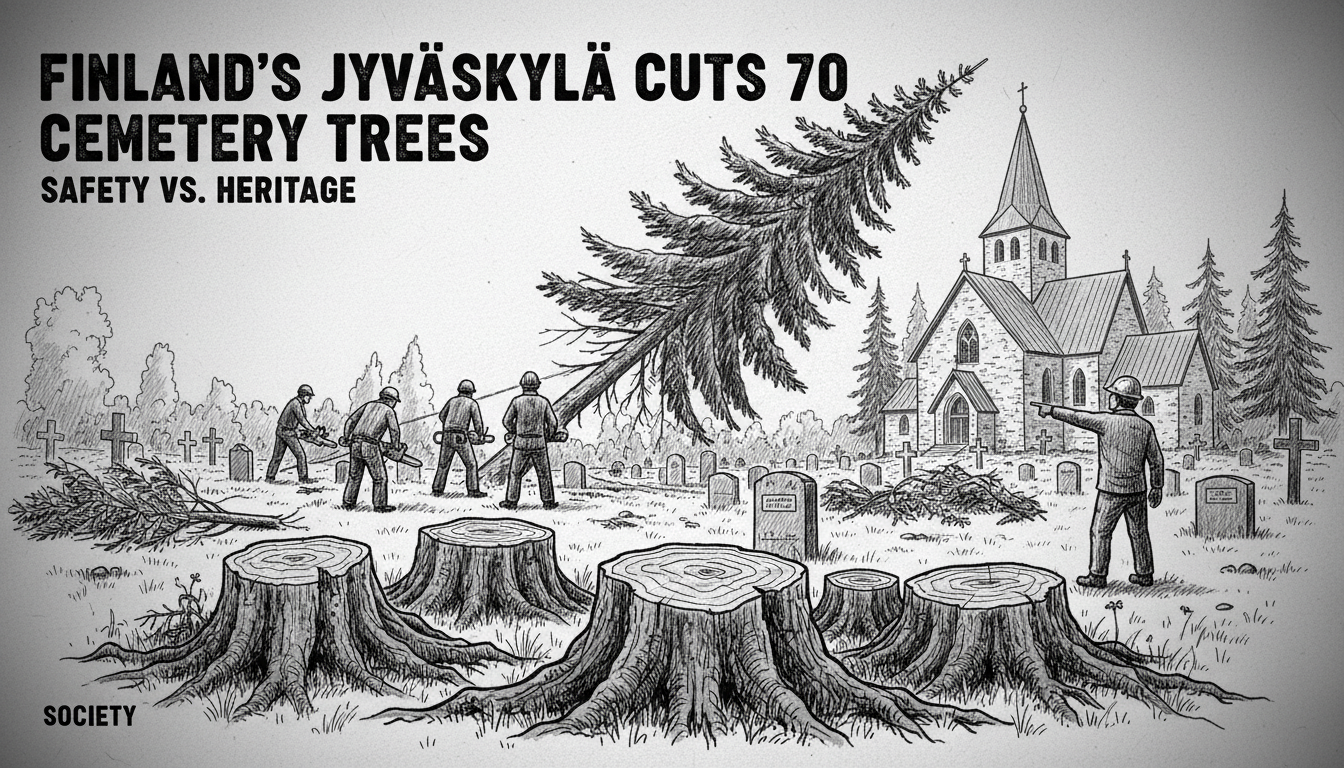
Finland's city of Jyväskylä is removing approximately 70 old trees from its historic Vanha hautausmaa, or Old Cemetery, in a week-long operation concluding Friday. The decision follows a detailed arborist assessment that identified the trees as being in poor or dangerous condition, posing a direct risk to visitors and maintenance staff. This action highlights the complex balance Finnish municipalities must strike between preserving culturally significant green spaces and ensuring public safety in urban environments.
"It was also a work safety risk for the parish employees who maintain the cemetery and the graves," said Liisa Kontunen, work manager for the Jyväskylä Parish, which manages the site. Kontunen explained that the planning process took several years, beginning with a professional evaluation. The assessment concluded that around 50 trees needed removal because they were either hazardous or in weak health, with branches that could detach and fall on people moving through the grounds.
The Delicate Task of Cemetery Stewardship
The operation in Jyväskylä is not merely forestry work; it is a careful exercise in landscape management within a sensitive historical context. Cemeteries in Finland serve as important green lungs in cities and are often protected areas due to their cultural, historical, and environmental value. The Vanha hautausmaa is part of Jyväskylä's urban fabric, a serene space that intertwines natural beauty with communal memory. Removing mature trees from such a setting requires justification that extends beyond simple convenience.
Experts in urban forestry note that while mature trees are invaluable for biodiversity, carbon sequestration, and historical continuity, their management in public spaces is non-negotiable when safety is compromised. "An aging tree in a forest can be left to decay naturally, contributing to the ecosystem," explains a Helsinki-based arborist who preferred not to be named. "But an aging tree next to a well-used path in a city cemetery is a liability. The duty of care for the landowner is paramount." The Jyväskylä Parish, by commissioning a specialist report before any action, followed established best practice for mitigating this liability.
A Process Measured in Years, Not Days
Kontunen's revelation that the project was planned over multiple years is significant. It indicates a deliberate, non-hasty approach characteristic of Finnish public administration and heritage management. The initial step—hiring an arborist to conduct a thorough survey—shifted the decision from a subjective opinion to a risk-based, professional evaluation. This methodology is crucial for public acceptance and aligns with Finland's generally consensus-driven and data-informed policy culture.
The work itself is being conducted with precision. Operators are navigating around gravestones and monuments, avoiding damage to the historic fabric of the cemetery. This careful execution underscores the respectful ethos guiding the project: the removal is an act of necessary stewardship, not disregard. The parish's approach mirrors national guidelines for managing protected and heritage landscapes, where any alteration demands careful documentation and a minimal-impact methodology.
The Broader Finnish Context of Urban Tree Management
This incident in central Finland reflects a nationwide conversation about urban tree canopies. Finnish cities, including Helsinki, Tampere, and Turku, consistently rank high in global assessments of urban green space. Maintaining this reputation requires active management. Climate change introduces new stressors, such as pests and extreme weather events, which can accelerate the decline of older trees. Municipalities across the country are increasingly investing in tree health monitoring and diversified planting strategies to build resilience.
The situation in Jyväskylä also touches on the role of the Evangelical Lutheran Church of Finland, which remains the largest religious community and manages thousands of cemeteries nationwide. These spaces are legally open to all residents for burial, regardless of faith, making their upkeep a matter of broad public interest. The church's forestry decisions in these cemeteries are therefore subject to public scrutiny and must balance practical, safety, aesthetic, and memorial considerations.
Between Preservation and Practicality
Public reaction to such tree removals is often mixed. Some citizens mourn the loss of mature trees that have shaped a familiar skyline for decades. Others understand the imperative of safety, especially in a place of quiet reflection where visitors, including the elderly, expect a secure environment. The Jyväskylä Parish has proactively communicated the reasons behind the operation, emphasizing the arborist's findings—a key strategy for maintaining public trust.
There is an inherent tension in managing any historical landscape: the desire to preserve it unchanged conflicts with the reality of natural decay and evolution. A cemetery is a living landscape, not a museum diorama. Trees grow, age, and die. The challenge for managers is to intervene in a way that honors the site's character while guiding its evolution safely. This sometimes means removing iconic trees before they fail catastrophically.
Looking Ahead: Replacement and Legacy
A critical question following any removal of this scale is replanting. While the source material does not specify plans for Jyväskylä, standard practice in Finnish urban forestry is to replace removed trees with new plantings, often choosing a diverse mix of native species to ensure future canopy cover and ecological health. This forward-looking perspective is essential. The work this week is not just about eliminating risk but about responsibly renewing the cemetery's arboreal heritage for future generations.
The trees being removed have witnessed decades of Jyväskylä's history. Their replacement saplings will grow in a different city, facing a changed climate. This cyclical process is a quiet metaphor for the cemetery's own purpose: a space that acknowledges endings while nurturing continuity. The parish's careful, documented process provides a template for other Finnish towns facing similar dilemmas with their own historic green spaces.
Ultimately, the story of the 70 trees in Jyväskylä is a microcosm of modern Nordic urban governance. It involves expert consultation, transparent risk management, respectful execution, and a long-term view of the public good. It demonstrates that preserving heritage sometimes requires difficult change, and that safety in shared communal spaces is a foundational responsibility. As the machinery falls silent in the Vanha hautausmaa on Friday, the landscape will be altered, but the careful thought behind the alteration will ensure its role as a protected, peaceful refuge endures.