
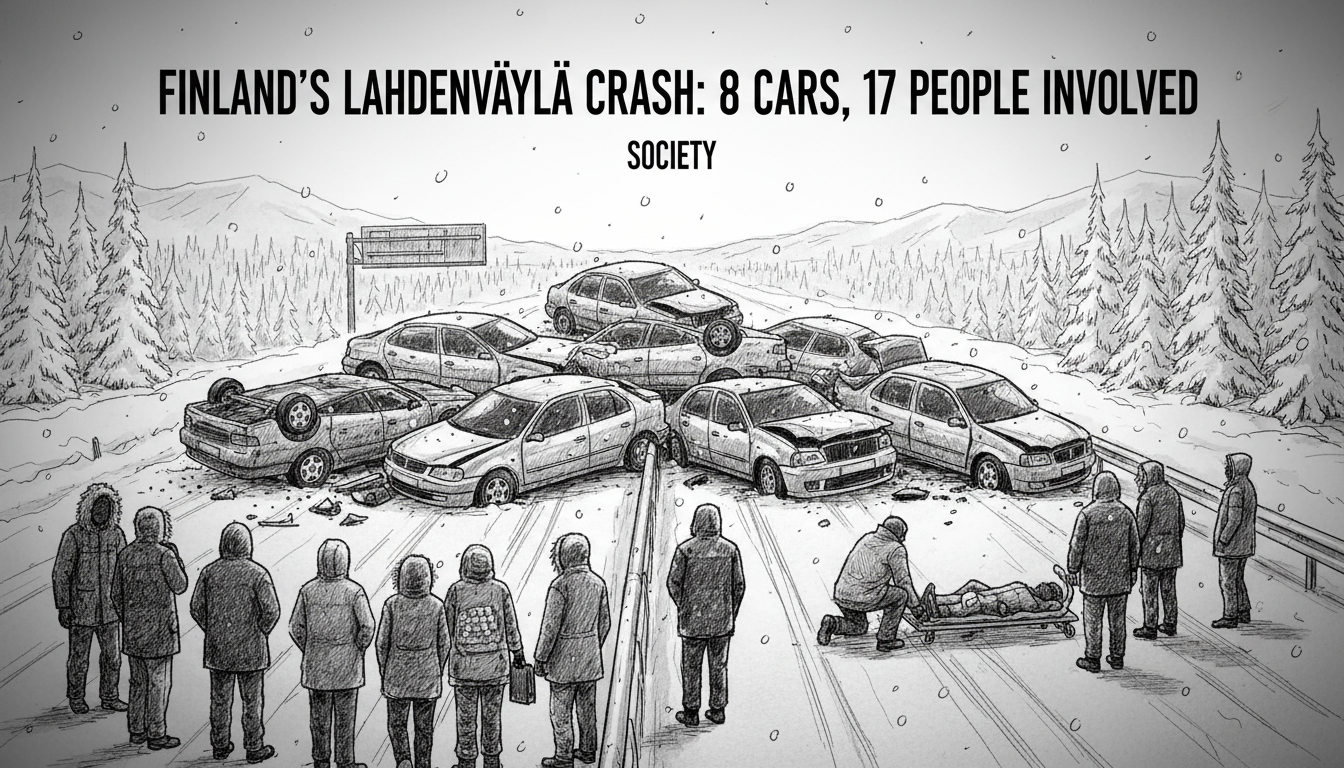
Finland's Lahdenväylä highway witnessed a significant chain collision on St. Stephen's Day, involving eight vehicles and seventeen people. The accident occurred on the southbound lanes between the Korso and Koivukylä interchanges in Vantaa, with emergency services receiving the first alert around 2:40 PM. Three individuals required hospital transport following the crash, which caused temporary traffic congestion on the vital arterial route. Police have launched a formal investigation into the circumstances of the pile-up, a stark reminder of winter driving hazards during Finland's darkest season.
A Recurring Winter Hazard on Finnish Roads
This collision on National Road 4 fits a familiar and dangerous pattern on Finnish highways during the winter months. Chain collisions, or pile-ups, are a recurring traffic safety challenge, often triggered by a sudden convergence of adverse weather, reduced visibility, and high speeds. The period around Christmas and New Year is particularly risky, with holiday travel volumes meeting the challenging conditions of the Finnish winter. Daylight is scarce, and roads can quickly become slick with ice or obscured by blowing snow. Finland's Traffic Safety Agency (Liikenneturva) consistently warns drivers that the legal speed limit is a maximum under ideal conditions, not a target. Finnish law explicitly requires motorists to adjust their speed and driving style to match the prevailing road and weather conditions, a rule rigorously enforced by police.
“The fundamental rule is that your following distance must be sufficient to stop safely if the vehicle in front of you brakes suddenly,” explains a senior traffic safety expert familiar with Finnish road policies. “In winter conditions, this distance needs to be multiplied. Many drivers underestimate how much longer the braking distance is on ice, even with modern winter tires.” The expert, who requested anonymity as they were not the investigating officer on this specific case, emphasized that winter tires—mandatory in Finland from December to February—are a necessary tool but not a guarantee of safety. Driver awareness, reduced speed, and increased following distance form the critical triad of winter driving prevention.
The Critical Infrastructure of Lahdenväylä
Lahdenväylä, or Highway 4, is one of Finland's most important and busiest transport corridors. It connects the capital region of Helsinki and Vantaa to the cities of Lahti and further north, forming a key part of the European route E75. The stretch where the accident occurred, near the densely populated areas of Korso and Koivukylä, typically carries heavy commuter and freight traffic. Any major incident here causes immediate and widespread disruption, as witnessed by the rapid congestion following this eight-car collision. The Finnish Transport Infrastructure Agency (Väylävirasto) maintains the road, employing round-the-clock winter maintenance crews. However, as this accident demonstrates, even well-maintained roads are vulnerable during sudden weather shifts or when driver behavior fails to adapt.
Parliamentary committees have periodically reviewed funding for road maintenance and safety improvements on major highways like Lahdenväylä. The Ministry of Transport and Communications operates under a strategic goal of Vision Zero, aiming to eliminate fatal and serious traffic accidents. This vision guides infrastructure investments, with priorities on separating oncoming traffic, improving road surfaces, and enhancing lighting. Yet, the human factor remains the most volatile element in the safety equation. The Eduskunta has supported stricter penalties for serious traffic violations, reflecting a political consensus on improving road safety, though debates continue on the balance between enforcement, education, and infrastructure spending.
Emergency Response and Investigation Protocols
The response to the Vantaa pile-up activated standard Finnish emergency protocols. The Uusimaa Rescue Department (Pelastuslaitos) coordinated the scene, assessing injuries and securing the vehicles. The triage and transport of the three hospitalized individuals were handled by emergency medical services, with patients taken to the nearest appropriate hospital for evaluation. Police from the Helsinki Police Department, under the National Police Board, assumed control of the traffic investigation. Their work will be meticulous, involving scene documentation, witness statements, and potentially technical analysis of vehicle data.
A police investigation into a multi-vehicle collision like this will seek to establish the sequence of impacts, identify any primary cause such as excessive speed or a sudden stop, and rule out mechanical failures. Finland's legal framework for traffic investigations is thorough, and findings can lead to fines or prosecutions for traffic endangerment if gross negligence is established. The results also feed into national traffic safety statistics, which inform policy at the Ministry of Transport and Communications. While the specific findings from this St. Stephen's Day crash are pending, the immediate outcome—seventeen people involved, three hospitalized—will be recorded as another serious incident in the annual winter statistics.
The Broader Context of Nordic Winter Mobility
Finland's struggle with winter road safety is shared by its Nordic neighbors, yet each country employs a slightly different mix of policies. Sweden and Norway similarly mandate winter tires for seasonal periods and emphasize the concept of adapted driving. All Nordic countries invest heavily in road maintenance, but Finland's more extensive network of rural roads and its particular climate present unique challenges. The Finnish model places significant responsibility on the individual driver, backed by strong public awareness campaigns from Liikenneturva about safe following distances and speed adjustment.
This cultural and legal emphasis on personal responsibility is a cornerstone of Finnish traffic safety philosophy. From the driver's education curriculum to national media campaigns, the message is consistent: the vehicle's capabilities and the law are secondary to the demands of the current road conditions. The Lahdenväylä crash serves as a case study in what happens when that principle is overlooked, even momentarily, on a high-speed highway. It also tests the resilience of the emergency response system, which in this instance functioned to prevent more serious outcomes, according to initial reports.
Policy Responses and Preventative Measures
In the wake of such incidents, calls for action typically follow a predictable pattern. Opposition politicians may question if maintenance budgets are adequate or if enforcement is strong enough. The government, currently led by Prime Minister Petteri Orpo's coalition, points to ongoing investments and the overarching Vision Zero strategy. The Ministry of Transport and Communications regularly updates its action plans, which include technological solutions like intelligent weather stations that provide real-time data to navigation apps, warning drivers of slippery patches ahead.
However, traffic safety experts argue that technology can only assist an attentive driver. “The most effective safety feature is the person behind the wheel,” the traffic safety expert reiterated. “Advanced driver assistance systems like automatic emergency braking can help mitigate collisions, but they are not infallible, especially in heavy snow or fog. The primary prevention tool is a driver who understands that arriving safely is more important than arriving quickly.” This incident on a major highway two days after Christmas will likely be referenced in upcoming spring campaigns, reminding Finns that winter driving vigilance is required until the last frost melts.
As the investigation continues and the affected individuals recover, the Lahdenväylä chain collision stands as a somber post-holiday reminder. It underscores the non-negotiable relationship between speed, distance, and traction on icy asphalt. For Finland's transport authorities and lawmakers, it reinforces the continuous challenge of safeguarding mobility during the country's most demanding season. The ultimate goal remains clear: to ensure that the nation's vital arteries, like Highway 4, facilitate connection and commerce without becoming venues for preventable tragedy. The coming weeks will show if this single event sparks renewed political debate or simply fades into the annual tally of winter mishaps, a statistic everyone hopes to reduce.