
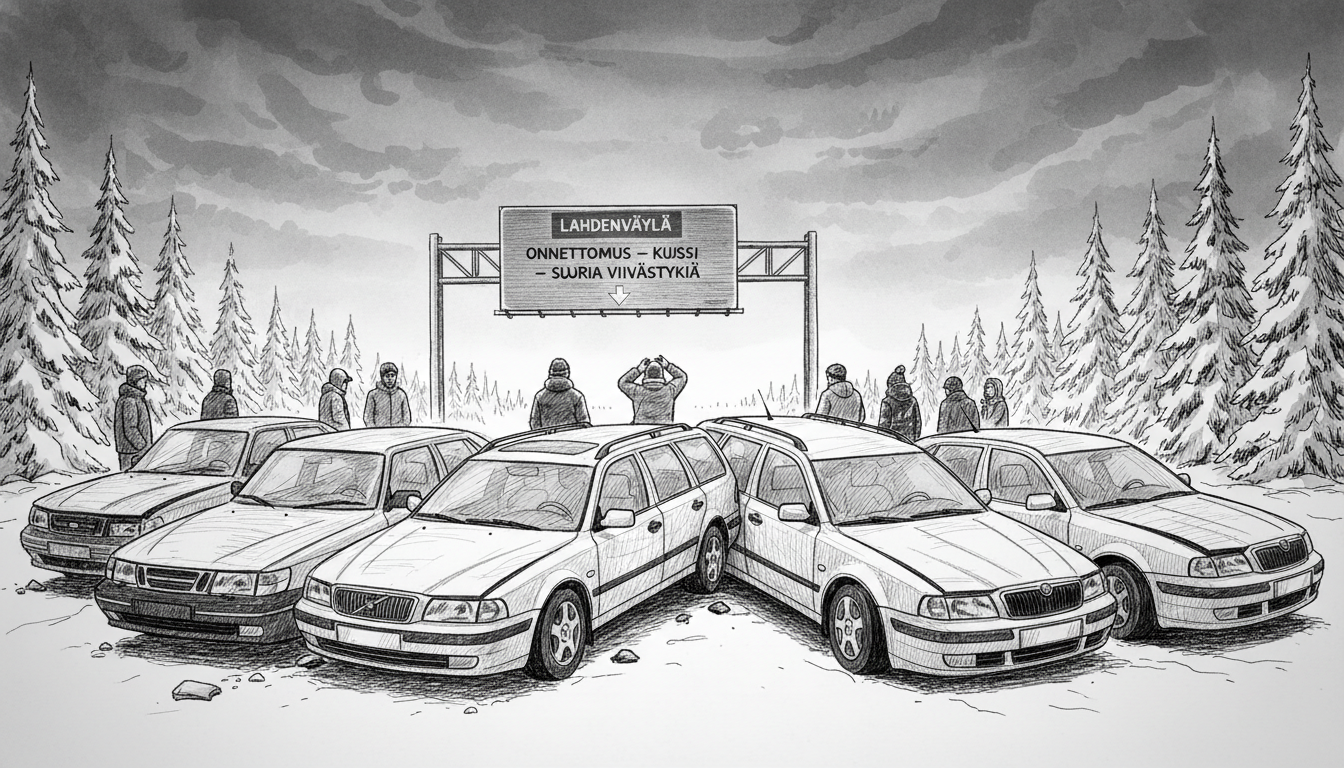
Finland's main Lahdenväylä highway was the site of a major multi-vehicle collision Thursday afternoon, causing severe disruptions for thousands of commuters. A chain-reaction accident involving six passenger cars forced the closure of one southbound lane on the vital E75 motorway, triggering extensive traffic congestion stretching toward the capital region.
The incident was reported at 2:43 PM between the Korso and Koivukylä interchanges in Vantaa, a densely populated suburban area. By 3:31 PM, national traffic management authority Fintraffic had issued a formal alert confirming the lane closure and the resulting traffic buildup. The crash blocked a critical artery for the Helsinki metropolitan area, where an estimated 100,000 vehicles travel this stretch daily.
Immediate Aftermath and Traffic Gridlock
Emergency services responded swiftly to the scene. The extent of injuries remains unclear, though the involvement of six vehicles suggests a significant impact. The closure of the southbound lane, the primary route for commuters heading into Helsinki from the northern suburbs and beyond, created an immediate bottleneck. Real-time traffic maps showed a solid red line of congested vehicles extending several kilometers north from the accident site.
This disruption highlights the fragility of the Greater Helsinki road network. Lahdenväylä, officially Finnish national road 4, is part of the European route E75 running from Vardø, Norway, to Sitia, Greece. In Finland, it serves as the principal connection between Helsinki and the major cities of Lahti and beyond. Any incident on this road has a cascading effect on the entire region's traffic flow, paralyzing key junctions like the Ring I and affecting public transport schedules.
A Critical Choke Point in Finnish Transport
The crash site near the Korso junction is a known pressure point. This area experiences intense traffic volume during morning and afternoon peak hours, with drivers often maintaining high speeds. Traffic safety analysts consistently point to such high-density, high-speed corridors as locations where minor errors can escalate into major pile-ups. Weather conditions at the time were reportedly clear, which will likely focus any official investigation on factors like driver attentiveness, speed adaptation, and following distances.
"A chain collision of this scale on a road of this importance is a stark reminder of the constant vigilance required," said a veteran Finnish traffic police inspector, speaking on the condition of anonymity as the investigation is active. "The safe distance between vehicles is not a suggestion; it's a physical necessity for stopping in time. On highways like Lahdenväylä, where traffic density is high, that margin for error evaporates quickly."
The economic ripple effect of such an outage is considerable. Delays for freight transport, commuter time lost, and increased fuel consumption from idling vehicles create a tangible, if often uncounted, cost. For individuals, the impact is direct—missed appointments, late arrivals home, and heightened stress.
Infrastructure Strain and Recurring Challenges
Thursday's crash is not an isolated event on Lahdenväylä. The road has a history of serious accidents leading to major disruptions. Each incident renews debates about road safety measures, potential infrastructure upgrades, and driver education. While Finland boasts one of the world's safest road networks, its main arteries remain vulnerable to sudden, severe interruptions.
Current traffic management relies heavily on real-time information from Fintraffic and rapid response from emergency crews. However, the physical reality of a blocked lane on a key highway means backups are inevitable. Alternative routes through Vantaa's urban grid quickly become saturated, offering little relief during peak hours.
This event also underscores the region's dependency on private car travel, despite significant investments in public transit like the Helsinki metro extension and commuter rail. For many living in the growing suburbs north of the capital, the car remains the only viable option, funneling enormous numbers of vehicles onto a limited number of highways.
Looking Ahead: Safety and Solutions
As tow trucks clear the wreckage and the closed lane reopens, the immediate crisis will fade. The longer-term questions will persist. Transport officials continuously analyze accident data to identify black spots and propose engineering solutions, such as improved lane markings, better lighting, or dynamic speed limit systems. Yet, the human factor remains the most unpredictable variable.
The coming days will see the police release more details on the cause of the chain collision. Their findings will feed into the ongoing work of the Finnish Transport and Communications Agency (Traficom) and other safety bodies. For the countless drivers stuck in Thursday's gridlock, the experience serves as a frustrating and personal lesson in the interconnected nature of modern transportation.
How does a nation committed to efficiency and safety further fortify its critical transport links against the domino effect of a single accident? The answer lies in a complex mix of technology, infrastructure investment, and perennial public awareness campaigns about the fundamentals of defensive driving. As traffic finally begins to flow normally on Lahdenväylä, the search for more resilient solutions continues, one commute at a time.