
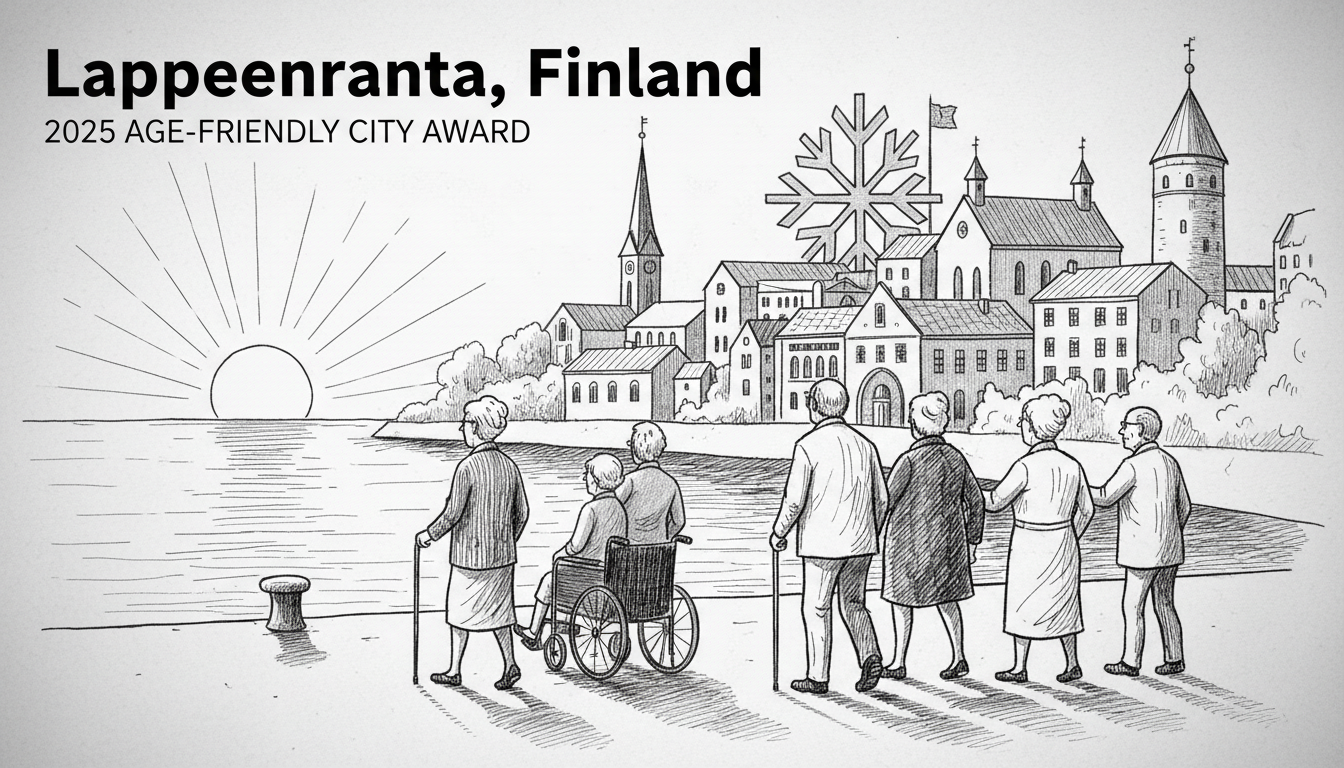
Finland's national pensioners' organization has awarded Lappeenranta its 2025 Age-Friendly Act recognition for exemplary housing policy. The city earned praise for its systematic inclusion of the local council for the elderly in developing a comprehensive housing strategy that addresses the needs of its aging population. This award highlights a growing municipal focus across Finland on creating sustainable living environments for seniors as demographic pressures intensify.
Eläkeläiset ry, the influential national pensioners' association, selected Lappeenranta based on proposals from its local chapters. The organization specifically commended the city for granting its vanhusneuvosto, or council for the elderly, genuine influence in the drafting process of a new housing policy program. This participatory model ensures the perspectives of older residents are embedded from the initial planning stages, leading to what the association calls "good and sustainable solutions."
A Blueprint for Participatory Policy
The core of Lappeenranta's recognized approach is the formal integration of its elderly council into municipal governance. Unlike token consultations, the vanhusneuvosto was involved in shaping the city's housing development strategy and its detailed housing policy program. This program now comprehensively outlines measures to develop housing opportunities for the elderly. The city has committed to considering population aging in all aspects of urban development, including housing and construction design, neighborhood development, and renovation projects.
"When the perspectives of the elderly are considered already in the planning and preparation phase, we achieve good and sustainable solutions," Eläkeläiset ry stated in its award announcement. The organization used the award to issue a broader recommendation to all Finnish municipalities: actively involve pensioners in decision-making and provide elderly councils with real authority. This model counters a common pitfall where advisory bodies are heard but lack the power to shape outcomes.
Finland's Demographic Imperative
Lappeenranta's policy shift is not an isolated initiative but a direct response to a national demographic reality. Finland's population is aging rapidly, a trend that places immense pressure on social services, healthcare, and housing markets. In 2022, people aged 65 or over constituted 23.5 per cent of the Finnish population, a figure that is projected to grow steadily. This shift transforms housing from a simple shelter into a critical component of health, independence, and social inclusion for seniors.
Municipalities are on the front lines of this challenge. They control zoning, local infrastructure, and social housing policies, making their actions decisive for everyday quality of life. An age-friendly city goes beyond building nursing homes; it encompasses accessible public transport, walkable neighborhoods with benches and safe crossings, housing suitable for reduced mobility, and community spaces that combat loneliness. Lappeenranta's program attempts to weave these considerations into the fabric of its urban planning.
The Expert View on Co-Creation
Urban planning and gerontology experts strongly endorse the participatory model championed by Eläkeläiset ry and implemented in Lappeenranta. "Policies crafted for the elderly, without the elderly, are destined to be inefficient and often miss the mark," says Dr. Eeva Liukko, a researcher specializing in aging and the built environment. "The lived experience of an 80-year-old navigating their city is data that cannot be replicated in a planner's office. Councils for the elderly provide that essential, granular insight."
This expert context underscores that involving seniors is not merely a box-ticking exercise in inclusivity. It is a practical method to create policies that work. Seniors can identify barriers invisible to younger planners—a curb that is just a bit too high, a public bathroom that is poorly signed, a bus route that misses a key community center. Their input leads to environments that prolong independent living, reduce accidental injuries, and foster social connections, ultimately alleviating pressure on formal care systems.
From Recognition to Replication
The 'Age-Friendly Act' award serves a dual purpose: it honors Lappeenranta and provides a replicable template for other cities. The award criteria effectively create a checklist for municipal action: establish a formal elderly council, grant it authority in strategic planning, and comprehensively address aging in housing, construction, and environmental design. Other Finnish cities, from Helsinki to smaller rural municipalities, are now observing a concrete case study of this policy in action.
The challenge for Lappeenranta will be implementation and long-term commitment. Embedding these principles into annual budgets, planning permissions, and infrastructure projects requires sustained political will. The city must ensure that the collaborative spirit of the planning phase continues as projects move to construction and maintenance. Furthermore, the needs of the elderly are not monolithic; the city must also account for diversity in income, health, and family structure within its senior population.
The Broader Nordic Context
While Finland faces a particularly acute aging trend, the quest for age-friendly cities is a Nordic-wide priority. Similar discussions are underway in Sweden, Denmark, and Norway, where municipalities are experimenting with co-housing models, smart home technology for assisted living, and retrofitting existing suburbs. The Nordic welfare model, with its strong municipal role, is uniquely positioned to develop systematic, rather than piecemeal, solutions. Lappeenranta's award-winning approach contributes to this regional knowledge base, demonstrating the value of institutionalized citizen participation.
The recognition from Eläkeläiset ry also highlights the powerful role of civil society organizations in shaping public policy in Finland. Pensioners' associations are well-organized advocacy groups capable of setting agendas and benchmarking municipal performance. Their annual award creates positive competition and public recognition, incentivizing cities to prioritize the needs of their older residents.
As Finland continues to gray, the question for every mayor and city council is straightforward: are we building a city our residents can grow old in with dignity, or are we constructing barriers to a full life? Lappeenranta's 2025 Age-Friendly Act award suggests it has chosen the former path, making its elderly population not just recipients of policy, but active architects of their own urban future. The true test will be whether the streets, homes, and communities of Lappeenranta in 2030 reflect the promises made in its housing policy program today.