
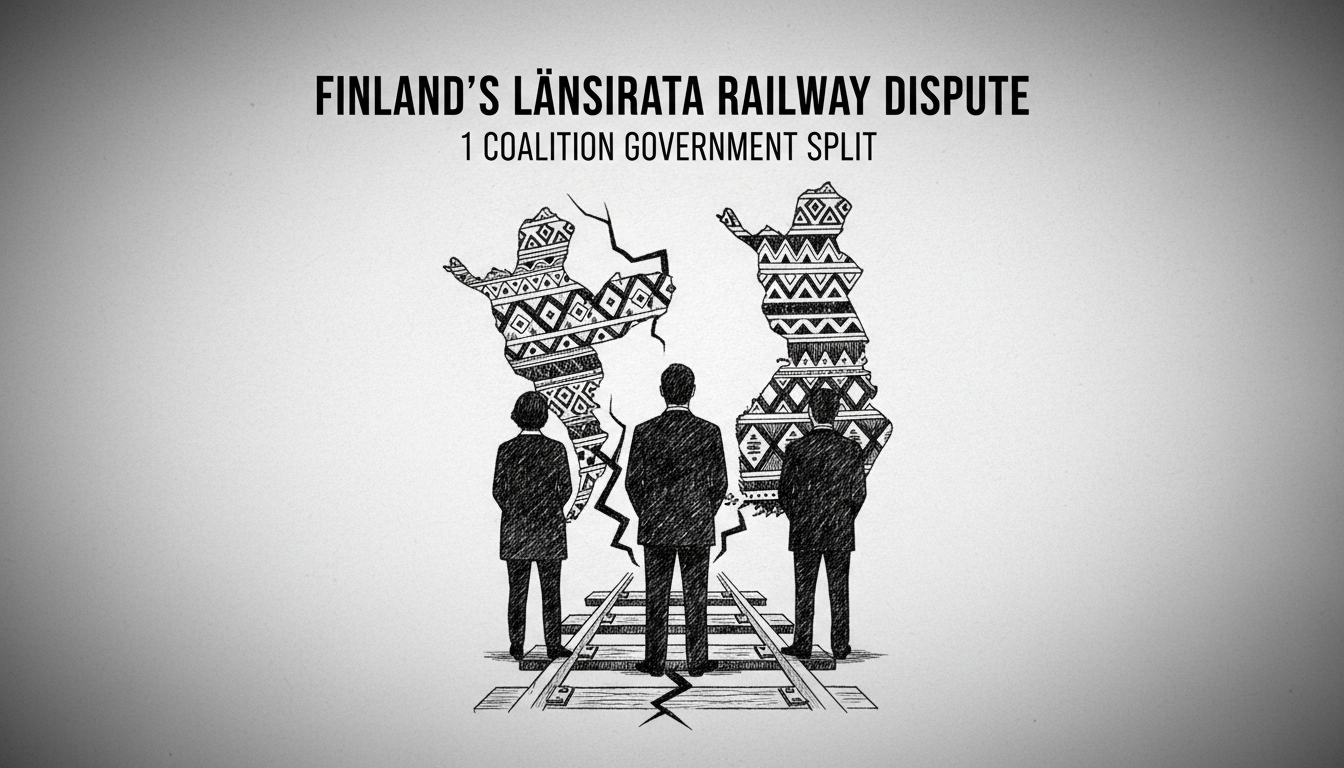
Finland's Länsirata railway project has triggered a public rift between two government ministers, exposing deep fault lines within Prime Minister Petteri Orpo's coalition. Transport Minister Lulu Ranne of the Finns Party declared the project's shareholder agreement invalid, only to be directly contradicted hours later by Social Security Minister Sanni Grahn-Laasonen of the National Coalition Party. This clash over a major infrastructure commitment reveals the fragile compromises underpinning Finland's four-party government.
A Minister's Declaration and an Immediate Rebuttal
The conflict erupted after the municipal council of Kirkkonummi, a key town on the planned route, rejected the Länsirata shareholder agreement by a decisive vote of 36 to 15. In response, Transport and Communications Minister Lulu Ranne stated to media that the agreement between the state and participating municipalities was no longer valid. "The ball is in the municipalities' court. They must agree on how the terms of the shareholder agreement can be met after Kirkkonummi's decision," Ranne said via text message. Her statement framed the project's future as uncertain and placed responsibility for reviving it squarely on local governments.
This interpretation was swiftly rejected by the National Coalition Party, the senior partner in the governing coalition. Social Security Minister Sanni Grahn-Laasonen, who oversees monitoring of the transport ministry for her party, publicly rebuked her cabinet colleague. "The claim that the agreement between the state and municipalities is not valid is not the government's position," Grahn-Laasonen wrote on social media platform X. She emphasized that Ranne had commented without internal government discussion and pointedly noted the project's inclusion in the official government program. The Prime Minister's Office confirmed that the cabinet had not yet formally assessed the impact of Kirkkonummi's vote.
The Stakes of the Länsirata Project
The Länsirata, or West Rail, is a long-planned railway line designed to improve connections between Helsinki and the growing western Uusimaa region. It represents a significant infrastructure investment aimed at alleviating congestion, supporting regional development, and enhancing public transport capacity. For the government, it is a flagship project symbolizing a commitment to growth and connectivity. Its potential derailment threatens not just transportation plans but also political capital and inter-party trust.
Minister Ranne's comments suggest a strict, contractual view of the project's prerequisites. From this perspective, the rejection by one key municipality fundamentally undermines the legal and financial framework agreed upon by all parties. The Finns Party has historically voiced skepticism about certain large-scale infrastructure expenditures, and Ranne's stance may reflect this fiscal caution. In contrast, the National Coalition Party's reaction underscores its commitment to seeing the project through as a pro-growth policy, viewing the municipal vote as a hurdle to be overcome through negotiation rather than a terminal blow.
Coalition Governance Under Strain
This public disagreement highlights the inherent tensions of coalition politics in Finland's multi-party system. The Orpo government is composed of the National Coalition Party, the Finns Party, the Swedish People's Party, and the Christian Democrats. Managing divergent priorities and ideologies requires constant negotiation and a disciplined public front. The breach over Länsirata suggests that agreed-upon internal processes have broken down. According to sources familiar with government operations, ministers had previously agreed to discuss the railway's status in the Economic Policy Committee only after all municipal councils along the route had made their decisions. This was intended to give municipalities "working peace" to deliberate without federal pressure.
Ranne's unilateral declaration shattered this understanding. It raises questions about communication channels within the cabinet and the enforcement of collective responsibility—the principle that ministers must publicly support all government decisions once they are made. While common in parliamentary systems, this principle is tested when coalition partners hold fundamentally different views on a policy's viability. The incident shows how a minister from one party can attempt to steer policy through public statements, forcing their coalition partners into a reactive position.
Expert Analysis: A Test for Project and Government
Political analysts observing the situation note that this dispute is about more than just a railway. "This is a classic stress test for a coalition government," says Dr. Elina Kestilä, a professor of political science at Tampere University. "A major project faces a setback, and immediately the differing priorities and risk appetites of the coalition partners come to the surface. The National Coalition Party sees it as an essential investment that must be saved. The Finns Party may see a chance to renegotiate terms or even redirect funds, all while appearing to respect local democracy."
Dr. Kestilä points out that the public contradiction damages the government's image of unity and competence. "It creates an impression of disorder and internal conflict, which can erode public confidence. The Prime Minister now must reassert control, clarify the official position, and mediate between his ministers. How he handles this will set a precedent for future disputes." Infrastructure policy experts add that the uncertainty itself is damaging. Municipalities like Turku, Espoo, and Vihti, which have already approved the agreement, now face confusion over the legal and financial ground rules. Private sector partners and potential investors may also pause, awaiting clear signals from Helsinki.
The Road Ahead for Western Rail
The immediate future of Länsirata is now shrouded in political ambiguity. The government must convene to establish a unified position, a process that will involve difficult negotiations behind closed doors. Options include pressuring Kirkkonummi to reconsider, revising the financial or routing terms of the agreement to gain its approval, or exploring legal mechanisms to proceed without the municipality's full participation. Each path carries political costs and risks alienating one coalition partner or another.
The broader question is whether this incident represents a temporary clash or a symptom of deeper incompatibility within the government. Large infrastructure projects often become lightning rods for political conflict because of their high cost, long timelines, and significant local impacts. If the coalition cannot resolve this dispute smoothly, it may struggle with other complex reforms outlined in its program. The principle of collective responsibility is vital for stability; its erosion could lead to a pattern of public disagreements that weaken the government's effectiveness.
For residents and businesses in western Uusimaa, the political drama translates into continued uncertainty about a critical piece of transport infrastructure. The Länsirata project was promised as a solution to current and future congestion, a driver of economic development beyond Helsinki. Now, its fate hinges not on engineering challenges, but on the ability of rival politicians in the capital to find common ground. The coming weeks will show if Finland's coalition can bridge this divide or if the track to agreement has been fundamentally broken.